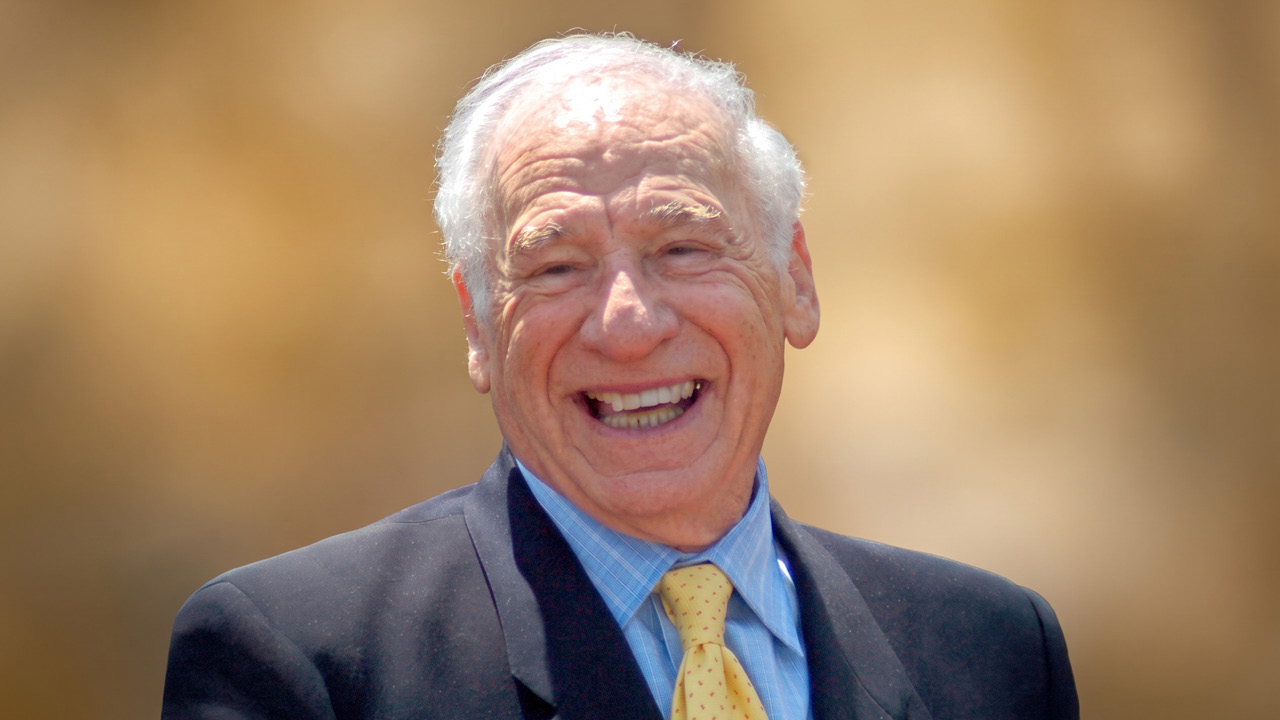
As Mel Brooks marks his 100th year, the legendary comic has a straightforward explanation for how he has stayed going so long.
“Making comedy is a great job. It keeps you sane and happy. It gives you a reason to be alive,” the actor, director and producer told People magazine in January.
There may be more truth in that than it first seems.
Brooks was born Melvin Kaminsky in Brooklyn, New York, on June 28, 1926. After coming back from World War II, he began building his comic career in the “Borscht Belt,” the upstate New York hotels and resorts that drew Jewish holidaymakers.
From there, he went on to create a run of classic screen comedies including Get Smart, The Producers, Blazing Saddles, Young Frankenstein, Silent Movie and High Anxiety.
He is still working too, with a starring role in Spaceballs: The New One, the sequel to 1988’s Spaceballs, due for release early next year.
For Brooks’ centennial, the American Film Institute has declared 1974’s Blazing Saddles the funniest film ever made. The movie had previously been placed sixth on its list of the 100 greatest films. It now takes the top position from Some Like It Hot, a film Brooks had long insisted was not as funny as his own work.
“He’s right!,” said Bob Gazzale, AFI president and chief executive.
Brooks told The Associated Press in 2021 that his bond with comedy started in his Williamsburg, Brooklyn childhood.
“I wanted to keep the party going. I wanted to keep the happiness and joy and explosions of laughter going into a dour part of our lives, not our childhood anymore,” Brooks recalled.
He also remembered being asked in an interview about the happiest period of his life.
“I was once interviewed and the guy said, ‘What was the happiest part of your life? Was it winning the Academy Award? Was it marrying Anne Bancroft?’ I said no, not at all. It was my childhood. From about four or five to nine, it was the most exciting, happiest, joyous life that anyone could experience.
“The guy said, ‘What happened at nine?’. I said, ‘Homework’.”
Earlier this year, Judd Apatow used that spirit for the title of his retrospective documentary, Mel Brooks: The 99 Year Old Man!
In the film, Brooks says: “I was born to make people laugh.”
“So, I do that.”
The idea that laughter may be tied to a longer life has also been backed by research.
A 2016 Norwegian study published in Psychosomatic Medicine found that women who scored highly on the cognitive component of sense of humour, meaning the ability to detect humour, had a 48 per cent lower risk of death from all causes. The study also found that deaths from cardiovascular disease were “significantly lower” in women with high scores on that cognitive component.
Another study from the United States in 2023 found that spontaneous laughter was linked to a greater reduction in cortisol levels and could be a useful supplementary medical therapy to improve wellbeing.
In 2024, Mayo Clinic oncologist and expert Edward T Creagan said laughter helped mental wellbeing.
“If a patient can have a moment of levity in the face of crisis, I think it helps them better cope and better deal with the uncertainties of their problems,”Creagan said.
Brooks, for his part, has said he no longer dwells on age or how much time remains.
“I gave up after 60 thinking about it because if I did, I’d be thinking about it all the time, he told the Associated Press in 2021.”
“When and if it happens it’s going to be a sad day — for everybody but me,” he joked.
“I enjoy living. I’d like to do it as long as I can.”
He has even turned mortality itself into material. In a sketch from the 1980s, Brooks invented a coin-operated gravestone for himself that played a recorded message beginning: “I was Mel Brooks, one of the funniest little Jews to walk the Earth.”