Sarbi, the Australian special forces dog who survived alone in Afghanistan for more than a year after going missing during a Taliban ambush, is set to be honoured as part of a major new exhibition at the Australian War Memorial.
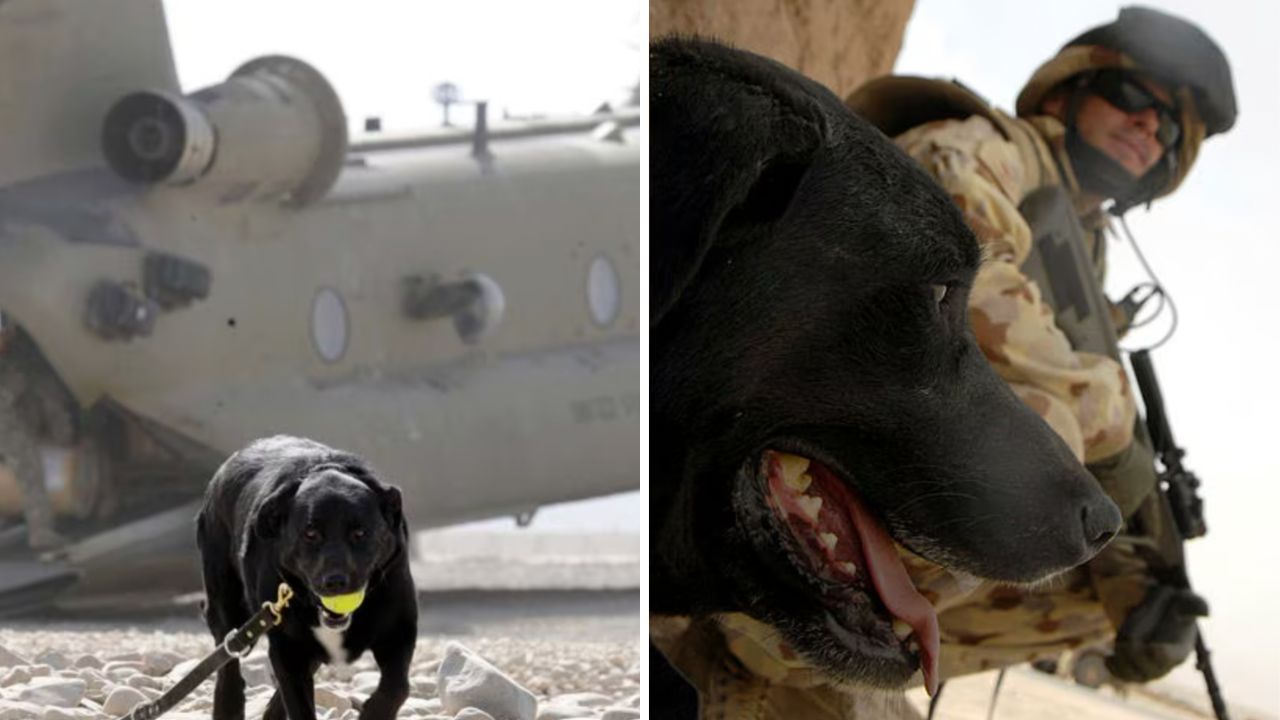
Sarbi, an explosive detection dog, became one of the most recognisable figures of Australia’s involvement in Afghanistan after she disappeared in Uruzgan province in 2008.
Separated from her handler, Corporal David Simpson, during an ambush, the labrador-newfoundland cross survived for 13 months around military bases before being found by a US soldier and reunited with Australian troops.
Following her death in 2015, Sarbi was taxidermied and will now feature as the centrepiece of the Australian War Memorial’s new Afghanistan gallery, located within the redeveloped Anzac Hall, which opens on Thursday.
Australian War Memorial director Matt Anderson, who served as Australia’s ambassador to Afghanistan in 2015 and 2016, said the exhibition would honour the 40,000 Australian personnel who served in the conflict between 2001 and 2021.
“This is the most comprehensive exhibition ever created on Australia’s involvement in Afghanistan – Australia’s longest war,” he said.
“It tells our uniting story of service and sacrifice through the experiences and the voices of the men and women who put themselves in harm’s way in our uniform and in our name.”
Anderson said he hoped Sarbi’s story would resonate with younger visitors and encourage conversations about the realities of war.
“I would imagine once Sarbi’s harness was taken off at the end of a patrol, it would have been a remarkably normal and affectionate moment for the men and women at the operating base just to engage with a dog and throw a tennis ball around,” he said.
“For our veterans, that must have given them an enormous sense of relief, a chance for that affection and that connection away from fighting in the midst of a war.
“To have (Sarbi) now on display in the galleries also draws children in to ask questions of the nature of that conflict and the nature of war.”
The new gallery also features preserved fighter aircraft, long-range patrol vehicles, photographs and artworks from the conflict, as well as material from the Brereton Report into alleged war crimes committed in Afghanistan between 2005 and 2016.
Australian War Memorial collection logistics manager Kassandra Hobbs said relocating more than 3,700 objects during the gallery’s redevelopment had been a significant undertaking, but she was particularly proud of Sarbi’s place in the exhibition.
“It’s fitting that a dog who never gave up would be among the last (items to be installed),” she said.
“You really have to be mindful of how you move (objects), how it fits in the space and always be thinking 10 steps ahead.”
“Every single one of those (objects) has a story and has been carefully preserved … there were curators involved, exhibition designers, construction workers. It really is a whole team effort, which I’m really proud of.”
Anderson said the gallery would help visitors better understand Australia’s involvement in Afghanistan and recognise the service of those who served.
“Those veterans have waited long enough, and frankly they are owed nothing less than having their stories told at the Australian War Memorial so the nation can be proud of what they did in our name.”
Image: Department of Defence