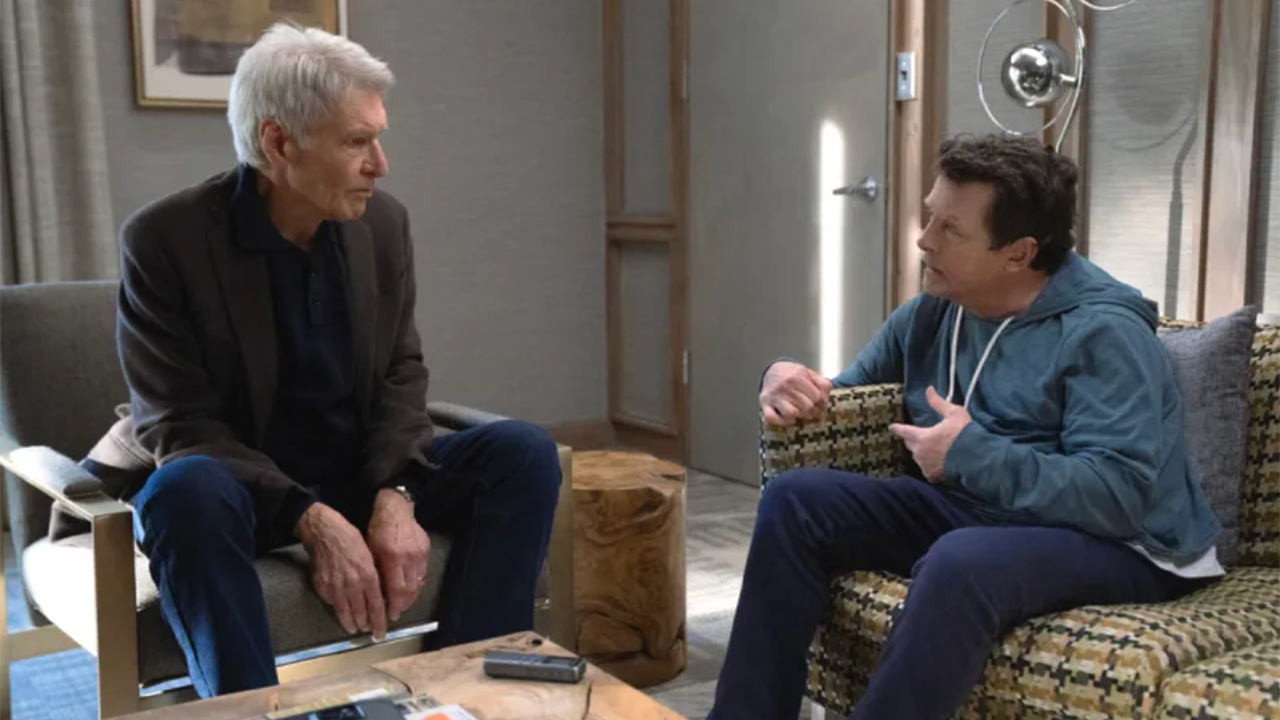
Hollywood legend Harrison Ford has paid an emotional tribute to his Shrinking co-star Michael J. Fox, describing the beloved actor as “the most stubborn optimist I know” during a heartfelt awards presentation celebrating Fox’s decades-long fight against Parkinson’s disease.
Ford presented Fox, 65, and Deborah W. Brooks, co-founder of The Michael J. Fox Foundation, with an award at The Hollywood Reporter‘s annual Social Impact Summit, praising the Back to the Future star for turning a devastating diagnosis into a mission that has transformed Parkinson’s research.
“Thirty-five years ago, Michael J. Fox got some very bad news. Most people handed something like that endure it; Michael went right to work,” Ford told the audience.
“Playing Paul Rhoades on Shrinking gave me some understanding of what it means to live with Parkinson’s and it also gave me Michael, as an actor, as a friend and the most stubborn optimist I know. Through him, I’ve seen what his foundation does.”
Fox was diagnosed with young-onset Parkinson’s disease in 1991 at just 29 years old, shortly after filming Back to the Future Part III. Since then, he has become one of the world’s most recognisable advocates for Parkinson’s awareness and research.
His foundation, established in 2000, has now funded more than $US3 billion in Parkinson’s research, helping drive major advances in the search for better treatments and, ultimately, a cure.
The two actors recently shared the screen in the third season of Apple TV+’s Shrinking, where Fox played Gerry, a man living with Parkinson’s who befriends Ford’s character, therapist Dr Paul Rhoades, who is also navigating the disease.
Speaking at the event, Fox reflected on his return to acting after stepping away from the profession in 2020, revealing the comeback has given him a renewed sense of purpose.
“It’s really prolonged my life and made my life interesting in a way that I didn’t think it would be to this point,” he said.
“I’m not retired from acting, but if I didn’t act again, it would be for a very good reason. I let Parkinson’s make decisions for me.”
Fox also recalled the moment he decided to publicly reveal his diagnosis in 1998, admitting he initially struggled with the reaction from other Parkinson’s patients.
He said many people living with the condition celebrated his openness because, until then, they had felt invisible.
“It was considered an old person’s disease,” Fox said.
He realised he needed to overcome his own “vanity” and help “normalise” the illness by speaking openly about his experiences.
Shrinking creator Bill Lawrence, whose father and grandfather both had Parkinson’s disease, also praised Fox for refusing to let the diagnosis define him.
“I was struck by how quickly Mike made the transition from saying, ‘I’m retiring’ to suddenly working harder than anybody I’ve ever met in my life,” Lawrence said.
Image: Apple TV