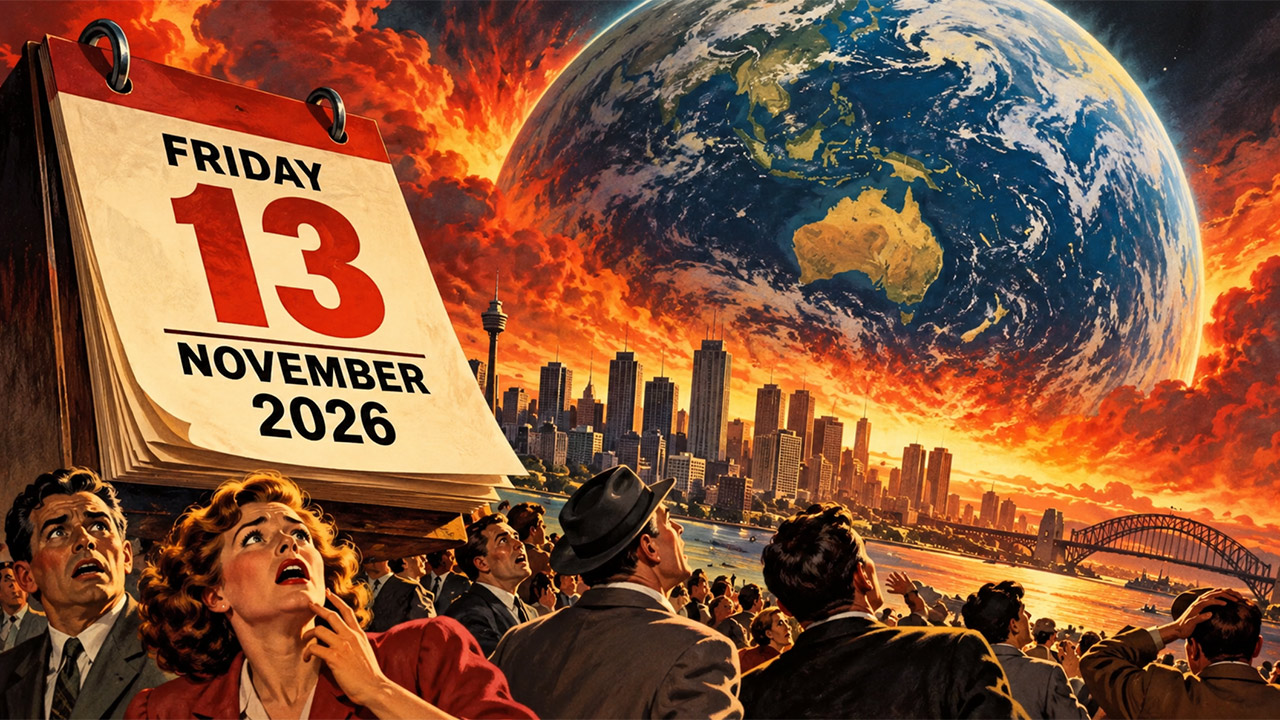
If you’ve been putting off cleaning out the garage, tackling the garden or finally sorting through those boxes in the spare room, we have some potentially excellent news: according to a scientific prediction made 66 years ago, the world is scheduled to end next month.
And not just any day, either. Apparently, humanity’s final curtain call is booked for Friday, November 13, 2026.
Because, naturally, if you’re going to schedule the apocalypse, Friday the 13th seems as good a choice as any.
The rather alarming prediction dates back to 1960, when Austrian-American physicist Heinz von Foerster and two researchers at the University of Illinois published a paper in the prestigious journal Science.
Its title was hardly subtle: Doomsday: Friday, 13 November, A.D. 2026.
But before you cancel Christmas, there’s a little more to the story.
Unlike the usual end-of-the-world predictions involving asteroids, nuclear war or mysterious celestial events, von Foerster’s theory suggested humanity would effectively destroy itself by doing something it had become exceptionally good at: making more humans.
The researchers examined historical population growth and noticed that the time it took for the world’s population to double had been getting progressively shorter for centuries.
Extrapolating that trend into the future, they calculated that humanity was heading towards a mathematical breaking point, with the population theoretically approaching infinity in November 2026.
Their conclusion was particularly cheerful.
“Our great-great-grandchildren will not starve. They will be squeezed to death.”
Not exactly the sort of thing you’d want printed inside a Christmas cracker.
The prediction attracted considerable attention at the time, with newspapers reporting that humanity might be approaching its final days.
There was, however, one rather significant flaw in the calculations: people didn’t keep reproducing at the predicted rate.
Population growth began slowing, particularly from the 1990s onwards, and the world’s population today stands at approximately 8.2 billion.
That’s certainly a lot of people, but it’s considerably fewer than the 25 billion the researchers’ model suggested we might have reached by 2020, and nowhere remotely close to infinity.
In fact, the United Nations now expects the global population to peak at around 10.3 billion in the mid-2080s before gradually declining.
So it appears we may have dodged the rather unpleasant prospect of being squeezed out of existence.
There’s another curious detail about the man behind the prediction.
Before becoming a respected physicist, von Foerster worked as a magician. And, in a coincidence almost too good to be true, November 13 was also his birthday.
Whether his choice of date was a little scientific showmanship remains a matter of debate.
Some modern researchers believe the dramatic prediction was never intended to be taken quite so literally.
Rockefeller University population biologist Joel Cohen recently suggested von Foerster was trying to draw attention to an important demographic trend rather than seriously forecasting humanity’s extinction.
“I don’t think [von Foerster] was seriously trying to predict the future,” Cohen told Science.
Nevertheless, while this particular apocalypse appears to have been cancelled, scientists haven’t exactly given humanity a clean bill of health.
Earlier this year, the Bulletin of the Atomic Scientists moved its famous Doomsday Clock to just 85 seconds before midnight, the closest it has ever been to its symbolic representation of global catastrophe.
The organisation cited growing threats from nuclear weapons, climate change and emerging technologies, including artificial intelligence.
Unlike von Foerster’s prediction, however, the Doomsday Clock isn’t an actual countdown to a specific date. It’s a warning about the dangers humanity faces and the decisions that could make things better or worse.
Meanwhile, a science conference in Vienna has been scheduled for November 13 to examine population trends and the rather appropriately titled subject of “the sense and nonsense of end-of-the-world predictions”.
Assuming everyone makes it there, of course.
For the rest of us, the good news is that there’s no credible scientific reason to believe the world will end next month.
So perhaps don’t cancel the Christmas shopping just yet.
And unfortunately, that garage still isn’t going to clean itself.