Ticketek, Ticketmaster, Virgin Australia and Sony are among the major brands named in Choice’s 2026 Shonky Awards.
The annual awards are run by consumer advocacy group Choice to hold businesses accountable for what it considers poor products, unfair practices and misleading claims.
“At a time when consumers are doing it really tough, you’d think that companies would give us a break – but that’s not the case,” said Choice CEO Monique Perry.
“This year we had so many contenders for our annual Shonky Awards.”
Ticketek and Ticketmaster were among the biggest names on this year’s list, with Choice accusing the ticketing agencies of using dynamic and in-demand pricing to charge more when demand is high.
One example was the John Farnham charity concert at Melbourne’s Rod Laver Arena in September, where tickets sold for up to $1650 through Ticketek, despite Farnham not performing at the event.
Fans waiting in virtual queues were warned that prices could rise or fall, prompting complaints on social media.
“Looks like dynamic pricing will be happening, which is awful considering it is a charity event,” one person wrote.
Perry also said NRL supporters had reported Ticketmaster charging $50 more for in-demand seats than regular seats just one row and one bay away.
Appliance manufacturer Hisense was also criticised over a washer-dryer promoted for its energy efficiency. Choice found its nominated eco drying cycle took 13.5 hours to dry clothes, while the washing cycle used for its energy rating took more than 12 hours.
“While technically the (Hisense) machine is energy-efficient when run on the Eco drying cycle, it goes without saying that over 13 hours to dry a load of clothes is an unrealistic wait time for most households,” Perry said.
“The Hisense machine also received its five-star energy rating for washing based on – you guessed it – a 728-minute-long program. Use both the energy-efficient cycles together, and you’ll be hitting over 25 hours of laundry.”
Choice said the issue highlights how energy ratings can be misleading, as manufacturers nominate the programs used to calculate their appliances’ efficiency.
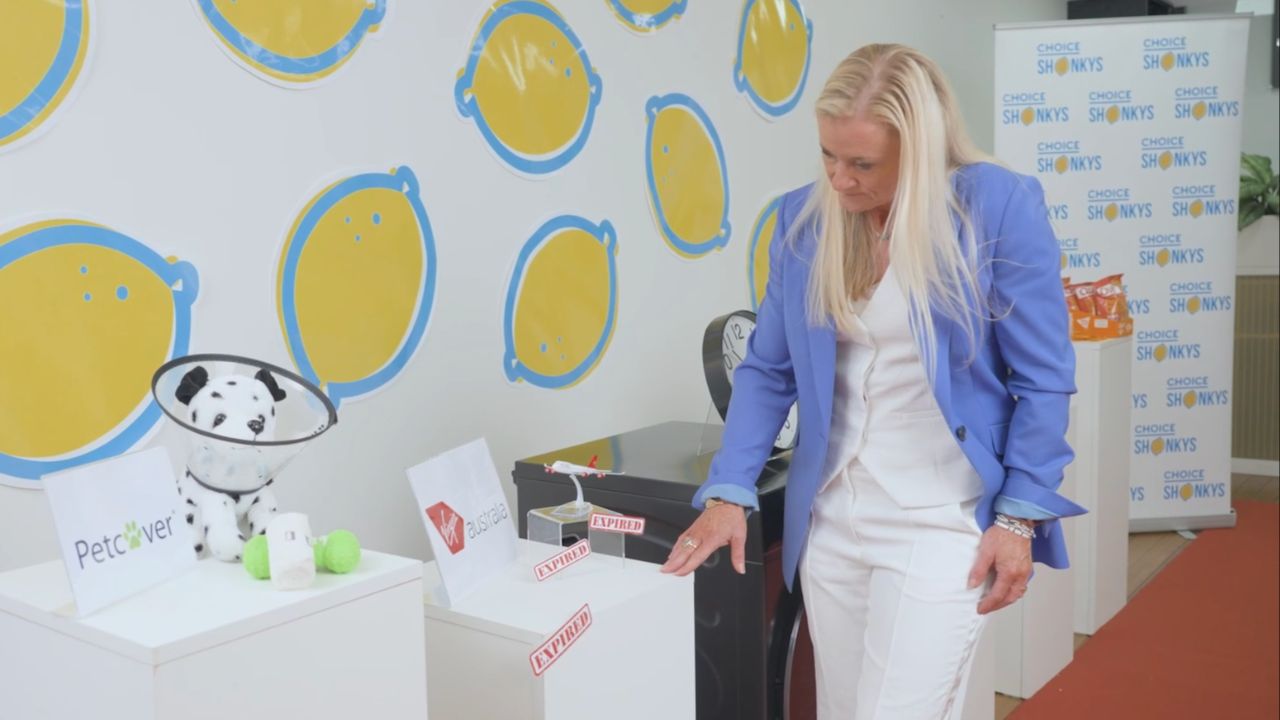
Pet insurer Petcover also received an award over its Economy policy, which Choice said requires customers to take out a new policy every 12 months. This can mean conditions a pet has previously experienced are classified as pre-existing and excluded from cover.
“Every 12 months, Petcover Economy customers are sold an entirely new policy, which classifies all conditions the pet has previously experienced as pre-existing, thus excluding them from cover,” Perry said.
“The policy’s definition of pre-existing conditions is also problematic, and one of the broadest we’ve seen… This is a policy that reduces cover every time you make a claim.”
Other recipients included Virgin Australia, which Choice criticised over deadlines requiring customers with flight credits from Covid-era cancellations to rebook by June 30, 2026, and use their flights by May 27, 2027.
“While some of these customers were able to redeem their flight credits, Virgin’s strict flight credit deadlines meant $75 million of these credits expired, going straight to Virgin’s revenue,” Perry said.
Snack brand Quest Protein Chips was criticised after Choice found its products were 886 per cent more expensive than comparable non-protein chips. A 32-gram bag cost $6.50 at one major supermarket, equivalent to more than $20 per 100 grams.
Sony Interactive Entertainment was also named over plans to sell all PlayStation video games exclusively as digital downloads from January 2028. Choice raised concerns that customers would only be buying a licence to access games, which could be revoked without a refund.
Choice has presented the Shonky Awards for 20 years, with previous recipients listed in its online “Hall of Shame”. Last year’s winners included Temu, health insurer HCF and a plug-in heater that Choice said “doesn’t plug in, or heat”.
The Commonwealth Bank has also received four Shonky Awards, including one after the corporate regulator found about 2.2 million low-income customers had collectively been charged $270 million in excessive fees.
Image: Choice