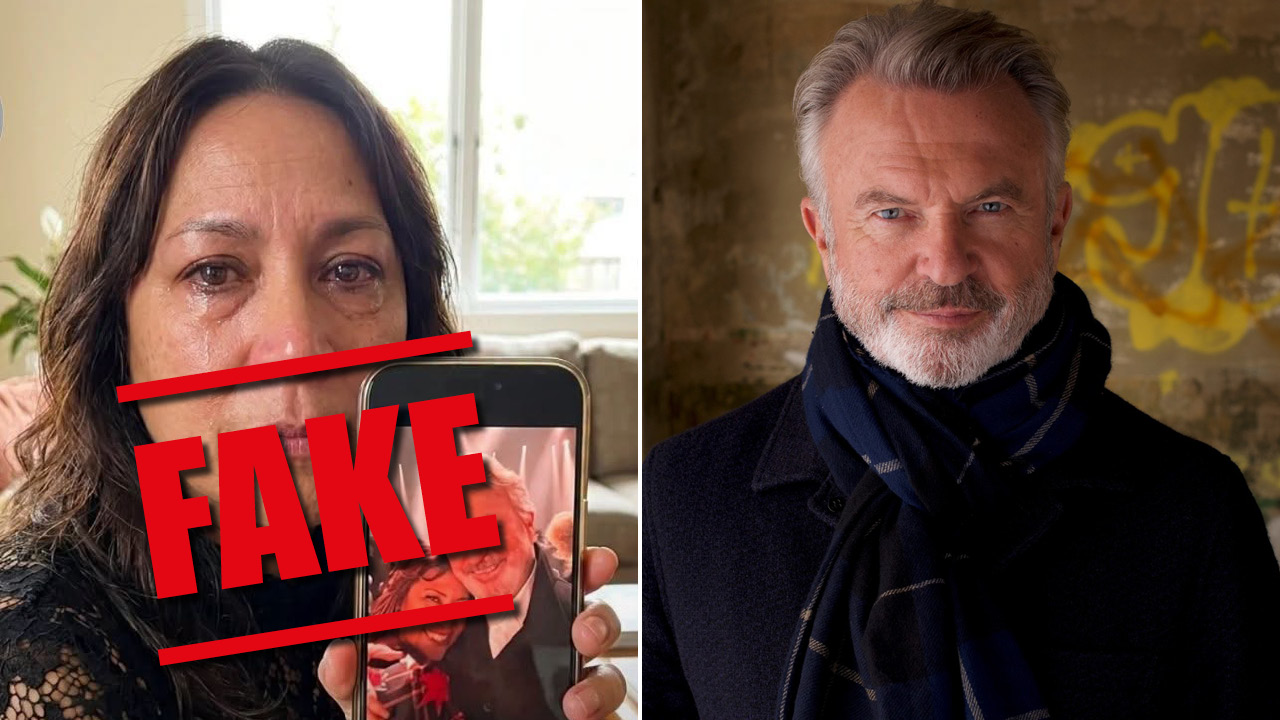
Kate Ceberano, an inductee into the ARIA Hall of Fame, was so shaken by a deepfake post falsely portraying her in mourning over the late actor Sam Neill that she said she “nearly threw up”.
The piece of artificial intelligence content showed a weeping Ceberano clutching a phone that displayed an image of her hugging the Jurassic Park star. Beneath it ran the caption: “Kate Ceberano mourned her dear friend Sam Neill by sharing their final photo together from his last public appearance”.
The Australian singer was incensed that her image had been co-opted this way, and did not hold back her reaction. “What the actual…!!!” she wrote across Facebook, Instagram and X. “My first interaction with an AI version of myself. I nearly threw up.”
She also felt for the many followers who had responded sincerely to the fake, believing it to be genuine. “I feel sorry to the good people who wrote meaningful comments to this specious post,” she said. “You were tricked and I kinda think this is just the beginning. I’m speechless!”
Her posts drew hundreds of replies, with plenty of people rallying behind her and others pointing to the disturbing implications of what one called a “grim new reality upon us”. As one commenter put it, “People need to question everything because reality as we know it is being manipulated big time.” Another wrote: “Sorry you were targeted Kate. I’m sure it feels quite violating and humiliating to experience.”
The fabricated image of Ceberano originated from Golden Era Hollywood, a Facebook page with roughly 330,000 followers that has churned out numerous other posts featuring celebrities. In the upload about the Australian singer, the page wrote: “Kate Ceberano’s final photograph with Sam Neill has become a deeply emotional memory. The two looked happy as they enjoyed the evening together, never knowing it would be their last public moment. After his passing, she remembered the laughter and warmth they shared, honouring not only the celebrated actor the world admired, but the kind and genuine friend she was fortunate to know.”
The convincing nature of the post was evident in the reactions it attracted. Among the hundreds who responded, one person wrote: “I’m so sorry for the loss of your dear friend, I think we’re all grieving.” The people behind the Facebook page were approached for comment but had not responded.
The underlying friendship between the pair was real. Neill and Ceberano were friends and appeared together at the ARIA Hall of Fame Awards in June, an occasion that turned out to be one of Neill’s last public outings. Reflecting on the evening, Neill wrote on Instagram: “Great night in Sydney. Four women I have idolised for decades were honoured. Jenny Morris, Kate Ceberano, and Vika and Linda Bull. Jenny was inducted into the Hall by no less than our former NZ PM, Jacinda Ardern. Another hero.”
Following Neill’s death, Ceberano paid tribute with a tender photograph of the two of them taken that same night, which was the very image later repurposed for the AI post. “I sang with you in Molokai whilst you played your ukulele. Your gentle heart and radiant smile made me feel seen and loved,” she wrote. “You will always be one of the special souls it has been such a pleasure to know you. Aloha ‘Oe til we meet again dear Sam.”
Her ordeal follows research led by an Australian team that showed people can be taught to spot AI generated faces. Rapid progress in artificial intelligence has fuelled hyper-realistic deepfake imagery, footage and audio, blurring the line between genuine and synthetic content and creating serious risks. “Deepfake fraud is a real and growing problem,” Dr James Dunn, director of the UNSW Sydney IDeA Lab, said. “AI-generated faces can make fake profiles, romance scams and misinformation campaigns appear more credible, and Interpol reports that synthetic images are already being used in social-engineering schemes worldwide.”
The scale of the threat is significant, with a Commonwealth Bank study finding that about one in four Australians report having encountered a deepfake scam in recent years.