Well, this is awkward.
After 12 months of technological breakthroughs, artificial intelligence, political upheaval and the occasional moment of collective madness, Australia’s leading dictionary has chosen the expression that best sums up 2026.
And the winner is…
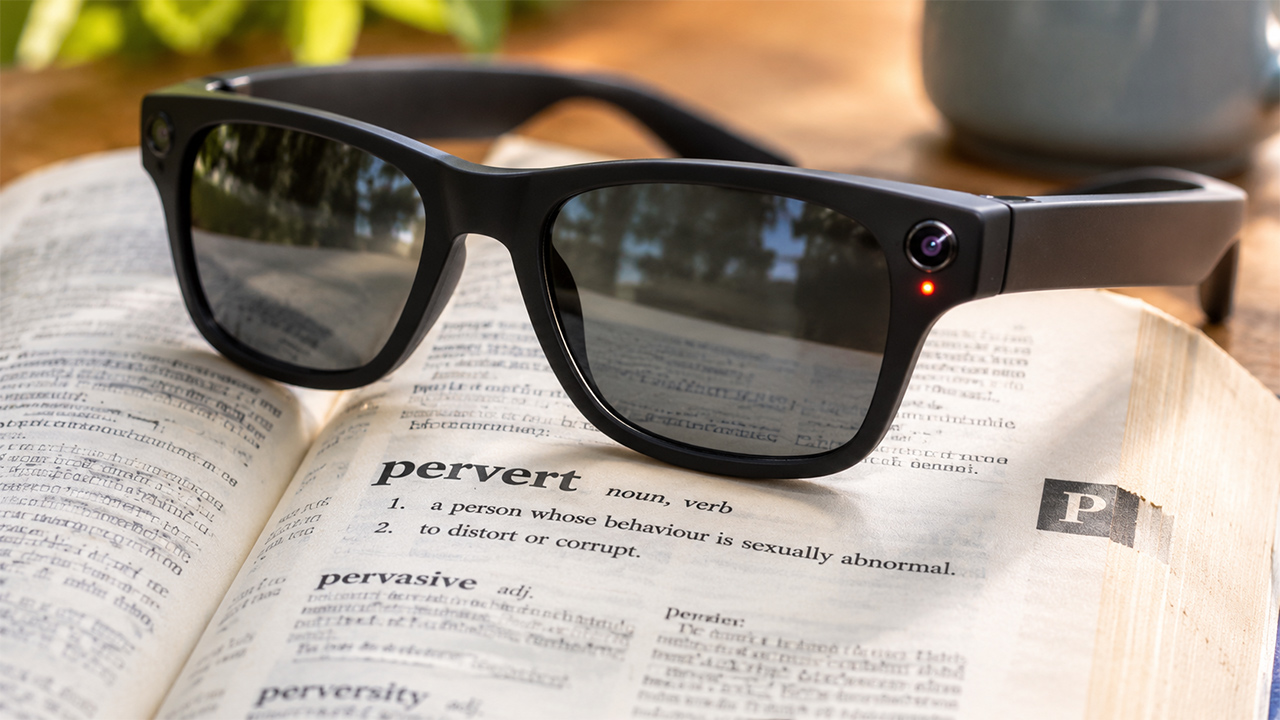
Pervert glasses.
Yes, really.
The good people at Macquarie Dictionary, who spend their working lives carefully documenting the evolution of the English language, have decided that those two rather unfortunate words perfectly capture the spirit of the past year.
And frankly, it’s hard to argue with them.
The expression refers to smart glasses equipped with built-in cameras, particularly those that allow wearers to discreetly photograph or film people without their knowledge.
You know the ones. They look like ordinary sunglasses, except they’re capable of recording video, taking photographs and accessing artificial intelligence.
Which sounds terribly clever until you realise the person sitting opposite you at the café might be filming you with their spectacles.
Suddenly, the good old days of losing your reading glasses don’t seem so bad.
The dictionary’s expert committee said the phrase captured the public’s growing unease about technology, surveillance and artificial intelligence.
“The name represents the year we’ve all endured, with AI, the manosphere, increasing surveillance in supermarkets, and more,” the committee explained.
And while manufacturers might prefer sophisticated descriptions such as “smart glasses” or “camera glasses”, the dictionary’s experts clearly felt the public had come up with something rather more memorable.
But here’s the really interesting part.
It wasn’t just the experts who chose it.
For the third consecutive year, the Australian public agreed with the dictionary’s committee, selecting the same expression as its People’s Choice Word of the Year.
So there you have it. A rare moment of national unity.
Australia has spoken, and apparently we’re all a little suspicious of people wearing fancy sunglasses.
The decision follows growing concerns about the privacy implications of wearable cameras, with some Australian swimming pools and playgrounds restricting the use of smart glasses over fears that people could be filmed without their consent.
Of course, the technology itself has plenty of legitimate uses, from hands-free photography to accessibility assistance.
But as the winning expression suggests, not everyone is entirely comfortable with the idea of cameras becoming quite so inconspicuous.
And the other contenders were almost as entertaining.
Among the committee’s honourable mentions was “Marrickville pause”, a wonderfully Australian expression describing the moment a conversation comes to a complete halt while a low-flying aircraft roars overhead.
Anyone who has spent time beneath Sydney Airport’s flight path will understand this one immediately.
“So anyway, I was telling Margaret about the…”
ROOOOOAAAAARRRR.
“…and that’s when she discovered he’d been married three times!”
Another contender was “agentic”, describing artificial intelligence capable of making decisions and taking actions independently.
Which sounds impressive, although some of us would settle for a printer that could independently decide to work.
The committee also recognised PMOS, a new name for the condition previously known as polycystic ovarian syndrome, reflecting efforts to improve medical terminology and understanding.
Meanwhile, the public gave an honourable mention to “digital dementia”, a phrase describing concerns that our increasing dependence on technology might be affecting our memory, attention and decision-making.
It’s important to note that digital dementia isn’t a recognised medical diagnosis.
But the expression has clearly struck a chord with Australians who increasingly rely on their phones to remember appointments, navigate unfamiliar streets and recall information they once kept in their heads.
Remember when we knew everyone’s telephone number by heart?
These days, some of us struggle to remember our own.
Another People’s Choice honourable mention was “AI;DR”, a clever twist on the familiar internet abbreviation TL;DR, meaning “too long; didn’t read”.
AI;DR essentially means “AI, didn’t read”, a rather dismissive way of announcing that something appears to have been generated by artificial intelligence and isn’t worth your time.
Ouch.
It’s a particularly fitting addition after last year’s winning expression, “AI slop”, which described the flood of low-quality, often nonsensical content generated by artificial intelligence.
And the year before that?
“Enshittification”, a term describing the gradual deterioration of online platforms and services.
Clearly, Australia’s relationship with technology is going swimmingly.
But beyond the laughs, Macquarie Dictionary’s annual announcement offers a fascinating glimpse into how our language continues to evolve.
Words and expressions that might once have seemed ridiculous can quickly become part of everyday conversation, reflecting the things that amuse, frustrate or worry us.
And while some of this year’s contenders might leave older Australians scratching their heads, there’s something reassuring about the fact that we’re still finding inventive new ways to describe the world around us.
After all, Australians have always had a particular talent for cutting through pretension with a well-placed nickname.
We gave the world the esky, the mozzie, the servo and the humble budgie smuggler.
Now we’ve added pervert glasses to the national vocabulary.
Somewhere, a dictionary editor is probably polishing their spectacles with considerable satisfaction.
Just make sure they’re not recording anything.