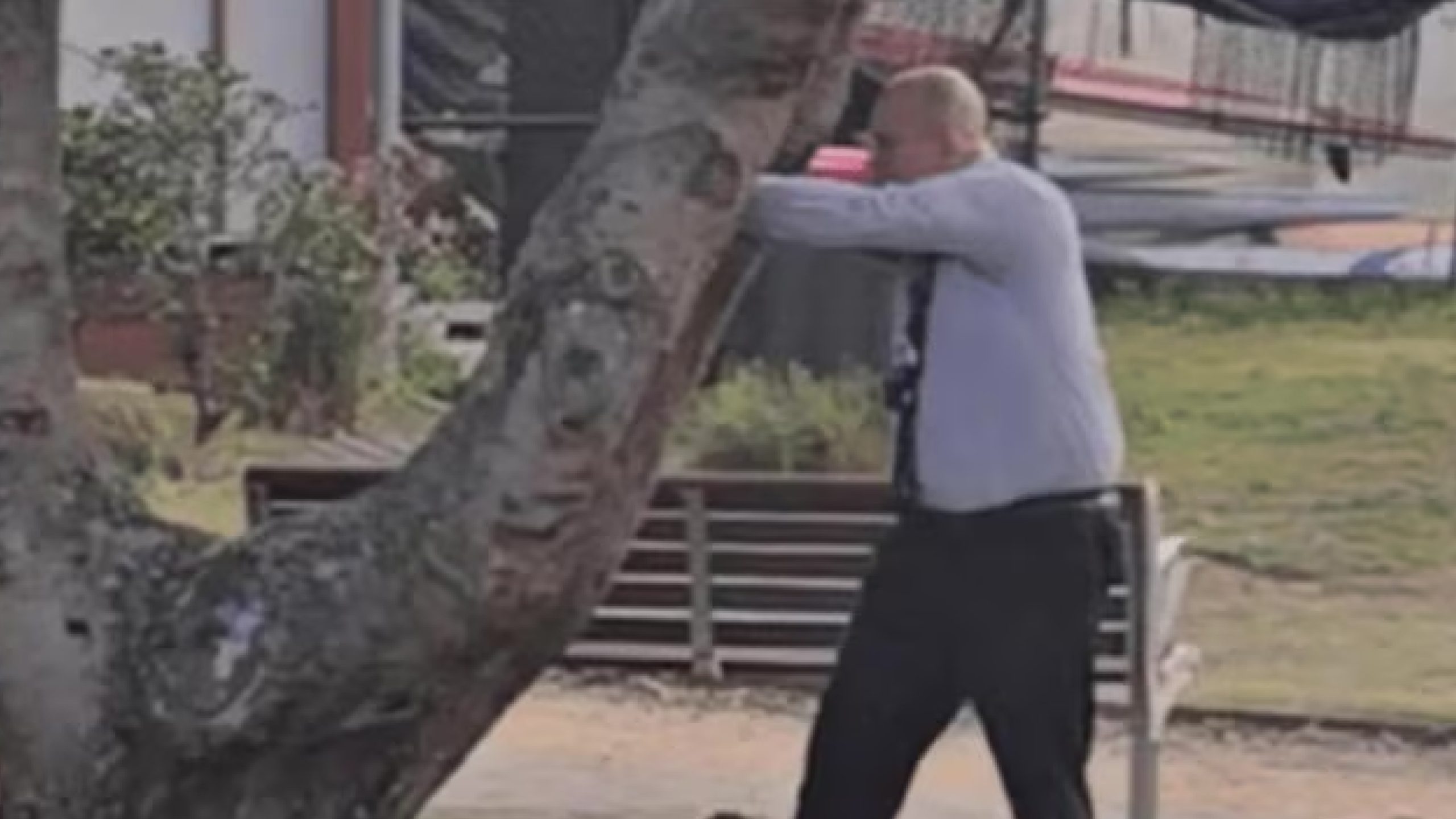
Detective Senior Constable Cesar Barraza had just three bullets remaining when the Bondi firefight was over after he rushed toward the attack without a bulletproof vest, body camera or even his mobile phone.
The account is told in the new book “Bondi Terror”, which recounts how the 16-year police veteran was at Bondi police station eating dinner on December 14 during his final shift before annual leave when a message came over the police radio: ‘Possible armed offenders. Shots fired.’
Barraza paused for confirmation. Then he heard Constable Scott Dyson say, “I think I’ve been shot.”
He immediately moved. He did not collect his body-worn video camera, his phone or his vest. He took no spare pistol magazines. Without telling anyone what he was doing, he ran out the back door of the station.
At that point, he did not know where the shooting was happening or that it was at a Chanukah festival. He followed the sound of gunfire and ran toward the area people were fleeing.
Police had earlier been briefed about several Chanukah events taking place across Sydney’s eastern suburbs that day, including at Coogee, Dover Heights and Bondi, but there had been no expectation of violence. Officers were patrolling between those events rather than being stationed at them full-time.
Only six weeks before the attack, Barraza had been transferred to Bondi. Before that posting, he had been working in cybercrime and had applied for promotion at three different commands: Cumberland, Campbelltown and Bondi.
A Seventh-day Adventist Christian, Barraza had prayed that he would be sent to the station where he was most needed. He also asked his parish priest to pray for the same outcome.
He was posted to Bondi on October 30. The shooting came just six weeks later, and his annual leave was due to begin the next day.
Within a couple of minutes of leaving the station, Barraza reached the area near the Bondi Pavilion. There he saw two men with long-arm weapons firing at police, including his colleagues. He did not know and could not see whether civilians had been shot, but he knew Dyson had been hit.
Barraza took cover behind a tree near the bridge. He would have preferred to be closer, but it was the most substantial cover available. “It’s a big enough tree,” he thought.
When he returned to the site three days later, he saw the tree was nowhere near big enough. Its trunk was marked by large bullet holes, underscoring how easily events could have turned out differently.
At first, the gunmen were facing away from him and had no idea he was there. Barraza took aim and fired once. His first shot killed Sajid Akram, who went down immediately.
That shot alerted the attackers to Barraza’s position behind them, and he then became a target.
Footage obtained during the investigation for the book “Bondi Terror” shows Barraza first standing behind the tree. It then shows him, dressed in ordinary clothes, crouching and kneeling there as he exchanged fire with Sajid’s son, Naveed Akram.
For more than a minute, Barraza remained in a prolonged gun battle with Naveed while other police officers fired from the opposite side of the bridge.
Later, Barraza told friends he felt no fear during the exchange and believed his training had taken over. According to the book, he said he felt no nerves, was not shaking and did not feel fear or exhaustion. He had trained for this moment and was on autopilot. Missing never entered his mind. He believed he would make the shot, and he did.
Naveed had been ducking and moving, but for a split second he exposed himself through a small gap between the stairs and the bridge. Barraza saw the opening and fired.
Both attackers were down seven minutes and 40 seconds after the first shot.
Barraza entered the gun battle with one magazine holding 18 rounds and no spare ammunition. He fired 15 shots. When the shooting ended, three bullets remained.
The timing carried another significance. Barraza had recently been issued a Glock 17, a larger handgun that offers greater ammunition capacity and accuracy than the sidearm commonly carried by many officers.
His firearms training is also above that of the average officer. He shoots once a month at the police pistol club, performs strongly at the NSW Police annual live-fire training and previously won a medal in his category at the NSW Police games.
After about an hour spent helping secure the scene and identify victims, Barraza was taken away from the immediate crime scene because, having shot the attackers, he would go through the standard critical incident process.
He went back to Bondi police station, where the cold nachos he had left behind were still there. He ate about half.