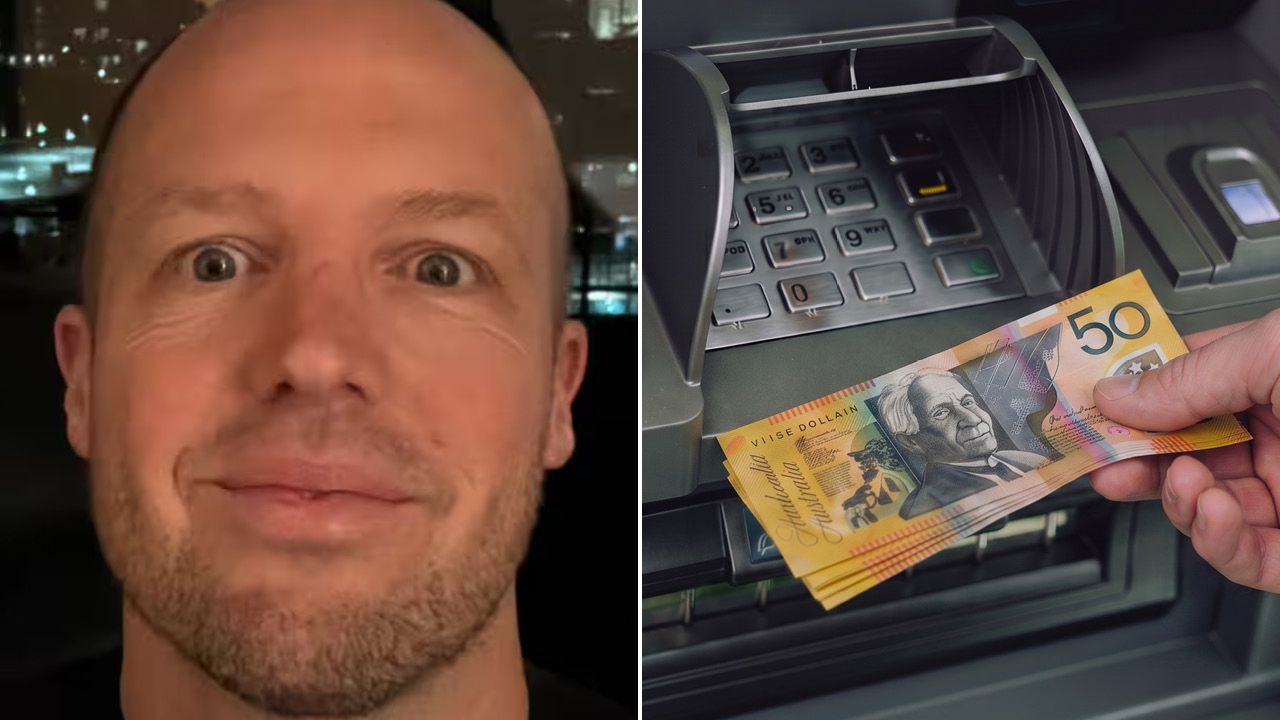
Dan Saunders says his life changed in 2011 after a trip to an ATM late one night following a shift at a pub in Wangaratta in northeast Victoria, a story now featured in an episode of Coming Into Money on SBS On Demand.
Saunders was 29 at the time and earning $700 a week pouring beers at the same pub. He says he often had just three dollars to his name and a gambling habit he had told himself was “just a bit of fun”.
After finishing work and going out with friends, he ran out of money for the next round and walked around the corner to an ATM. He tried to transfer $200 from his credit card into his savings account, but the machine displayed, “transaction cancelled”, and returned his card. When he checked his balance, the money had appeared anyway, so he withdrew the $200 and went back to the bar.

On his way out, he passed the same ATM again and stopped. He inserted his card and tried transferring $500, then $600. Each time, the transaction was cancelled, but the money still showed up.
By the end of the night, Saunders had maxed out both of his cards and gone home believing he might have imagined it.
He had not.
Over the next four and a half months, he withdrew $1.6 million.
Saunders says it did not immediately feel like a windfall. Instead, he says it felt unreal. “It was exhilarating. The power I felt during that time was unlike anything I’d experienced in my entire life.”
He says there was something intoxicating about being a barman from a small regional city who had managed to exploit a flaw at one of the country’s biggest banks. “This is one of the biggest banks in the country, and I was a barman from a small regional city who had found a crack in the wall,” he said. “Something was intoxicating about that – I felt it was the little guy getting one over on a system that never seems to work in your favour.”
He says he justified what he was doing by telling himself banks profit from ordinary people in many ways. “To any shareholders still upset about it, genuinely, I’m sorry, but I feel you do profit off other people.”
His gambling escalated quickly. Saunders says he began betting regularly behind the bar at work and placing much bigger bets, and he lost his job when management discovered it. His relationship also broke down, and he says the “limitless” bank card felt like the only good thing left in his life.
He spent heavily. He flew on private jets, took friends to a remote island in Asia for a weekend at a cost of $90,000 for the flight alone, ate at restaurants where the bill was more than many people earn in a month, checked a homeless man into the Hilton on impulse, and paid friends’ university fees, rent and car costs.
“I shook money from a tree I had no right to be near every single day, and part of me loved every second of it,” Saunders said.
But he says he knew throughout that what he was doing was wrong. “The excitement made it bearable. The justifications kept me going. But underneath all of it was a low, constant hum that never went away.”
The bank called to verify that he was using the accounts, and Saunders says he would confirm it was him before staff apologised for bothering him. Still, he says the anxiety never lifted. He had a panic attack in the foyer of a Sydney hotel so severe that a doctor passing by stopped to examine him. He says he took Valium to get through the days and had nightmares about a SWAT team storming whatever hotel room he was staying in.
He says every day felt like it could be the last. When no one came, and days turned into weeks and then months, that only made things worse.
In the end, Saunders says he stopped the transfers himself. He says he kept returning to a basic question: whether he would take the money overseas, become someone else and disappear. The answer, he says, was no. He could not leave his mother, his family or his friends, and he could not become that person.
So he stopped and contacted the bank. From what he remembers, little happened for three years beyond being told legal action would begin. He says he then went to the media because he did not want the story told without him in it. “If it was coming clean, I wanted to be honest about it on my own terms.”
The law eventually caught up with him. Saunders was charged with obtaining money by deception and, in 2015, was sentenced to a year in jail.
He says prison gave him long days and even longer nights to sit with what he had done. It was hard, he says, but also clarifying. He says he left jail quieter, surer of who he was and with a different understanding of life.
When asked about regret, Saunders says one thing stands above the rest. “People ask if I have regrets. My only real regret is my mother having to visit me in jail; that’s the part that stays with me.”
He says the reputational damage and the difficulty of finding work are consequences he accepts. Since then, he has spoken openly about gambling, not through scare campaigns but through honest conversations about where the line is. He says much of the public message is either “gambling is fine” or “gambling will destroy you”, and he wants to help people identify a problem before it becomes severe.
Looking back, Saunders says he had become addicted to the process more than the money itself. “Looking back, I was addicted to the process itself; the feeling of the glitch far outweighed any other high. The money was almost beside the point. Almost.”
A book and a film based on his experience are in development. But Saunders says that is not what he is proudest of. He says what matters most is that he told the truth. “But I came forward. I did what I felt was right. It cost me in certain ways – and I’d be naive to pretend otherwise.”
“But I’m in the position I’m in today because I told the truth, and I have no regrets about that. None.”