Pauline Hanson has indicated she is willing to consider scrapping compulsory super, arguing some Australians under financial strain may be better served by receiving that money immediately as wages. Her comments come as debate grows over whether the super guarantee, which requires employers to contribute 12 per cent on top of salaries into super funds, is still delivering what it was meant to.
Australia’s superannuation system now holds more than $4 trillion in retirement assets, cementing the country’s position as a global heavyweight in retirement savings. But speaking on News24, Senator Hanson said she was open to sweeping changes, including a rethink of the compulsory framework itself.
“Look, there’s a lot in that one with compulsory superannuation,’’ Senator Hanson said.
“A lot of Australians are doing it tough now and struggling to pay their mortgages.
“In some ways, I feel that you should give them their money now and let them help them with the cost of living. It is their money; they’ve sacrificed it in lieu of pay.
“So, in a lot of cases, people want it.”
She said the system had been intended to reduce reliance on the age pension, but argued it had fallen short of that goal, echoing concerns raised by Liberal frontbencher Andrew Bragg.
“It was supposed to be for in later years, so the government didn’t have to pay out full age pensions to these people,’’ she said.
“A lot of people (are) pulling out their superannuation, spending it, then end up on the age pension anyway. I think the whole system is broken, to tell you the truth.”
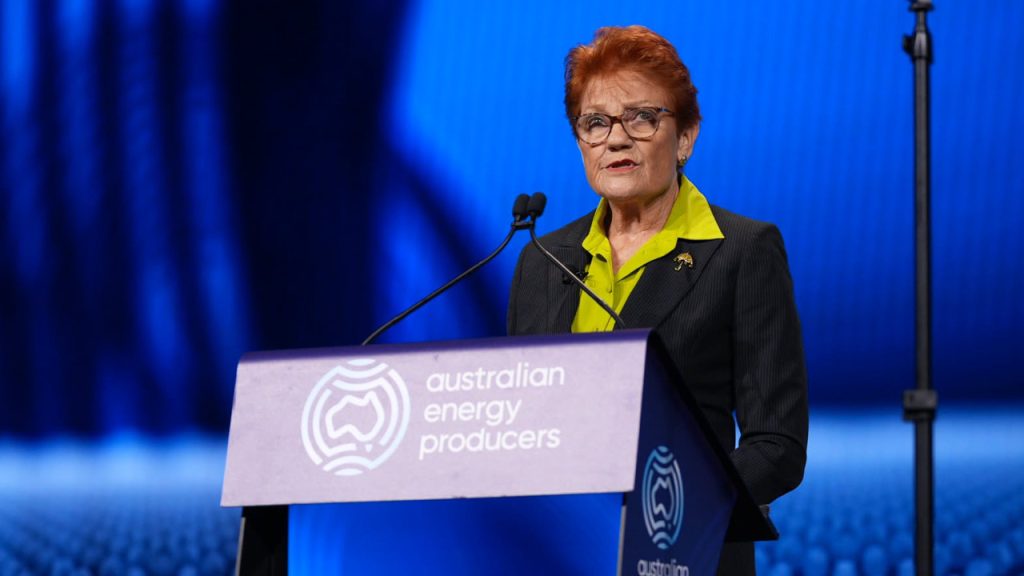
Senator Hanson has also previously supported letting people tap into their super to help buy a home, provided that when the property is sold, an amount matching the super investment is paid back into the fund.
“We brought out the policy that you could use the superannuation to put a deposit on your own home loan,’’ she said.
“You know that we brought that out years ago. Let people use that money to help them now in a state of crisis.
“You know, and some people, you know, who need these operations can’t get access to their superannuation to have that done.
“Superannuation should be lightened up a bit so people can utilise this money in times of crisis. It is their money.”
Her intervention lands as Liberal leader Angus Taylor faces calls from within his own frontbench to entertain a dramatic overhaul of super. Senator Andrew Bragg has publicly declared compulsory super a failed policy and said it should be reconsidered.
He reignited the issue last week in a speech at the National Press Club, then expanded on his argument in comments to ABC Radio on Thursday, where he said the super guarantee had not worked.
“It hasn’t worked,” Mr Bragg said.
“I mean, it’s one of the biggest public policy failures since federation, in the sense that it hasn’t helped the budget, and it has not really helped many people get off the pension.
“What it has done is it has created a huge viper’s nest for banks and financiers and unions to pilfer, which is why what you saw at the Labor Party conference was now you’re going to have super for under 18s, and soon you’ll have super for cats and dogs.”
Mr Bragg, who wrote the book Bad Egg on superannuation, said Australia had become a place where there was “superannuation for everything”.
“Most of their policies are driven (by) vested interest because they like to put their fingers into the till and pull out lots of money,” he said.
“Of course, that’s why they’ve given (former Labor MP turned superannuation chairman) Wayne Swan an award for being the world’s best person. Even though, of course, he is the chairman of a fund that doesn’t pay death benefits.”
Asked whether the Coalition should campaign to cut the super guarantee from 12 per cent of wages to a lower level, Mr Bragg said the present model should at least be up for discussion.
“I’m sceptical about the system’s capacity to deliver for the nation, but that’s something that I’d need to discuss with colleagues,” he said.
“And you know, [Liberal frontbencher] Tim Wilson and I, over a long period of time, have been sceptical about this particular policy. But it’s something that we need to work through carefully.”
Mr Bragg has long argued against universal compulsory super. At the National Press Club last week, he again made that case in blunt terms.
“Mandates are always costly. And in this case, it takes 12 per cent from people’s wages to vest them with managers they will never meet. It is a loss of liberty,” he said.
“As I said in my first speech, compulsory super remains a strange but huge illiberal experiment. So, you’ve got to ask yourself, what was the point of a scheme that gave you no public finance benefit and minimal personal benefit?”
Tim Wilson has expressed similar views in the past. In 2019, he told The Bolt Report that lower-paid workers, and possibly those on medium incomes, might benefit from being allowed to take the money as income instead.
“For low-income earners or even for medium-income earners in particular it might make more sense that they have at least the choice to be able to take that money instead of taking it as more super,” he said.
Other Liberal frontbenchers, including Jane Hume, have repeatedly rejected suggestions that voluntary super is official Coalition policy. At the last election, however, the Coalition did propose allowing first-home buyers to withdraw $50,000, and potentially more, from their super to buy homes.