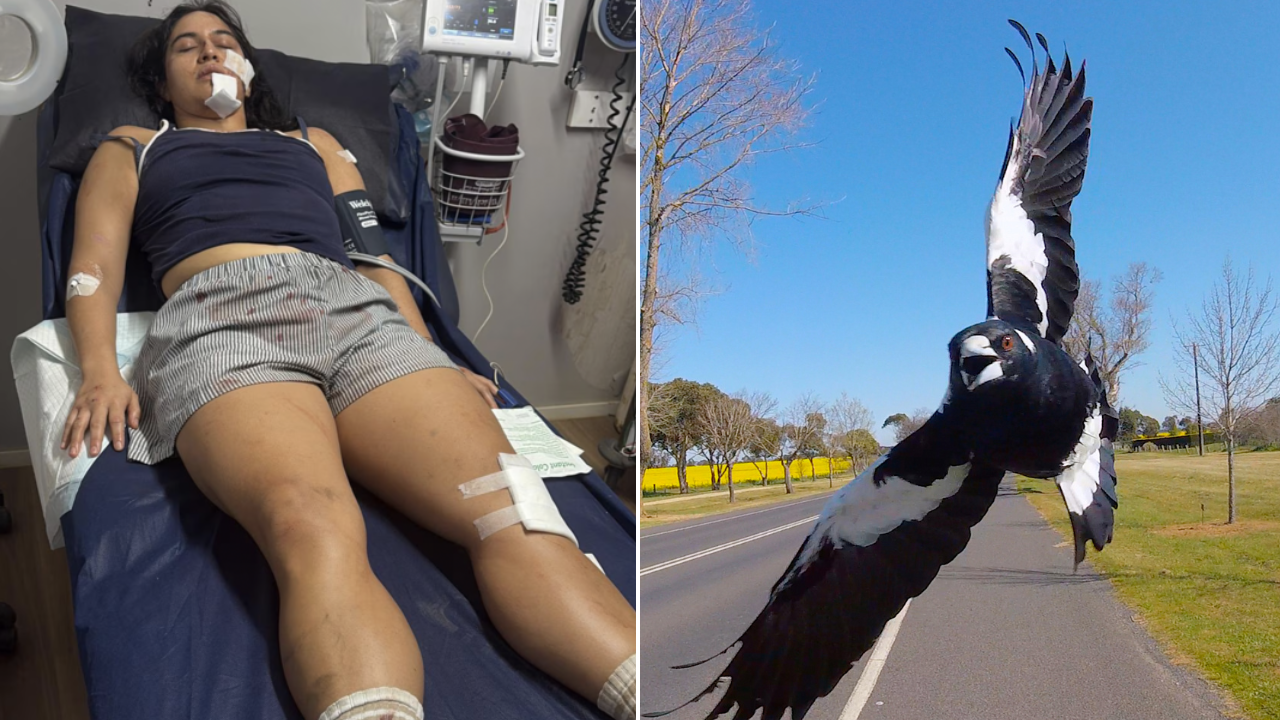
An expat living in outback Queensland has described the terrifying moment a magpie attack left her unconscious and with serious facial injuries during what began as a simple bike ride.
Marcela Montalva, 30, moved from Chile to Australia in February 2025 to complete her 88 days of regional work.
She had been living in the small, remote town of Ravenswood – about 90 minutes from Townsville – and working at the local service station.
On the morning of the incident, Montalva decided to borrow her boss’s bicycle for a short ride to the town’s post office, about two kilometres away.
But what should have been a quiet trip quickly turned into a nightmare.
Without warning, a territorial magpie swooped at her head, causing her to lose control of the bike and crash onto the roadside. The left side of her face struck the concrete, knocking her unconscious.
“It was not a new road to me, and I was in the middle of the [path]way when I see the shadow [of the magpie] and that’s the last I remember of the accident,” she told news.com.au.
“I woke up in the medical unit of the mine site, covered in blood, and they said they found me passed out and face down. I was very confused, and that’s all my memory from the accident.”
“I lost control of my bike, and just smashed my face into the concrete,” she added. “The nurses in the medical unit saw a lot of blood, and thought I might have bones broken which they were right about.”
Montalva was airlifted to Townsville University Hospital, where doctors told her she was “lucky to be alive.” Scans revealed multiple fractures to the left side of her face – including the cheekbone, orbit, maxilla and zygomatic arch – as well as a fracture to the hyoid bone in her neck.
“Fortunately that break didn’t block my airways, because I don’t know how long I was face down because if it did I would probably be dead,” she said.
“I don’t know how it happened, it was so weird, but it definitely could have killed me.”
Now recovering at home in Ravenswood with her boyfriend, Montalva remains in significant pain and is unable to fully close her mouth. She is waiting for a specialist appointment to determine whether she will require surgery.
“I have no information, I am in a super remote location and have no car … I don’t even know how to get to the hospital [for appointments] because people work and have stuff to do … there’s no public transportation or anything,” she said.
“I feel so anxious about this … and what will happen to me.”
She has since launched a GoFundMe to cover her medical expenses and says she is struggling to get assistance from her insurance provider after reports suggested she “wasn’t wearing a helmet when she was found.”
“I want to do things right. I travelled here with insurance, I did what I was supposed to do but I felt like they have left me,” she said.
University of Southern Queensland wildlife science lecturer Dr Meg Edwards said swooping is a common behaviour among magpies during the spring breeding season.
“We see these swooping events when magpies have either eggs or chicks in the nest, and that’s usually between August and October,” Dr Edwards explained.
“When they’re coming out of winter, there’s lots of food availability so it’s when lots of animals have their mating season.”
Dr Edwards said magpies typically defend their nests for about six weeks after chicks hatch – though only around 10 per cent of the species actually swoop at humans.
Images: Courtesy of Marcela Montalva/Shutterstock