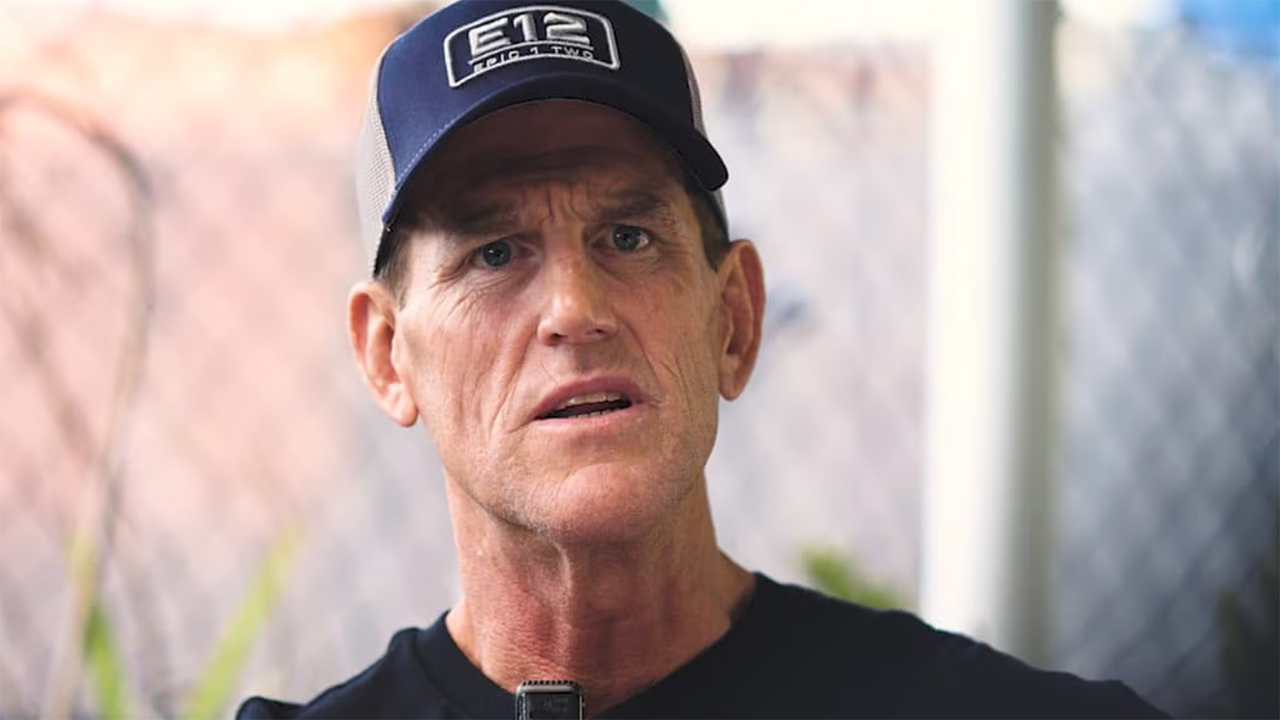
Ben Roberts-Smith has broken his silence for the first time since being charged with five counts of war crime murder.
In an interview with news.com.au, the Victoria Cross recipient described the psychological toll of years of allegations, his arrest at Sydney Airport in front of his family and spending nine nights in custody, including a night in a high-observation suicide cell.
“When that flood of media and allegations came, it was relentless,” Roberts-Smith said.
“And there were many times in that period that I thought it might be a better option for my family if I just took my own life and let it go.
“At that point, which probably played out over about three to six months of thinking about that every day, that’s rock bottom.”
Roberts-Smith said his daughters helped him move past those thoughts, alongside the belief that his death could be interpreted as an admission of guilt.
“What got me off rock bottom was the kids, but it was also the fact that if I took my own life, they’d win,” he said.
“They would be able to say I did it because I was guilty, and my family would have to live with that shame.”
He said the experience had reinforced the importance of remaining present for his children as he faced the criminal proceedings.
Roberts-Smith was arrested at Sydney Airport on April 7 while travelling from Queensland with his partner, Sarah Matulin, and their daughters.
He told news.com.au that he initially assumed a convoy of vehicles and flashing lights on the tarmac was for a visiting dignitary, admitting he “thought it must be some VIP or something”. He said he had previously offered to surrender voluntarily through his legal team.
He said the arrest unfolded in front of other passengers and that one of his daughters began crying as he was escorted from the plane.
“I just turned to the kids and Sarah and said, ‘Hey look, you’ll be alright, don’t stress about it,’” he said.
“They escorted me off, I obviously agreed, was compliant and respectful. When I got out onto the air bridge there were about another 10 uniformed and un-uniformed federal police officers with all their weapons. And at that point I think one of my daughters burst into tears,” he said.
“The gentleman was talking to me and explaining the situation… The only thing I said to him was, ‘I can’t believe you did it when the kids are here,’” Roberts-Smith said, recalling his conversation with an officer.
He questioned why police arrested him during the family trip rather than allowing him to surrender at another time.
The Australian Federal Police has previously said the decision was made for operational reasons, including that airports are controlled environments where officers can act more safely, which Roberts-Smith said “makes no sense”.
The AFP also said it had no evidence the agency provided the media with information about the timing or details of the arrest, but referred the matter to the National Anti-Corruption Commission as a precaution.
After his arrest, Roberts-Smith spent nine nights in custody at Sydney’s Silverwater Correctional Complex before securing conditional bail. He said his first night was in a high-observation suicide cell, where lights remained on overnight.
Despite expecting possible hostility, he said correctional officers treated him professionally and respectfully.
He recalled one guard asking whether he was all right, telling him he must be at rock bottom.
“And I thought that was funny because I had just looked at him and said, ‘Mate, this isn’t a rock bottom. I’ve been at rock bottom before and this is not it.’”
Roberts-Smith said he had anticipated the possibility of facing criminal proceedings and tried to focus on getting through the experience.
He now spends his time exercising, seeing his family and working with his legal team. His bail conditions include reporting to police three times a week and restrictions on electronic devices.
The Commonwealth Director of Public Prosecutions charged Roberts-Smith with five counts of war crime murder following a joint investigation by the Australian Federal Police and the Office of the Special Investigator.
The charges relate to the alleged killings of five unarmed Afghan detainees during SAS deployments between 2009 and 2012. Roberts-Smith denies the allegations and has maintained that the engagements involved Taliban members or their associates.
He is legally restricted from addressing the specific allegations in detail while the criminal case is pending.
Roberts-Smith previously lost a civil defamation case brought against Nine newspapers and journalists over reports alleging he was involved in unlawful killings in Afghanistan.
The Federal Court found the publications had established the substantial truth of key allegations on the balance of probabilities, a different standard from the criminal standard of proof beyond reasonable doubt.
In the interview, Roberts-Smith said he regretted remaining silent during the defamation proceedings, arguing that his decision allowed negative public opinion to take hold. He also criticised the way authorities handled his arrest and the investigation. Those criticisms remain his claims.
He said the uncertainty surrounding the criminal case had affected his family and left him facing years of legal proceedings.
“I’m still a son, I’m a brother, I’m a father,” Roberts-Smith said. “Like everyone else, I’m just living life and trying to pay the bills. I’m trying to keep my kids going to school, see them off into their lives, and manage a relationship.
“And on top of that, every now and again I’ve got to go to court and fight these allegations. It’s really unfortunate and hard sometimes, but that’s my lot. We’ll fight them.”
Image: Instagram