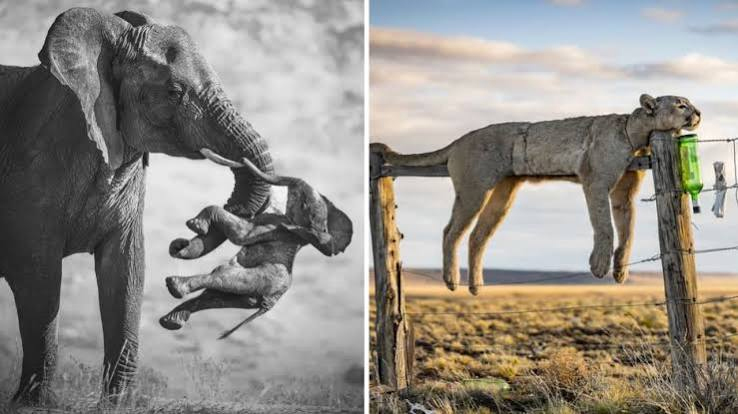
An emotional photograph of an elephant carrying a dead calf has earned Italian photographer Federico Veronesi the title of Wildlife Photographer of the Year 2026, while another award-winning image has sparked a strong reaction online for its confronting depiction of illegal wildlife hunting.
Veronesi captured the winning image while tracking elephants in Namibia’s Huab River Valley. After spotting drag marks in a dry riverbed, he followed them to find a female elephant carrying a dead calf, its leg caught between her tusk and trunk.
Researchers later identified the elephant as a female that had lost a calf several years earlier and had previously picked up dead calves belonging to other females. It remains unclear whether the elephant was the calf’s mother.
Reflecting on the encounter, Veronesi said: “Of all the 20 years I’ve done photographing animals, this is the most heart-wrecking and fascinating and dramatic,” describing the image as “revealing of the depth and complexity of the emotions, the feelings of the animals.”
He hopes the photograph will encourage people to recognise animals as individuals with their own relationships, memories and emotions.
“It’s a small window that opens just a crack into the complexity of their world,” he said.
Another image attracting widespread attention shows a puma tied up on a fence as a hunting trophy.
Captured by Chilean photographer Francisco Negroni, the photograph has prompted hundreds of thousands of online reactions, ranging from expressions of distress to comments defending the practice, while others questioned if it was real.
Negroni said he had “never witnessed or photographed before” such a sight. Although puma hunting was banned in Argentina’s Santa Cruz province in 2025, the persecution of the animals continues.
The photograph highlights the ongoing conflict between wildlife conservation and hunting, with the online response reflecting sharply divided views about how wild animals should be treated.
Other recognised images include Labour of Love, by young photographer Oscar Whitfield, showing a dung beetle pushing a ball of dung uphill in Zimbabwe; The Meeting Place, by James Lewin, capturing an elephant spraying zebras at a waterhole in Kenya; and Flight of the Bumblebee, by Amelie Davis, taken in her garden using her father’s smartphone.
The Wildlife Photographer of the Year exhibition opens at London’s Natural History Museum on October 16, showcasing award-winning images from around the world.
The museum’s 63rd competition opens for entries on October 19 and runs until December 3, 2026.
The new Positive Action category will highlight conservation successes and hopeful stories about people’s connections with the natural world, while the top prize for the 2027 winner has increased to £15,000.
The full list of winners and images is available through the Natural History Museum’s Wildlife Photographer of the Year exhibition website.
Images: Wildlife Photographer of the Year