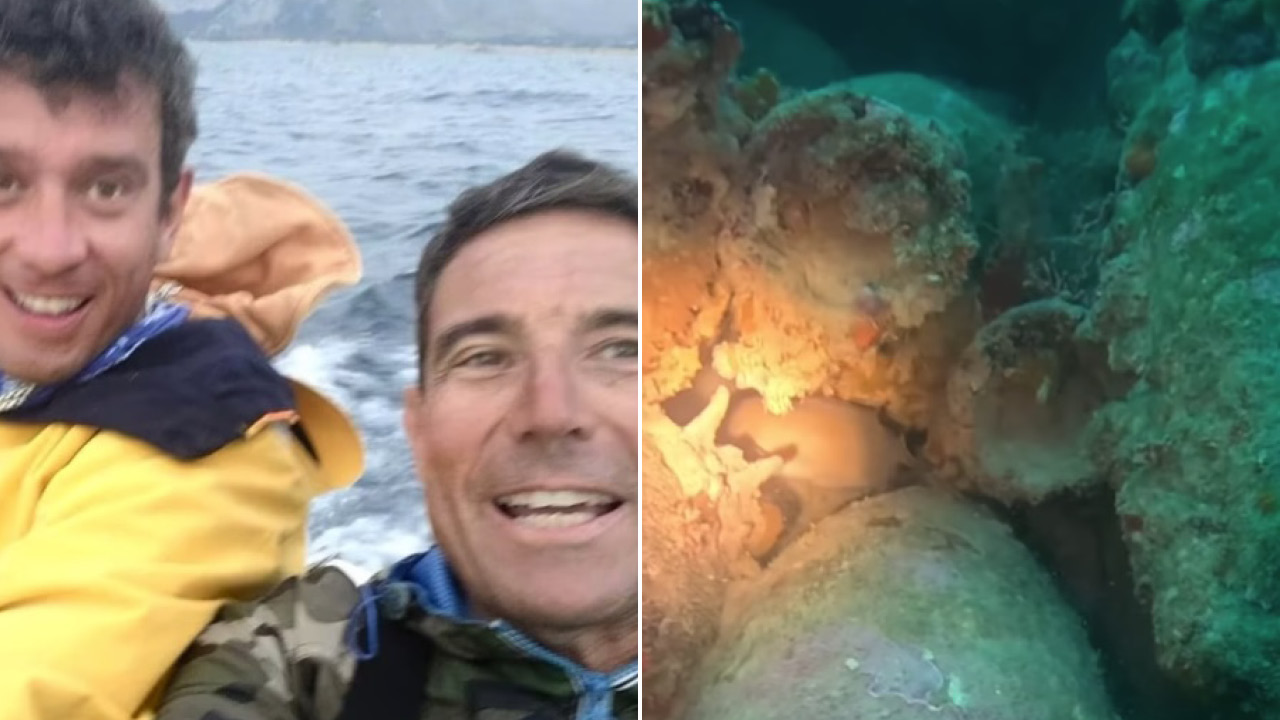
A team of Italian divers has uncovered a Roman shipwreck off Sicily that is believed to be more than 2,000 years old. The vessel was located around 4.8km from Mazara del Vallo, on Sicily’s western coastline.
Italy’s Ministry of Culture said the wreck is thought to belong to the second or first century B.C. The discovery included hundreds of ancient clay jars, prompting Culture Minister Alessandro Giuli to call it “extraordinary”.
Giuli also said the site is “one of the most important underwater archaeological discoveries of recent years”.
Writing on Instagram, he said: “I congratulate the Arma dei Carabinieri, its specialised departments, the TPC Nucleo and the Superintendent of the Sea of the Sicilian Region for one of the most important underwater archaeological discoveries in recent years,”
He added: “About three miles (4.8km) from the coast of Mazara del Vallo, 46 metres deep, a Roman wreck has been identified, presumably dated between the 2nd and 1st centuries BC, with hundreds of amphoras, two large lead anchor stumps and other structures.”
The ministry said the discovery “speaks to us of people, routes, and trade, and of the role of the Mediterranean as a crossroads of civilisations”.
Officials said further work will now be carried out through documentation and research efforts to rebuild the archaeological context of the wreck and safeguard it.
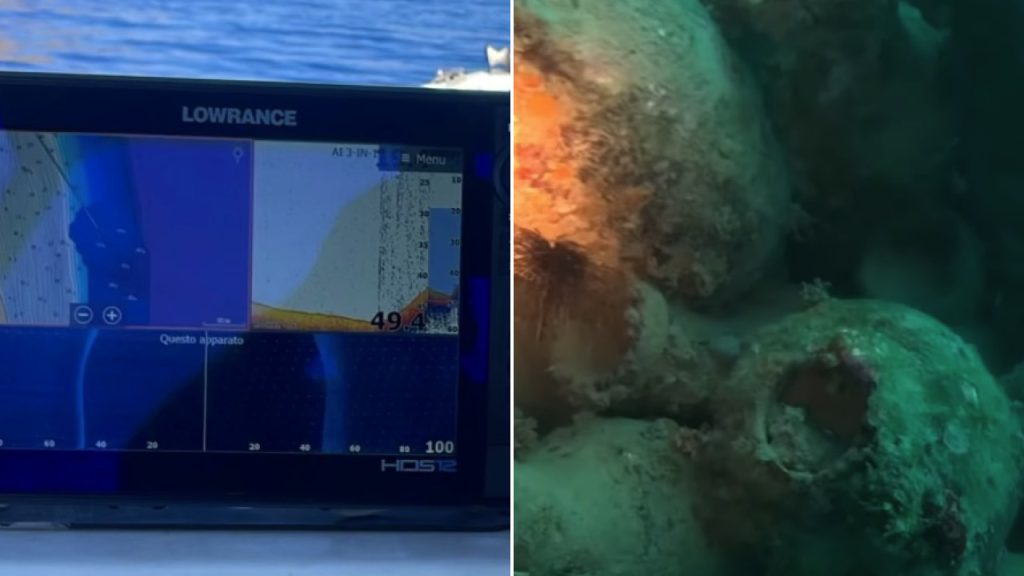
Among those involved was fisherman Giacomo De Mola, who said he and fellow divers were mapping the seafloor with sonar when they noticed “what looked like an ordinary rock”.
In his own Instagram post, he wrote: “This is, without a doubt, the most incredible discovery of my life,”
He described the moment this way: “During a day of surveying with Igor Bisulli, off the coast of Mazara del Vallo, on a seabed of about 45/50 metres, the StructureScan shows us what appears to be a simple rock. But something compels me to check. One last breath. And I descend.”
De Mola said visibility below was poor, and at first he assumed the shape beneath him was a “big rock”. A closer look changed everything.
“It wasn’t a rock. Below me was an immense expanse of amphorae. Hundreds of amphorae that had lain on the seabed for over 2,000 years.”
When he came back up, he told Igor: “You can’t imagine what’s down there …”
He also wrote: “It’s hard to explain what it feels like to be among the first humans, in nearly 20 centuries, to see that place again.
“We immediately reported the discovery to the Sicilian Regional Superintendency of the Sea.”
De Mola said preliminary analysis pointed to an exceptional site, with a concentration of amphorae measuring about 21 metres in length, 6 metres across and nearly 2 metres high. He said the wreck also included two large lead anchor stocks and a leaden fistula.
He added: “Most of the amphorae are of the Dressel 1A type, but there are also Lamboglia 2 amphorae, likely North African amphorae, and a Neo-Punic amphora. An extraordinary testimony to Mediterranean trade routes over 2,000 years ago.”




![Three hikers celebrate atop Katahdin beside a weathered summit sign with backpacks and blue sky above (split image).] ,](https://www.oversixty.com.au/wp-content/uploads/2026/09/OLD1.jpg)