For almost 90 years, the disappearance of Amelia Earhart has remained one of the great unsolved stories of flight, and now a team of researchers believes the answer may lie on a speck of coral roughly halfway between Australia and Hawaii.
A joint expedition from Purdue University, its research foundation and the not-for-profit Archaeological Legacy Institute is making the final approach to Nikumaroro, a remote island in Kiribati’s Phoenix Islands group, to investigate an unidentified object first photographed next to a lagoon there in 2020.
The 17-person team hopes that object will turn out to be the fuselage and tail of Earhart’s aircraft, missing since she vanished attempting to circle the globe in 1937.
After sailing from Kiribati’s capital, the researchers will spend days combing an atoll that stretches roughly 7.5 kilometres long and 2.5 kilometres wide, searching for wreckage that has waited nearly a century to be found.
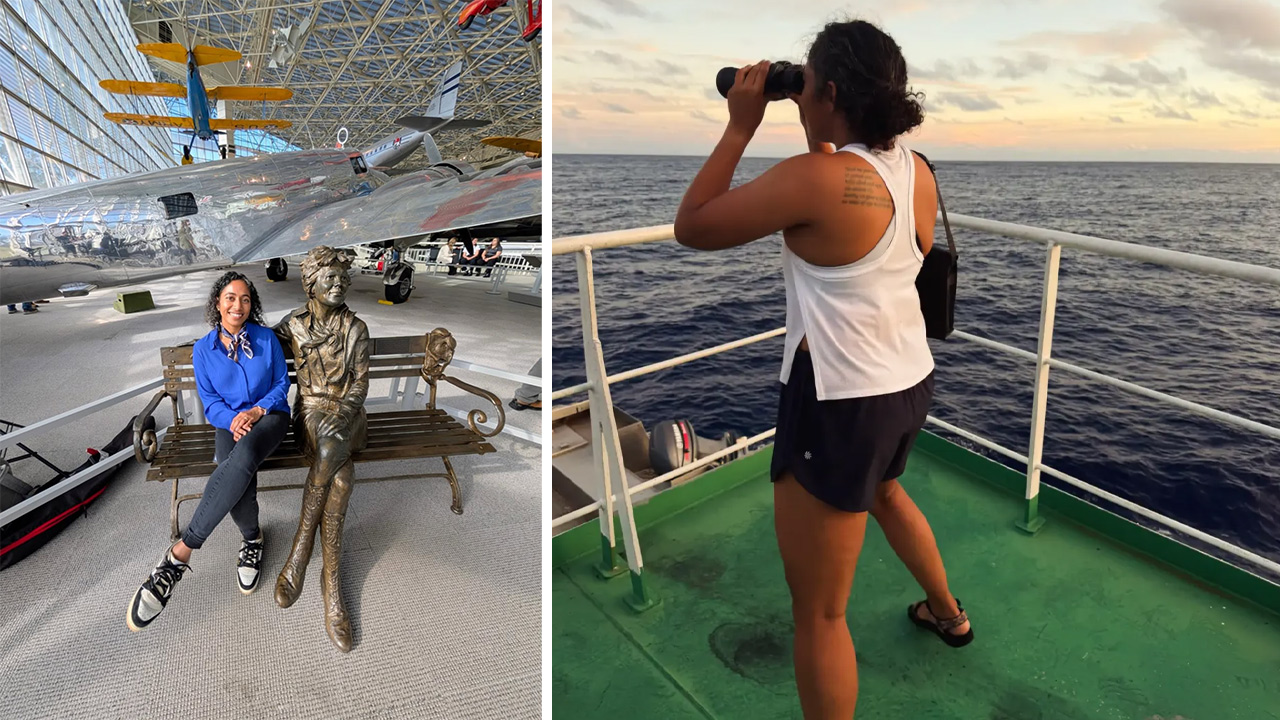
Expedition member Sirisha Bandla said flying the same stretch of ocean Earhart and navigator Fred Noonan were attempting to cross brought the weight of the mission into focus.
View this post on Instagram
“There’s something significant to flying over the Pacific Ocean,” she said. “As we finally arrived at our point of departure here in Tarawa, it struck home that we’d flown over a majority of the portion that Amelia Earhart and Fred Noonan were attempting to traverse when they were lost.”
“Now we hope to have a chance to bring closure to their story.”
Earhart’s own story began with a 10-minute plane ride at 23 that she said changed the course of her life. “By the time I had got two or three hundred feet off the ground, I knew I had to fly,” she later recalled.
She went on to cross the Atlantic twice by air, first as a passenger in 1928 and then alone in 1932, becoming the first woman to complete a solo flight across that ocean. That same year she flew solo and nonstop across the United States, and in 1935 she became the first person to fly solo and nonstop from Hawaii to the US mainland, adding to a string of speed and altitude records that made her one of the most recognised aviators in the world.
Her achievements earned her the Distinguished Flying Cross, the United States’ decoration for heroism in the air, long before she disappeared somewhere over the Pacific attempting to circle the globe.
For a generation of Australians who grew up with her story as a measure of courage and curiosity, the prospect that the answer has been sitting on a quiet island not far from our own coastline carries a particular kind of wonder.
Whatever the researchers find on Nikumaroro’s sand in the coming days, the mystery that has outlasted its own witnesses may finally be ready to give up its last secret.




![Three hikers celebrate atop Katahdin beside a weathered summit sign with backpacks and blue sky above (split image).] ,](https://www.oversixty.com.au/wp-content/uploads/2026/09/OLD1.jpg)