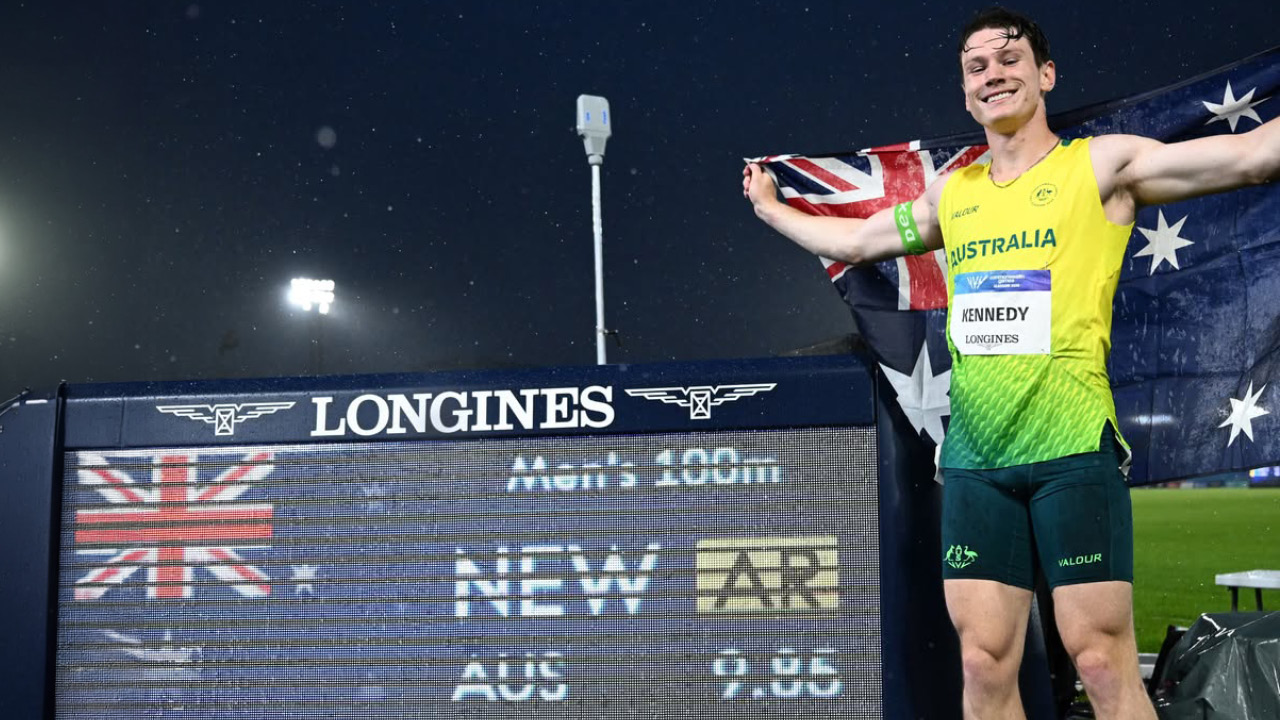
Lachlan Kennedy has produced the biggest run of his career, winning silver in the 100m at the Commonwealth Games in Glasgow on Wednesday morning (AEST) and breaking the Australian record that had stood for 23 years.
The Australian started strongly and appeared in control through 60m, but Cameroon’s Emmanuel Eseme charged late to take gold in a Games Record of 9.83. Kennedy initially believed he had done enough to win before spotting 9.85 on the scoreboard, a time that wiped out Patrick Johnson’s long-standing national mark of 9.93.
The 22-year-old had already shown his speed earlier on a wet night in Glasgow, clocking a personal best 9.94 in the semi-final before going even quicker in the final despite the rain.
As Johanna Griggs noted on Channel 7, Kennedy also became the fastest “white man” over 100m in history, moving past American Sam Blaskowski’s 9.89 from May. American athletics analyst Erin Brown also said Kennedy “broke the fastest white man world record”. Blaskowski had previously taken that mark from France’s Christopher Lemaitre, who ran 9.92 in 2011.
Before Glasgow, Kennedy’s best performances had drawn some caution because they had not come against the strongest international fields in major-pressure settings. He first broke 10 seconds at a meet in Kenya in 2025, then lowered his personal best to 9.96 at the Australian Championships in April. He also beat Gout Gout twice over 200m in the past two years.
Kennedy had won silver in the 60m at the world indoor titles last year, but this was comfortably his biggest result yet. His run also kept him ahead of Nigeria’s Kanyinsola Ajayi, regarded as one of the best young sprinters in the world.
Some critics, including Brown, had dismissed Australian sprinters such as Kennedy and Gout as over-hyped, arguing their top times were set on “fake” tracks and against weak opposition. Kennedy’s Glasgow performance gave those claims far less weight.
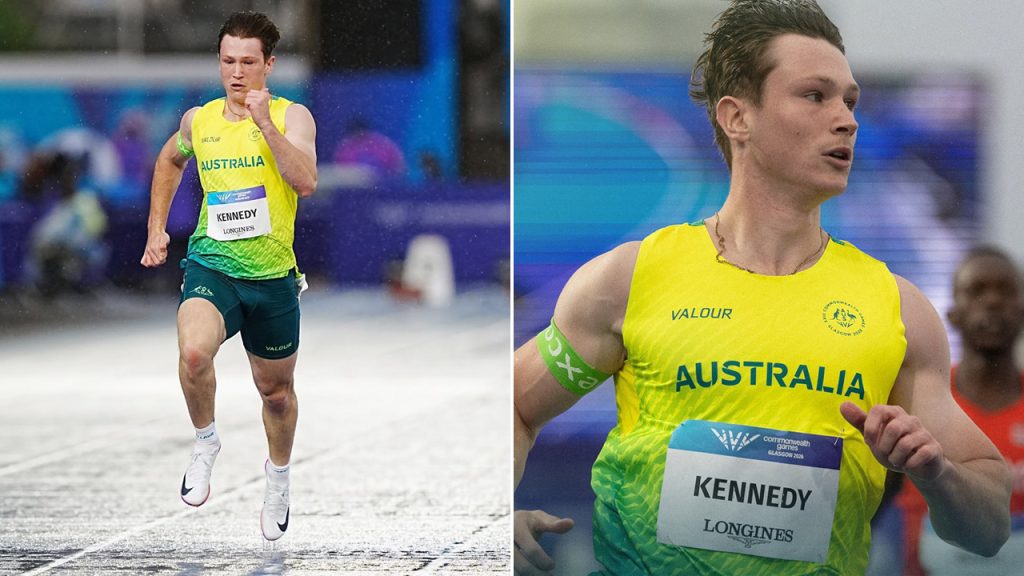
Rohan Browning, who narrowly missed the final, had become a household name when he won his heat from lane 1 at the Tokyo Olympics and reached the semi-finals. Gout did not travel to Glasgow, choosing to target the world junior championships before a hamstring injury ruled him out.
Kennedy said he had arrived intending to win and felt “relief” after delivering under pressure in difficult conditions. His 9.85 would have been good enough for fifth in the Paris Olympic final. It also would have beaten Noah Lyles for bronze at last year’s world championships, though the Jamaicans who ran 1-2 there in 9.77 and 9.82, Oblique Seville and Kishane Thomspon, did not compete in Glasgow.
“My goal is always to win in everything I do, be that Olympics, Comm Games, Shield meets,” he said.
“I don’t really care who’s out there. At the end of the day, I can only control how I run, I can’t control how the others win.
“I’m gonna go out there, do my best and aim to win everything, including Olympics.”
Australia has traditionally built medal momentum in the pool before facing a tougher reality on the track, but the athletics team is producing one of its strongest Commonwealth Games campaigns. Cathy Freeman, Steve Hooker, Sally Pearson and Nina Kennedy are among the Australians to win rare Olympic athletics gold medals, and the current team is adding to that momentum.
Australia has already claimed three athletics gold medals in Glasgow, with Rose Davies and Ky Robinson completing the 10,000m double and Eleanor Patterson winning the high jump title, 12 years after winning in Glasgow as a teenager.
Kennedy’s silver came alongside Torrie Lewis’ bronze, also in a national record, in what is shaping as a breakthrough meet for Australian sprinting.
“I mean, far out come on, we’ve got a medal in every event we’re competing in,” an ecstatic Kennedy said.
“Aussie track is in clearly the best spot it’s ever been, I think. Our team is so strong. Two Aussie sprint medals, that’s crazy at Comm Games.
“We’re in a real golden age, a lot of youngsters and a lot of veteran talent. Just honoured to be part of the team and out here contributing. Hopefully it just goes to reinforce our track programs in the future.”
Attention now shifts to Kennedy in the 200m, Aidan Murphy in the 400m and the men’s 4x100m, where Australia will be chasing a Commonwealth Games medal against teams including Ghana and Nigeria.
Lara Roberts has won bronze in the hammer throw, while Nina Kennedy, Kurtis Marschall and Matt Denny are all strong gold prospects. Peter Bol is aiming to go one better than Birmingham in the 800m, and Jess Hull is a major hope in the women’s mile, which has replaced the 1500m in Glasgow. Later in the program, Cameron Myers will try to upset world recorder and Scottish star Josh Kerr in the mile.
Kennedy will next turn his focus to the 200m and the relay.
“The next thing I’m thinking about is the 200m and then that 4x100m, hopefully we can bring home some more hardware,” Kennedy said after his 100m.
“I know we’ve got an unreal team in that 4x100m.”