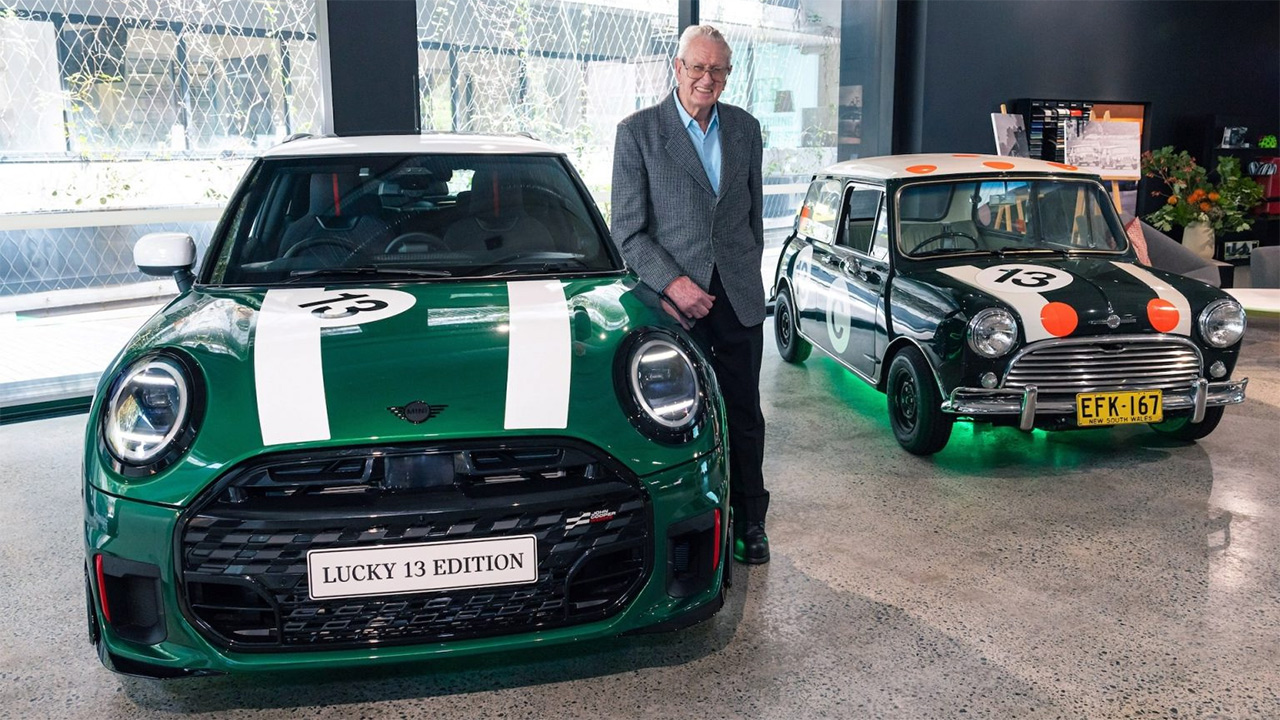
MINI has built a tribute to one of Bathurst’s more unlikely wins, and only 26 Australians will get the chance to own one. The MINI Lucky 13 Edition carries a list price of $71,990 before on-road costs, which sounds steep until you understand what is actually being sold here. This isn’t extra speed. It’s a numbered slice of motorsport folklore, built in a run so small that most people who want one simply won’t get one.
The story behind the number 13 goes back to 1966, when a British Racing Green Morris Mini Cooper S driven by Bob Holden and co-driver Rauno Aaltonen won the Gallaher 500 at Mount Panorama. Holden drew the number 13 from a hat before the race and made it his own. Minis filled the first nine places that day, and the winning car finished a full lap ahead of second place – a V8 field beaten by a car built for shopping trips and school runs.
“It is remarkable to see people still talking about that race 60 years on,” Holden said. “The Mini Cooper S showed what could be achieved through clever engineering, determination and teamwork, even against larger and more powerful cars.”
The new car wears that history rather than relives it mechanically. It’s based on the petrol MINI John Cooper Works 3-Door already sold here, sharing its 1,998cc turbocharged four-cylinder engine, producing 170kW and 380Nm, matched to a seven-speed sports dual-clutch transmission with shift paddles. There’s no power bump, no chassis rework – the drivetrain is identical to the standard car.
That makes the $10,500 premium over the regular JCW 3-Door entirely about badge and trim. MINI General Manager Alexander Brockhoff framed the car as a statement of character rather than capability, saying Holden and Aaltonen’s victory “demonstrated the qualities that have defined MINI, courage, determination and a willingness to challenge convention.”
What the extra $10,500 actually buys
The Lucky 13 Edition is finished in British Racing Green IV with a Glazed White roof and mirror caps, white bonnet stripes and circular ’13’ decals on the doors and bonnet. It rides on 18-inch John Cooper Works Rallye Spoke 964 Bicolor wheels finished in Frozen Midnight Grey, with black winglets and a red JCW tow strap carried over from the show car.
Inside, buyers get JCW seats and steering wheel, an Anthracite headliner, recycled polyester knit dashboard and door trim, and black Vescin upholstery. The front seats are heated and electrically adjustable, with massage function and memory on the driver’s side. A 240mm circular OLED display sits ahead of the driver alongside a head-up display, with MINI Experience Modes adding ambient light projection, and a Harman/Kardon 12-speaker, 365-watt sound system rounds out the cabin. The roof rails seen on MINI’s pre-production prototype won’t appear on customer cars.
Only 26 for the whole country
Production begins in October 2026, with customer deliveries into Australia expected in the first quarter of 2027. All 26 cars are earmarked for Australia alone – none will reach any other market. With a run that small, buyers chasing a particular colour combination or option should talk to their MINI dealer directly about allocation rather than assuming stock will be sitting on a showroom floor.
Whether that scarcity translates into collector value down the track is untested. There’s no sales history yet for a numbered, Australia-only MINI run of this size, so anyone buying with resale in mind is making an educated guess rather than banking on precedent.
The 1966 car versus the 2027 tribute
The original Bathurst-winning Mini Cooper S ran a 1275cc engine producing between 56kW and 107kW and weighed roughly 700kg. The modern tribute weighs closer to 1,300kg and makes 170kW – a different machine entirely, built for comfort, technology and daily driveability rather than a 500-mile dash around the Mountain. Even the paint has shifted with time: CarExpert’s side-by-side comparison found the production car’s British Racing Green IV runs noticeably lighter than the shade on the 1966 winner.
Behind the wheel, the Lucky 13 keeps the low, sporting driving position and clear forward sightlines of the standard JCW 3-Door, with compact dimensions that make it easy to place in traffic and park in a tight street. The large central display and head-up display keep speed and navigation information in the driver’s eyeline rather than buried in menus – a welcome touch for anyone who finds fiddly infotainment more trouble than it’s worth.
Before signing anything, it’s worth confirming the detail MINI hasn’t published. No ANCAP (the independent safety rating body) rating or Australian fuel-consumption figure for this specific variant appears in the release material, and warranty and servicing terms for the edition should be checked with MINI Australia before ordering. As with any new car bought in Australia, standard Australian Consumer Law guarantees apply regardless of what the manufacturer warranty says. It’s also a three-door hatch, so rear access means folding the front seats forward – worth a test sit if you’ll regularly carry passengers in the back.
What you’re really buying with the Lucky 13 Edition isn’t a faster MINI. It’s one of 26 cars in the country carrying a number that a driver pulled from a hat 60 years ago, and turned into the best kind of luck – the sort that still gets talked about long after the chequered flag.