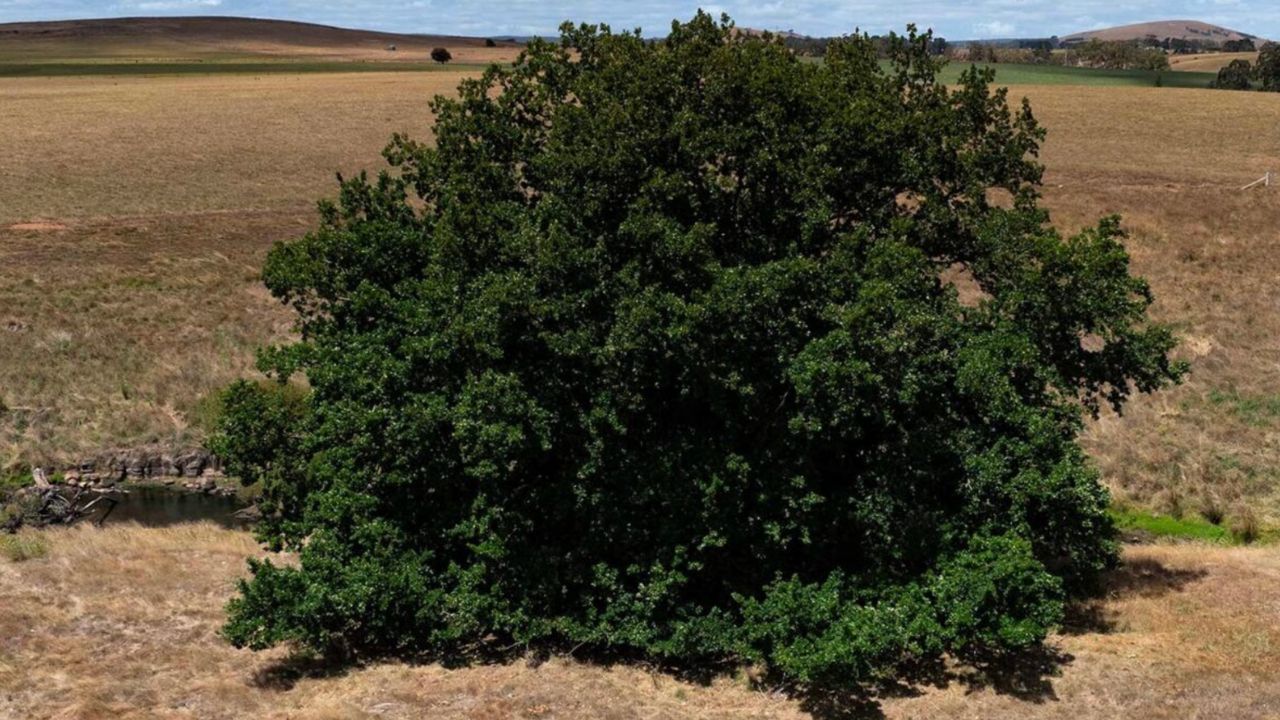
A 130-year-old Algerian oak has been crowned the National Trust’s Victorian Tree of the Year, but despite the honour, the historic tree could soon be cut down to make way for new power lines.
Residents hope the recognition will help protect the tree from being removed for AusNet’s proposed Western Renewables Link (WRL), a high-voltage transmission project designed to carry renewable energy across western Victoria.
Standing 16 metres tall with a canopy stretching 31 metres wide, the oak has long been a landmark and gathering spot for locals.
It stands within Kingston’s only public reserve, an area first proclaimed in the 1860s that runs alongside Birches Creek, home to platypuses and endangered growling grass frogs.
Kingston resident Jeremy Harper, who has lived in the area for nearly 50 years, has led the campaign to save the tree. His family has spent generations enjoying the area under the tree’s branches.
“I was over the moon — it’s a great honour for Kingston,” Mr Harper said after the oak was named Tree of the Year on Tuesday, securing more than 40 per cent of the public vote.
“I did come down to the tree actually, and I told the tree, that was pretty good — the tree was rapt.”
Mr Harper organised a petition, rally and signage to raise awareness, but said entering the National Trust competition had proven to be the most effective move.
The National Trust of Australia has championed tree protection for more than 70 years, recording over 2,500 listings since 1982 to ensure these living landmarks are formally recognised and preserved for future generations.
Each finalist is listed on the National Trust Significant Tree Register, which honours thousands of trees for their cultural, scientific and historic importance.
The runner-up in this year’s competition was the Tasmanian Blue Gum, known as the “Tree of Knowledge”, planted in 1896 at Federation University in Mt Helen.
Nearby residents Jenny Blackett-Smith and Paul McGoldrick, whose home borders the reserve, said the WRL project would have a devastating effect on both locals and wildlife.
“The power lines would go over the Algerian oak … and over the bridge there and that’s within 300 metres of our home,” Ms Blackett-Smith said.
“It’s towering over the top – we will see the towers [from] our living room, bedroom, the kitchen, the dining area. It will dominate our view.”
She said that while the community supported renewable energy they believe the project comes at too high a cost.
“We are absolutely for renewable energy – we think it’s a really important thing, but we don’t think that a small number of people should actually cop a very large bill,” she said.
“People are not sleeping at night, worrying about devaluation, worrying about the loss of some of their farming land. It’s been really hard.”
Mr McGoldrick said the area’s biodiversity was part of what made the reserve so special.
“We can get up in the evening and walk down to the creek and within about five [or] ten minutes you’ll see platypus swimming around the water holes, which is fantastic,” he said.
Ms Blackett-Smith added that the reserve around the tree was a safe spot for a lot of native wildlife including growling grass frogs, wallabies, possums, wombats, echidnas and local birds that nest in the trees.
While the National Trust title carries no legal protection, the recognition has drawn attention to the community’s efforts.
National Trust executive manager Justin Buckley said the award highlighted the need for stronger safeguards for culturally and environmentally significant trees.
“It’s a timely reminder that our planning system must evolve to reflect these values and offer stronger protection for irreplaceable natural heritage,” he said.
“We must strengthen protections rather than allow further loss.”
A WRL spokesperson said the project was aware of community concerns and that an independent process was underway to assess environmental impacts.
“The Western Renewables Link project understands the tree is important to the community,” the spokesperson said.
“We are investigating the matter and we will respond to the submissions on the Algerian oak tree as part of the environment effects statement inquiry and advisory committee process for the project as soon as we can.”
Mr Harper said he hoped the recognition would make a difference.
“If a tree becomes Victoria’s crown tree, what authority is going to cut it down?” he said.
Image: National Trust