Seventy years ago, they were young Australians with big dreams, marching proudly into the Melbourne Cricket Ground to represent their country on the world’s biggest sporting stage.
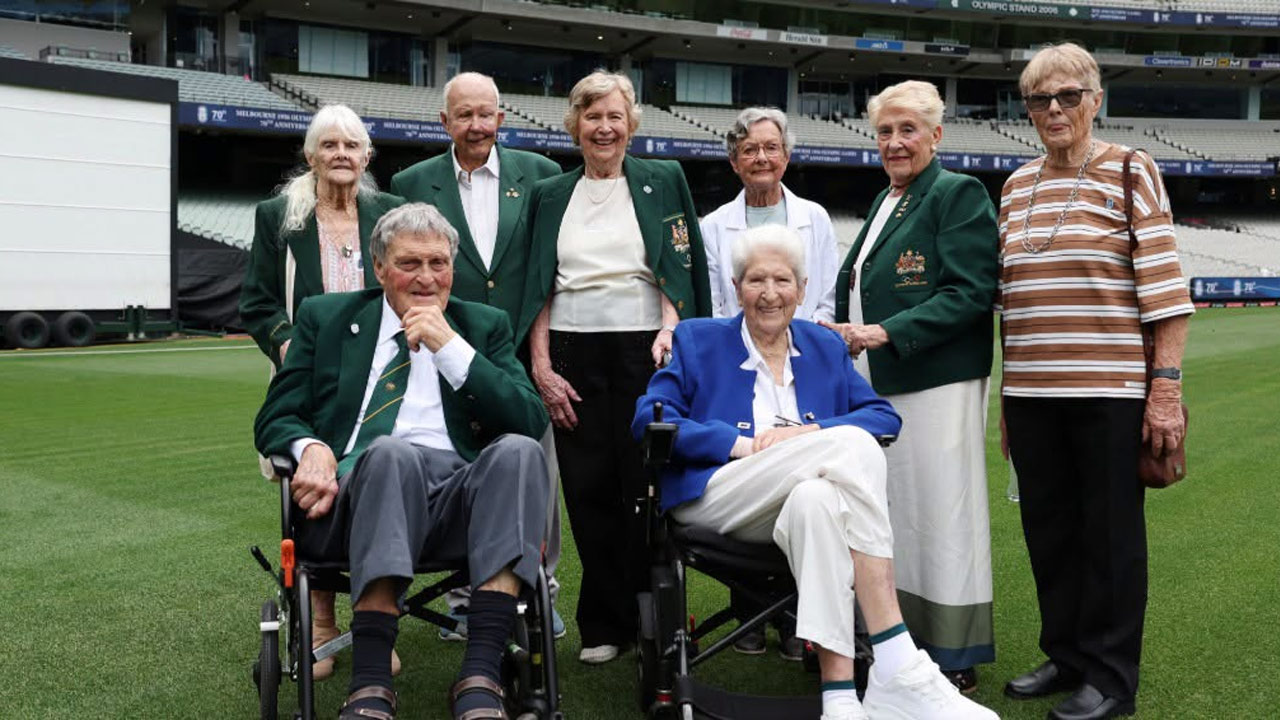
On Sunday, they returned to the very same ground, their hair a little greyer and their steps a little slower, but with the memories of that extraordinary summer of 1956 still burning brightly.
Among them was Australia’s beloved swimming legend Dawn Fraser, now 89, who joined more than 30 fellow Olympians for an emotional reunion and celebratory lunch marking the 70th anniversary of the opening ceremony of the Melbourne Olympic Games.
And while seven decades have passed since those history-making days, one thing was abundantly clear: the Olympic spirit never grows old.
The reunion brought together former athletes from swimming, athletics, gymnastics, canoeing and other sports, many of whom had not seen each other for decades.
For some, it was their first return to the MCG in years. For others, it was a chance to embrace old friends, remember teammates no longer with them and reflect on the remarkable journey that began on November 22, 1956.
For Fraser, who had missed an earlier commemorative dinner because of a health issue, the occasion was particularly special.
The four-time Olympic gold medallist arrived determined to make the most of every moment, planning to travel from table to table in her wheelchair to catch up with old friends and make some new ones.
And she had a rather wonderful announcement to make.
She’s not finished with the Olympics just yet.
“I would love to be there at ’32, to support our athletes,” Fraser told AAP, referring to the Brisbane Olympic Games in 2032.
“I think of my age – I just turned 89 – and, ‘Oh well, that’s so many years off.’ But then when I look at some of the athletes who are coming to this testimonial, some of them are 95, 99.”
Then came a flash of the wonderfully irrepressible Dawn Fraser Australians have loved for generations.
“Then I’m thinking – excuse the expression – ‘Shit! I can do that. If they can do it, I can do it.'”
And really, who’s going to argue with Dawn Fraser?
The woman who conquered three consecutive Olympic Games in the 100-metre freestyle certainly isn’t about to let something as inconvenient as turning 95 stop her from cheering on Australia’s next generation of champions.
But Sunday wasn’t just about looking forward.
It was also about remembering a remarkable chapter in Australian history.
When Melbourne hosted the Olympics in 1956, it was the first time the Games had been held in the southern hemisphere.
Australia was a very different country. Television had only just arrived, international travel was a luxury, and many of the young competitors had never raced against athletes from overseas.
Fraser was just 19, a working-class girl from Balmain who had never imagined the extraordinary life awaiting her.
“I never thought about it. [To me, the Olympics] was just another swimming event. But when I won my gold medal, I realised how big it was,” she recalled.
She went on to win gold in the 100-metre freestyle and the women’s 4×100-metre freestyle relay, as well as silver in the 400 metres.
But for Dawn, the most treasured memories weren’t necessarily about medals.
Her local community in Balmain had held chook raffles to raise enough money for her parents to travel to Melbourne and watch their daughter compete.
“To get my Olympic blazer and take it home and show Mum and Dad, I was just so thrilled and it made them so proud,” she recently told A Current Affair.
“I wanted to win for the people of Balmain, for what they had done for my mum and dad.”
It was the only Olympics her mother, Rose, would ever attend.
She died in a car accident shortly before the 1964 Tokyo Games, a loss that devastated Fraser and made her third consecutive 100-metre freestyle gold medal all the more emotional.
Another familiar face at Sunday’s reunion was former sprinter Marlene Mathews, now 92, who won bronze medals in both the 100 and 200 metres at the Melbourne Games.
Mathews still remembers the races with remarkable clarity, including the disappointment of a poor start in the 100-metre final, won by her great friend and rival Betty Cuthbert.
“I should have had that 100m,” she admitted with a smile.
Even after 70 years, the competitive fire clearly hasn’t gone out.
But Mathews’ reflections also carried a more poignant note.
She spoke of how much she missed Cuthbert, who died in 2017, and how wonderful it would have been to have her alongside the other athletes at the reunion.
“I keep thinking of Betty, thinking it would have been great for her to be here.”
It was a sentiment shared by many of those gathered, as they remembered the teammates and friends who had helped make Melbourne 1956 such an unforgettable experience.
Among the returning Olympians was canoeist Max Baldwin, now 98, whose story of courage and determination remains an inspiration.
Baldwin contracted polio as a baby, leaving him with paralysis in his legs, but refused to allow his disability to define his ambitions.
He went on to become the first Australian athlete with a disability to compete at the Olympic Games, long before the Paralympics became the major international event they are today.
He finished ninth in the gruelling 10,000-metre canoe race, although he still wonders what might have happened had he been allowed to compete in his preferred 1000-metre event.
“Winning a medal is icing on the cake, but making the Olympics is the big thing,” he said.
It’s a philosophy that beautifully captures the spirit of Sunday’s reunion.
These were athletes who competed in an era before multimillion-dollar sponsorships, social media followings and professional sporting careers.
They trained around work and family commitments, often with limited facilities and little financial support.
Yet together, they helped transform Australian sport.
At the 1956 Games, Australia finished third on the medal table, winning 35 medals, including 13 gold.
It remains the nation’s highest-ever Olympic placing.
But perhaps their greatest achievement was showing a generation of Australians what was possible.
As the former champions gathered for lunch, sharing stories and laughter, there was a wonderful sense of history coming full circle.
The same stadium that once echoed with the cheers of more than 100,000 spectators was again filled with the spirit of those remarkable young Australians.
Only now, the greatest victories were measured not in seconds or medals, but in friendships that had survived seven decades.
And with Brisbane preparing to welcome the world in 2032, Fraser is determined that Australia’s Olympic story still has another chapter waiting to be written.
“I want them to make it as successful as all the other Olympic Games – if not a little bit better,” she said.
“Sydney outshone Melbourne and I’m sure Brisbane will outshine Sydney.”
For now, though, the occasion belonged to the heroes of 1956.
The young men and women who marched into the MCG with dreams in their hearts, and returned 70 years later carrying a lifetime of extraordinary memories.
They may no longer be breaking world records, but they are still inspiring Australians.
And if Dawn Fraser has anything to do with it, they’ll be doing so for a few more years yet.