At 11am today, Australia will fall silent.
Across the country, in cities and country towns, at war memorials, schools and workplaces, Australians will pause for one minute to remember the men and women who served their nation, and especially those who never came home.
But this year’s Remembrance Day will carry an extra layer of poignancy, as one of Australia’s most treasured wartime relics emerges from decades of careful preservation to take its place in a remarkable ceremony at the Australian War Memorial in Canberra.
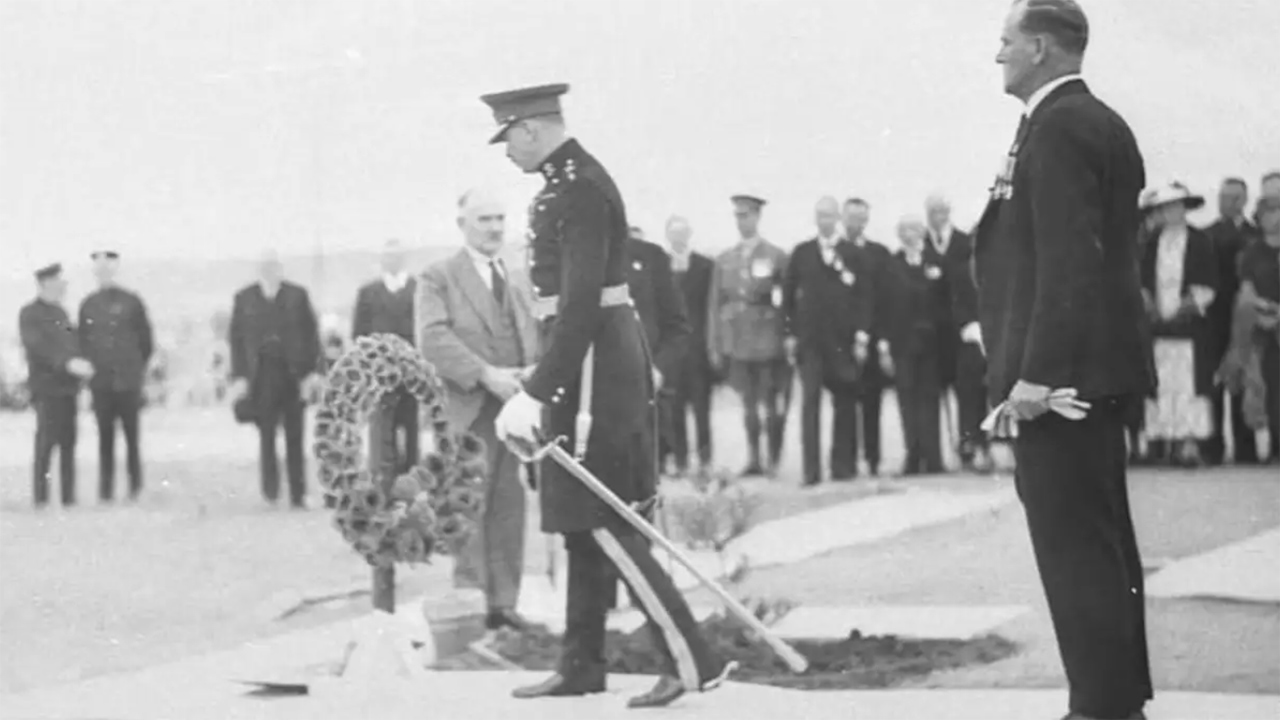
For the first time in decades, the Memorial’s oldest surviving wreath, a delicate arrangement of scarlet poppies dating back to 1934, will be laid once again in honour of Australia’s fallen.
Governor-General Sam Mostyn will perform the solemn duty, 92 years after the wreath was first placed at the site by the Duke of Gloucester, then a member of the British royal family.
When the Duke laid the wreath in 1934, the Australian War Memorial was still under construction.
The nation was mourning the 61,727 Australians who had died serving during the First World War, a conflict that had devastated families and communities across the country.
Nobody standing at that ceremony could have known that, just five years later, the world would once again be plunged into war.
Now, more than nine decades later, the very same wreath will return to the place where it first honoured those lost lives.
It is a powerful reminder that while generations pass, the debt of gratitude remains.
The historic wreath has been painstakingly preserved by specialists at the Australian War Memorial, stored in protective acid-free materials and carefully treated to prevent deterioration.
Its return coincides with the 85th anniversary of the Memorial’s official opening on November 11, 1941, when Australia was already embroiled in the Second World War.
Another precious piece of history will also be brought into the spotlight: a fragile cloth poppy worn by First World War veteran Stanley Mason at that opening ceremony.
Mason had enlisted as a private at just 23 years of age. His poppy was one of approximately 110 distributed at the opening, and is believed to be the only one that has since been traced.
Together, the two relics provide a tangible connection to Australians who witnessed the horrors of war firsthand.
Australian War Memorial senior curator Shane Casey said the objects represented something far greater than their physical form.
“These two items, a poppy from the official opening and the AWM’s oldest wreath, show the continuity of tradition in expressing commemoration,” he said.
Memorial director Matt Anderson said Remembrance Day remained an essential opportunity to reflect on the true human cost of conflict.
“We need to acknowledge the horrendous nature of war and what we ask our men and women to do,” he said.
“The purpose of the AWM was always to be a memorial, archive and museum while reminding people to say, ‘never again to war’ – just as the then governor-general Lord Gowrie said at the opening in 1941.”
Originally established to commemorate those who served and died in the First World War, the Memorial has since expanded to honour Australians who served in conflicts including the Second World War, Korea, Vietnam, East Timor, Afghanistan and the Middle East.
Its collection now contains almost two million objects, each helping to tell a story of courage, loss, service or sacrifice.
Today’s national ceremony begins at 10.45am, with Australia’s Federation Guard, military representatives, dignitaries and members of the public gathering to pay their respects.
At precisely 11am, the nation will observe one minute of silence, marking the moment the guns fell quiet on the Western Front on November 11, 1918.
For those who lived through war, those who lost loved ones, and the generations who have grown up hearing their stories, the moment remains profoundly personal.
And as the historic wreath is laid once more, its faded scarlet poppies will carry a message that has endured through 92 years of Australian history.
That the lives lost in service of this country must never be forgotten.
That peace should never be taken for granted.
And that remembrance is not simply about looking back, but about ensuring future generations understand the extraordinary price paid by those who came before them.
Lest we forget.