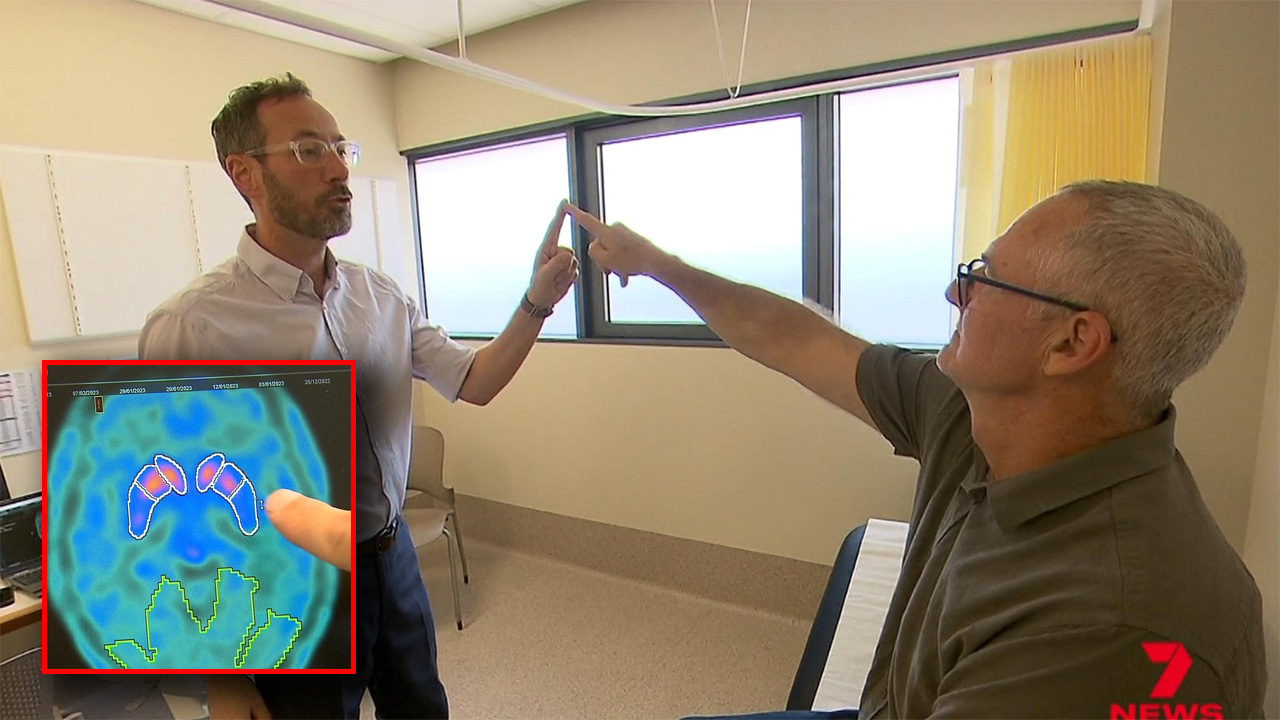
For Australians living with Parkinson’s disease, treatment has largely been about managing symptoms rather than stopping the disease itself. Now an Australian-first clinical trial is testing a very different approach: replacing some of the brain cells Parkinson’s gradually destroys.
The five-year trial is using donated stem cells in the hope of regenerating dopamine-producing cells in the brain, potentially slowing the progression of the disease and improving symptoms such as tremors and difficulty moving.
For Brett Smith, who is taking part in the trial, that possibility represents something he could scarcely have imagined when he was first diagnosed.
Smith had spent years putting his health problems down to getting older before his shaking eventually led to a very different explanation.
“When he saw my shakes, he goes, no mate, you’ve got Parkinson’s,” Smith told 7NEWS.
“Hit as though it’s a life sentence because, you know, there is no cure.”
Parkinson’s disease causes cells in the brain that produce dopamine to gradually deteriorate. Dopamine plays an important role in controlling movement, and its loss can lead to the tremors, stiffness, slowed movement and other symptoms commonly associated with the condition.
The new trial aims to tackle that process by surgically implanting dopamine-producing cells into the brain.
“What we’re hopeful to achieve is to be able to regenerate dopamine-producing cells in the brain,” Associate Professor Alex Lehn from the Translational Research Institute said.
Researchers will be watching for improvements including fewer tremors and a greater ability to move.
Fifteen Australians will participate alongside patients in the United States and Canada, with half of those taking part receiving a placebo. Researchers hope the first indications of whether the treatment is working could emerge after about 18 months, although the study itself will continue for five years.
It is an important distinction for patients and families: the treatment remains experimental, and the trial does not mean a cure for Parkinson’s has been found.
But the possibility of replacing cells lost to the disease represents an intriguing new direction after two decades of research.
For Smith, even an improvement in the physical symptoms would make an enormous difference.
“If it can help with the physical issues, that for me is like an 80 per cent win,” he said.
The stakes are considerable. Parkinson’s is regarded as the fastest-growing neurological condition worldwide, with about 150,000 Australians living with the disease and around 50 Australians diagnosed each day.
Its effects can also extend well beyond the person diagnosed.
“Day by day, you adjust to what the disease brings,” Smith’s wife Susan said.
Smith, a father of two and former engineer, knows there are no guarantees. But he also sees taking part in the research as an opportunity to contribute to something that could ultimately help many others.
“Help researchers have some raw material and develop a good outcome for society and hopefully myself,” he said.
For a disease that has long forced patients to concentrate on managing what comes next, the Australian-first trial offers something precious: the possibility that future treatment could do more than simply manage Parkinson’s symptoms – and instead begin replacing some of what the disease has taken away.