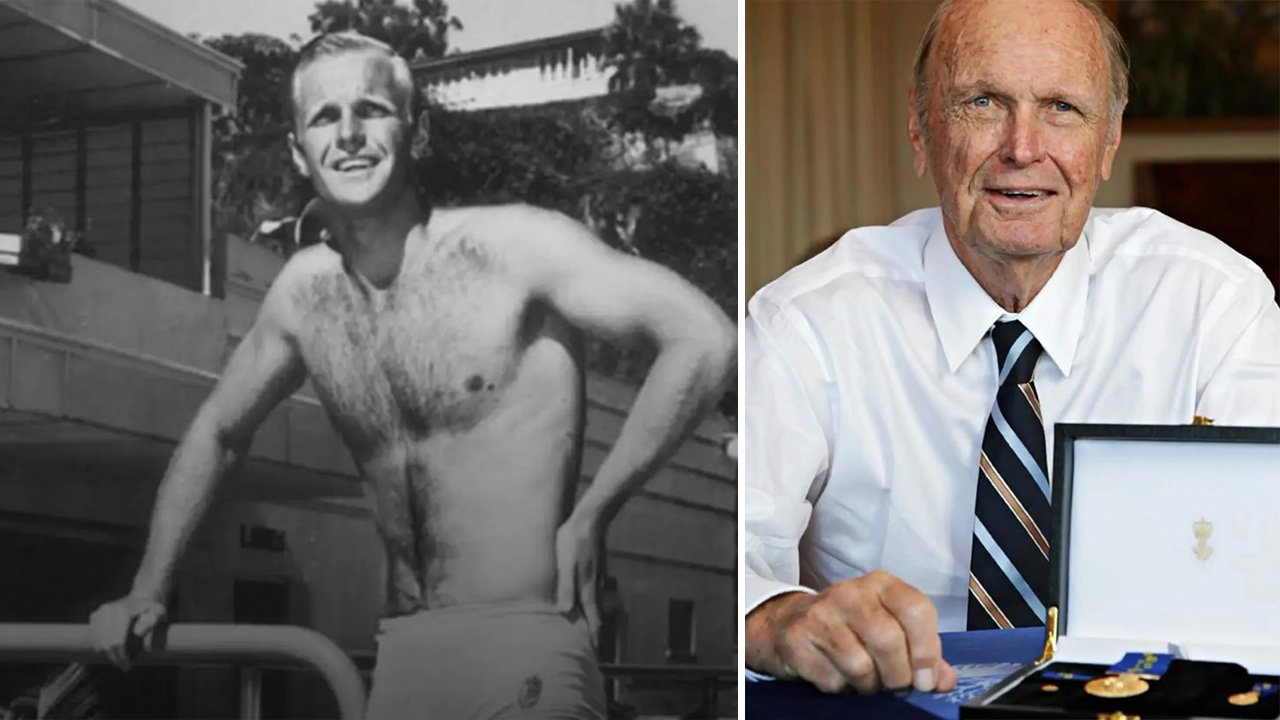
It was supposed to be a weekend of celebration, laughter and golden memories. Seventy years after the Melbourne Olympic Games, some of Australia’s greatest sporting heroes had returned to the MCG to remember the extraordinary summer of 1956, when a generation of young athletes captured the nation’s imagination.
But as Dawn Fraser and her fellow Olympians prepared for their emotional reunion, heartbreaking news arrived.
Jon Henricks, the legendary Australian swimmer who won two gold medals at those historic Games, had died at the age of 91.
His passing, announced on the eve of Sunday’s anniversary celebrations, brought a poignant sense of loss to an occasion dedicated to remembering the athletes who helped shape Australia’s sporting identity.
And few had played a greater role in that remarkable chapter than Henricks.
Born in Sydney in 1935, Henricks was just 21 when he stepped onto the starting blocks at the 1956 Melbourne Olympics.
Already a world-record holder and Commonwealth Games champion, he carried the hopes of a nation eager to prove itself on the international sporting stage.
And he certainly didn’t disappoint.
In front of a roaring home crowd, Henricks stormed to victory in the men’s 100-metre freestyle, leading an extraordinary Australian clean sweep of the medals.
John Devitt finished second, while Gary Chapman claimed bronze.
It was a moment of sporting history, and one Henricks would never forget.
“After I touched the wall, I looked for the timekeepers,” he recalled in a 1999 interview with The Age.
“They were all smiling at me, and I knew. As I scanned the lanes, I could see Gary Chapman and John Devitt being congratulated. We had made history.”
But Henricks wasn’t finished.
He went on to anchor Australia’s 4×200-metre freestyle relay team to another gold medal, helping establish a new world record alongside Devitt, Kevin O’Halloran and Murray Rose.
The Australian swimming team would ultimately claim eight of the 13 gold medals available in Melbourne, an extraordinary achievement that helped establish the nation’s reputation as a swimming powerhouse.
And Henricks was right at the heart of it.
Australian Olympic Committee president Ian Chesterman paid tribute to the champion, describing him as a giant of the 1956 Games.
“Jon Henricks was a giant of the Melbourne 1956 Games and part of a remarkable generation of Australian Olympians alongside Murray Rose, John Devitt, longtime friend Dawn Fraser and many others,” he said.
“That week helped establish Australia’s reputation as a swimming nation, and it still inspires our athletes today.”
For Fraser, now 89, the anniversary reunion was an opportunity to reconnect with the friends and teammates who had shared those extraordinary days.
She and Henricks had trained together under renowned swimming coach Harry Gallagher, both emerging as stars during an era when Australian swimmers were beginning to dominate the world.
While Henricks later made his home in the United States, he remained deeply connected to his Australian sporting roots.
His achievements extended well beyond Melbourne.
At the 1954 Commonwealth Games in Vancouver, he won three gold medals, establishing himself as one of the fastest swimmers in the world.
He was also a pioneer in swimming preparation, helping introduce training techniques that would eventually become standard practice for elite athletes.
His attempt to defend his Olympic title at the 1960 Rome Games ended in disappointment when a severe gastrointestinal illness left him too weak to qualify for the final.
But his legacy had already been secured.
He was inducted into the International Swimming Hall of Fame in 1973 and the Sport Australia Hall of Fame in 1986, later receiving the Medal of the Order of Australia for his services to swimming.
Yet for all the medals, records and accolades, one of Henricks’ most treasured memories had nothing to do with standing on the podium.
It was the moment he finally found his parents in the crowd after winning Olympic gold.
“I searched the crowd frantically for my parents,” he once recalled.
“In the pandemonium that was going on, there was no way I could pick them out. It would have to wait till much later for me to see that look of pride in my father’s face. The look that every son yearns for.”
It was a beautiful reminder that behind every great sporting achievement is a human story of love, sacrifice and family pride.
And it was those stories that made Sunday’s reunion at the MCG so special.
More than 30 surviving members of the 1956 Australian Olympic team gathered to mark the 70th anniversary of the opening ceremony, including Fraser, fellow swimming champion Sandra Morgan and athletics great Marlene Mathews.
For many, it was a chance to embrace old friends, share memories and reflect on the remarkable lives they had led since representing Australia seven decades earlier.
But it was also a reminder of the passing years, and of the teammates who were no longer there to share the occasion.
Swimming Australia chief executive Rob Woodhouse said Henricks’ death was especially sad given its timing.
“Jon will be remembered as one of our greatest ever champions,” he said.
“We are saddened to hear of his passing, especially on the eve of the 1956 Melbourne Olympians celebration.”
The timing was particularly poignant.
Seventy years earlier, Henricks had been a young man at the peak of his powers, helping write one of the most glorious chapters in Australian sporting history.
Now, as his surviving teammates returned to celebrate that remarkable achievement, the nation was saying goodbye to one of its greatest champions.
Henricks is survived by his wife Bonnie and their four children, Deborah, Michelle, Gretchen and William.
And while he could not be there to share the anniversary celebrations, his presence was woven into the history being remembered.
Every story of Melbourne 1956, every photograph of Australia’s triumphant swimmers and every recollection of that extraordinary summer carries a little of Jon Henricks with it.
For those who gathered at the MCG, the weekend was a celebration of 70 years of friendship, courage and sporting achievement.
And a farewell to a champion who helped make it all possible.
Rest in peace, Jon Henricks. Australia’s golden summer will always be part of your legacy.