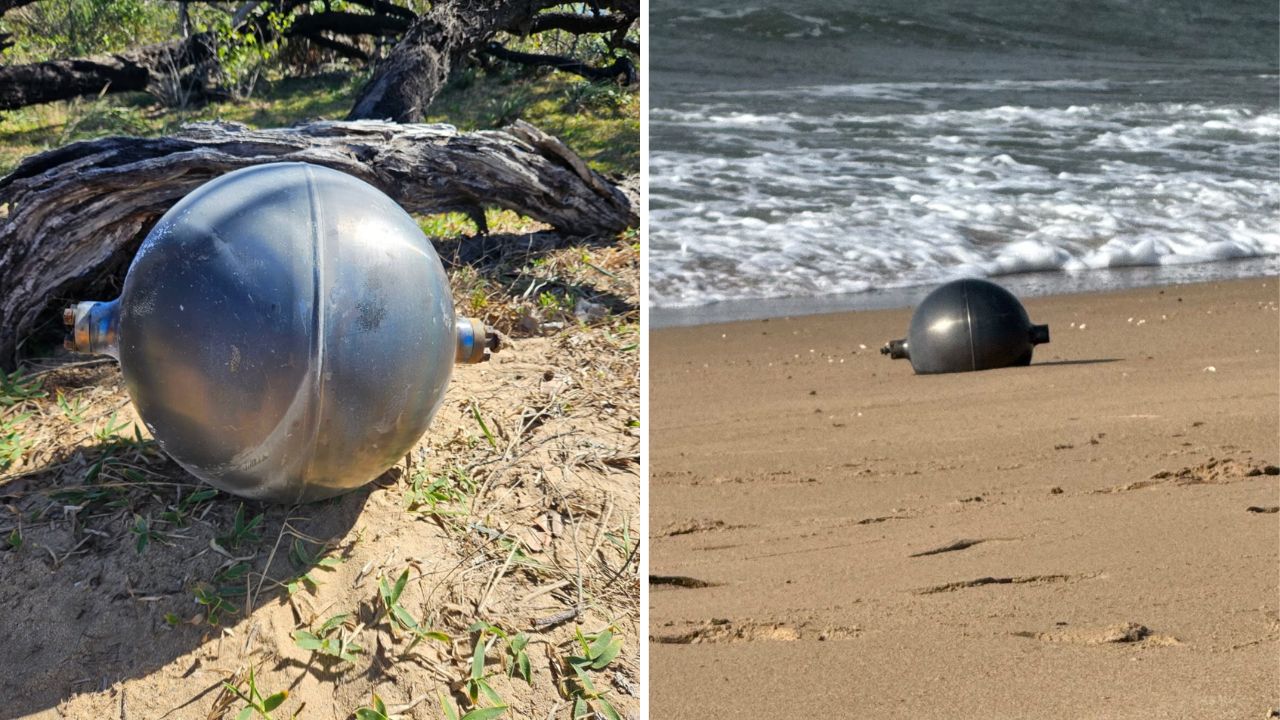
Six pieces of suspected space debris have been found washed up on multiple beaches on north Queensland.
The Queensland Fire Department were called to Townsville, after large spheres were found washed up on the Forrest Beach area on Sunday.
A total of six objects had been found, with five of them “secured into drums” and a sixth “rendered safe” on Sunday, according to a spokesperson for the fire department.
The Australian Space Agency confirmed they are working to determine the nature and origin of the objects, after it was initially suspected of containing hazardous chemicals.
“The Australian Space Agency is supporting local authorities in relation to suspected space debris located at Forrest Beach in North Queensland. The Agency is working to determine the nature of the debris and its origin,” a statement from the space agency read.
Police said there was “no danger to the local community and police are not investigating the incident”.
More debris could turn up over the next few days and while it is not dangerous, locals should check the official information provided by the Australian Space Agency.
Space archaeologist and space junk expert at Flinders University, Associate Prof Alice Gorman, said that based on existing coverage, the objects did not appear to have evidence of burning or scorching, meaning that it may have been from the early launch stages.
“This suggests they might be from a rocket stage – perhaps a first or second stage – that has fallen back to Earth while the rest of the stage goes on to deliver a payload into space,” she said.
“They look to be consistent with what you find as part of a fuel system. They are pressurised fuel vessels made of titanium alloys with a very high melting point.
“They’re actually known as space balls and they can be found years after a launch. It is perhaps not something that anyone would have seen [landing].”
She said that if the objects were space balls, they could have contained leftover hydrazine – a highly toxic rocket fuel.
According to the associate professor, space balls were “the most frequent piece of space junk” and had been found all over the world.
“Space junk most commonly flies in over the sea, but Australia is a very big land mass so we do get a reasonable amount of space junk,” Gorman said.
She added that the increase in space launches meant that space junk has been a growing problem, with more than 30,000 pieces of debris estimated to be orbiting the planet.
“Space junk most commonly flies in over the sea, but Australia is a very big land mass so we do get a reasonable amount of space junk,” she said.
“We’ve had more space launches in the last five years than in the whole of history. That means there are more re-entries happening.”
Image: Queensland Fire Department