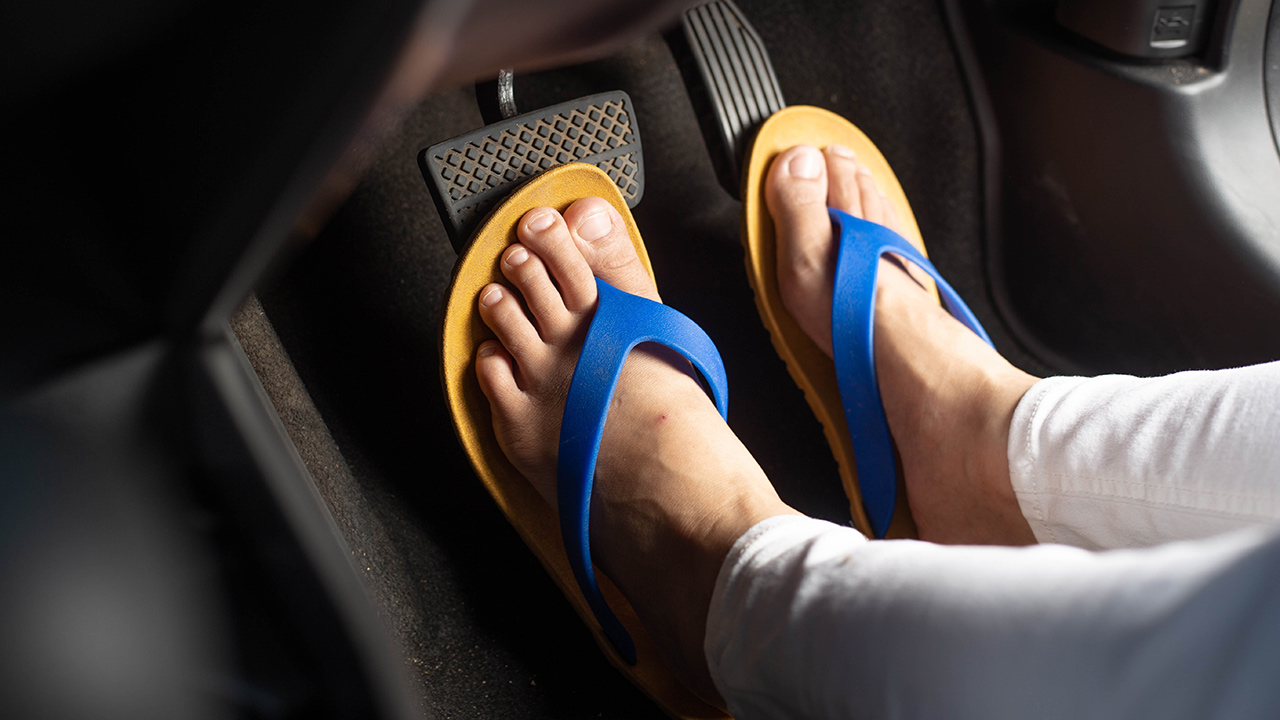
Every summer, without fail, someone asks the same question at a barbecue or in the comments of a driving forum: is it actually illegal to drive barefoot in Australia? The honest answer is no – not in a single state or territory. But before anyone kicks off their thongs for a quick trip to the shops, there is a catch worth knowing, and it has nothing to do with fines for bare feet themselves.
No Australian jurisdiction has a specific law banning barefoot driving. It carries no automatic fine and no demerit points on its own, and the myth that it is somehow against the road rules has persisted for generations without ever being true. The confusion runs so deep that curious drivers overseas have gone looking for a definitive answer too – in the United States, one driver in the 1990s wrote to every one of the 50 state motor vehicle departments asking the same thing, and every state eventually wrote back confirming it was legal.
The question tends to resurface each year as the weather warms and long weekends roll around, when thongs, sliders and bare feet become the default footwear for short errands. With the October long weekend on the horizon, it is a fair moment to think about what is actually in the car rather than what is on your feet.
What the law actually cares about
What is illegal everywhere in Australia, regardless of what is on your feet, is failing to maintain proper control of the vehicle or failing to give full attention to the road. Those broader rules apply whether you are wearing boots, thongs or nothing at all, and they can still attract fines and demerit points if a driver fumbles a pedal or reacts too slowly. In other words, bare feet are not the offence – losing control is.
EzLicence, a driving school resource often consulted on this exact question, puts the practical concern plainly: “The curves of your feet don’t provide the best surface area for your break or acceleration pedals.” That is not a legal warning so much as a physical one – it is about grip and feedback, not paperwork.
Why the pedal feel matters more than the paperwork
The real risk sits in the moment of a sudden stop. Bare feet do not offer the same contact a shoe sole provides, and a hard press on the brake can cause pain across the heel or sole that briefly delays a second response if one is needed. It is a small window, but on the road small windows matter.
Ironically, some of the footwear people reach for instead can be worse. Loose sandals, thongs, high heels or shoes with long laces are flagged by legal commentators as a greater practical hazard than bare feet, because they can slip off entirely or catch underneath a pedal at the worst possible moment. Even overseas, the rules acknowledge this nuance – Alabama, for instance, allows barefoot driving of a car but makes it illegal to ride a motorcycle without shoes, showing that footwear risk is judged by vehicle type, not blanket morality.
The part that can still cost you
Here is the twist that matters most for anyone weighing up whether to worry about this. Even though barefoot driving breaks no law, being barefoot at the time of a crash can still be raised by an insurer or in court as a factor in shared fault, if it is judged to have contributed to delayed braking or lost control. Nothing was broken, legally speaking – but the question can still be asked, and it can still shape how blame and cost are divided afterwards.
That is the gap between “legal” and “sensible” that catches people out. A driver can be entirely within their rights and still find themselves explaining bare feet to an insurance assessor after a collision that was, on paper, nobody’s fault but the other driver’s.
Before your next drive, it is worth confirming your own state’s specific wording if you want full peace of mind, since general control-and-attention rules are consistent but always best read in your own jurisdiction’s road rules. It also pays to double-check with your insurer how footwear questions are handled in a claim, since practices can vary between providers.
The simplest fix costs nothing and takes no effort at all: keep a proper pair of flat, snug-fitting shoes in the car, even if thongs are comfortable for the rest of the day. It will not change what the law says – bare feet were never illegal, and never will be – but it removes any question of fault before it can ever be asked, and gives your foot the grip it deserves when it matters most.