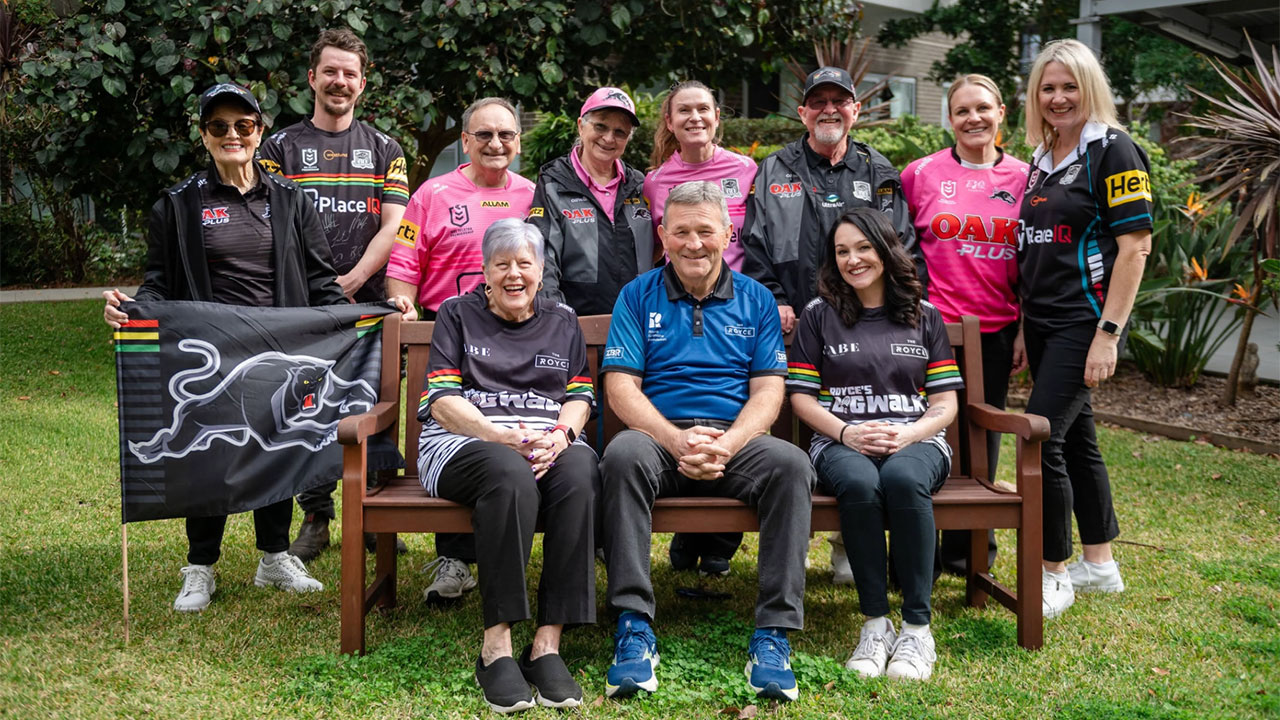
Rugby league legend Royce Simmons has spoken candidly about his worsening battle with dementia as he once again puts one foot in front of the other for a cause that has become the fight of his life.
The Penrith Panthers great has embarked on his fifth annual Royce’s Big Walk, a gruelling 320km trek through regional NSW to raise money for dementia research and support families living with the disease.
For the 1991 premiership-winning captain, however, this year’s walk carries an added poignancy.
Simmons, who was diagnosed with early-onset dementia in his early 60s, has revealed his memory is continuing to deteriorate, describing the progression of the disease as a series of increasingly difficult “dips”.
“Everyone’s probably different, but I’ve sort of gone along like I didn’t notice too much, but then you have a bit of a dip,” Simmons told AAP.
“Then you flatten out and you dip a bit again. I don’t think I’ve got too many more dips left. My memory’s getting pretty ordinary.”
It is a confronting admission from a man who built his reputation on toughness.
Known affectionately as “Simmo”, Simmons played 238 first-grade games for Penrith and represented NSW and Australia during a decorated career. He famously scored two tries in the Panthers’ breakthrough 1991 grand final victory over Canberra, including the match-sealing try in the dying minutes.
More than three decades later, he is tackling an opponent of a very different kind.
Rather than retreat after his diagnosis, Simmons has thrown himself into raising awareness and money for dementia research, turning Royce’s Big Walk into an annual event that has drawn support from across the rugby league community.
This year, Simmons began his journey in Gilgandra on Monday and will eventually finish in Cowra next Friday after covering 320km. Along the way, he will be joined for sections of the trek by some familiar rugby league faces, including Brad Fittler, James Maloney, John Skandalis and Tony Butterfield.
But there is another old rugby league mate accompanying Simmons in spirit.
The 2026 walk is being held in honour of much-loved Panthers player and clubman John Farragher, who died last year.
Farragher was just 21 and playing only his seventh first-grade match when a collapsed scrum left him a quadriplegic. Despite the devastating injury, he remained an integral part of the Panthers family for almost another 50 years.
Penrith has since established a memorial garden in his honour opposite the training field at the club’s centre of excellence.
Fittingly, Simmons chose Farragher’s hometown of Gilgandra as the starting point for this year’s journey.
The walk will take Simmons through plenty of rugby league heartland, including Dubbo, hometown of current Panthers co-captain Isaah Yeo.
And while the kilometres will undoubtedly hurt, the purpose behind them remains clear.
Simmons hopes this year’s fundraising will generate enough money to fund two dementia research programs, while continuing to provide assistance to families whose lives have been turned upside down by the disease.
There are an estimated 446,500 Australians currently living with dementia, and Simmons is determined to use the time and profile he has to make sure their experiences are not forgotten.
“You can’t get the message out there enough about awareness,” he said.
“What’s happened lately is it’s starting to kill young people and people don’t realise that either, they think it’s an old people’s disease.
“We need to work hard and find an answer.”
For Simmons, that search for an answer has become intensely personal.
He knows the road ahead with dementia is uncertain. He knows his memory is not what it once was. But for now, he can still walk.
So that is exactly what he is doing — 320 kilometres, one step at a time, for an old mate, for hundreds of thousands of Australian families and, hopefully, for a future in which fewer people have to face the same diagnosis.
Image: Facebook