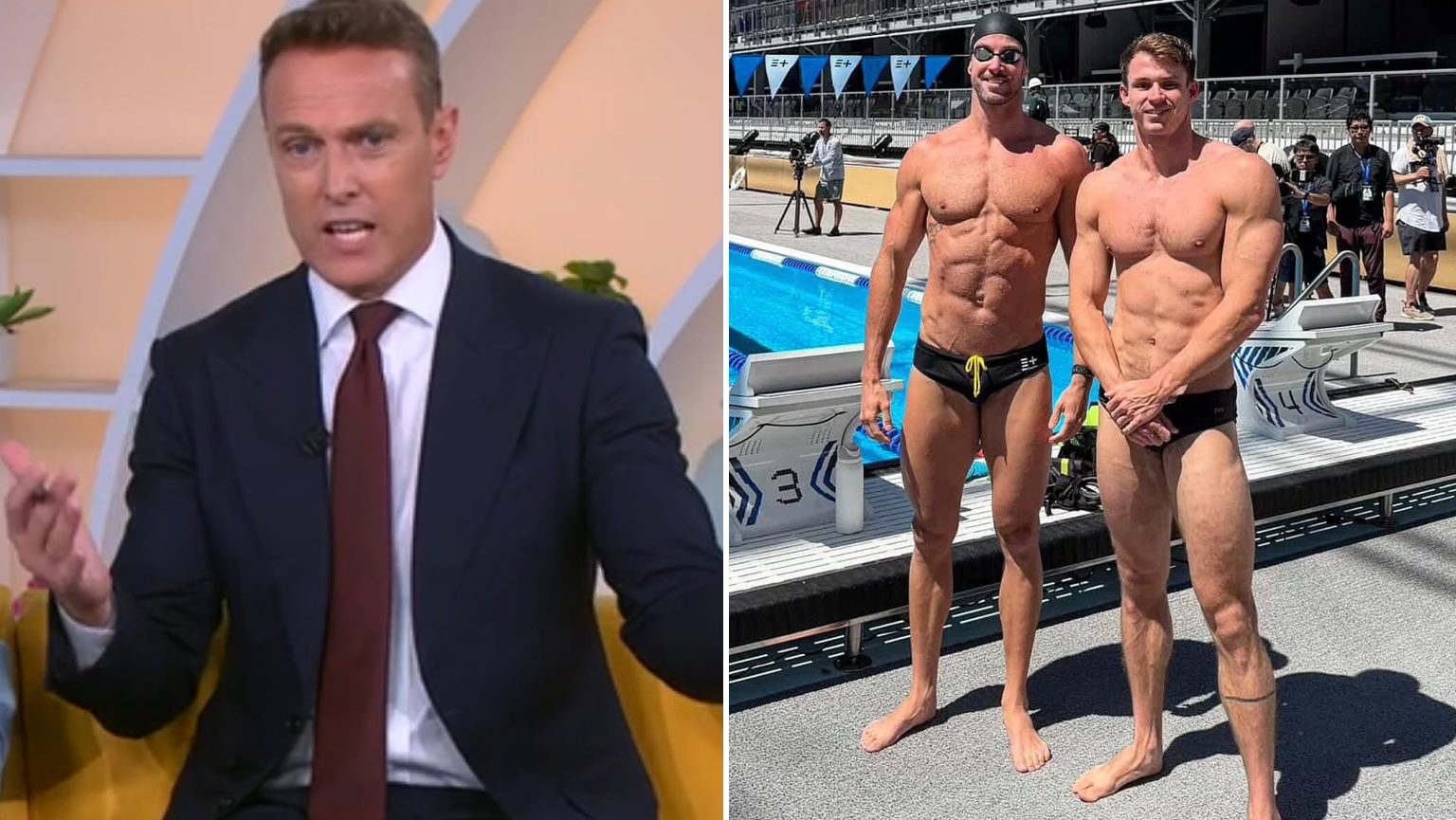
Sunrise host Matt Shirvington has delivered a scathing assessment of the controversial Enhanced Games, casting doubt on how far organisers might be prepared to go to produce world records.
Labelled the “Steroid Olympics” by critics, the Las Vegas event has drawn worldwide attention. Olympians including James Magnussen are competing with the use of performance-enhancing drugs for a share of $35 million in prize money across swimming, athletics and weightlifting. Athletes can also collect $1 million bonuses for world records.
Organisers insist the event is simply regulating what they say already occurs in elite sport. Shirvington, however, said he was deeply sceptical about whether any records set at the Games could be viewed as legitimate.
On Sunrise, the former Australian Olympian questioned whether the event’s set-up itself could be manipulated in a bid to make the competition look successful.
“Has anyone measured the pool, has anyone measured the length of the track itself? The idea that they have to get a world record to prove it’s going to be successful, how do we even know that the length of the track is right? Who knows, maybe its a 98 metre track,” Shirvington said on Sunrise.
Olympic gold medallist Sally Pearson said she was curious to watch the Games unfold from a scientific point of view, but remained firmly opposed to drug use in sport.
“I know that there’s probably about 10 per cent of athletes that won’t be using the banned substance, and I would really be cheering for those guys,” Pearson said.
“We come from a traditional sporting background, where there’s no drugs allowed in the sport. So I think as an ethics point of view, it is quite hard for us to understand this.”
Pearson also backed Shirvington’s concerns about the pressure on organisers to produce record-breaking performances.
“I would hope that we’re not going to see a world record in the mens 100 metres,” she said, agreeing they could go to extreme lengths to prove the Games were a success,” he said.
Reports discussed on the program claimed 90 per cent of competitors are using testosterone, 79 per cent are taking human growth hormone, while others are reportedly using Adderall and anabolic steroids.
Shirvington also raised concerns about the lack of transparency around how those substances are being administered and monitored.
Dr Zac Turner said full details of the drug regimens should be made public for scientific scrutiny.
“They’re going to be on five, or six, or seven different types of medications… they’re stimulating themselves before the race, and then they’re doing a whole lot of other things pre and post, and they’re not giving us what they’re doing to keep it safe,” he said.
When asked whether she would ever consider taking part, Pearson was emphatic.
“Definitely not. I’ve always been so against the drugs in the sport as well,” she said.
“I was always terrified that if something like that ever happened to me, I would have a heart attack on the spot.”
“I wanted to be the best athlete in the world, but there’s certainly lines that I would never cross.”
Turner warned the health consequences linked to the drugs being used are severe and widely documented, including heart attacks, strokes and irreversible cardiovascular damage in young athletes.
“These aren’t vitamins we’re talking about. We’re talking about athletes taking doses of hormones and steroids that are far greater and far more than the body would ever naturally produce,” Turner said.