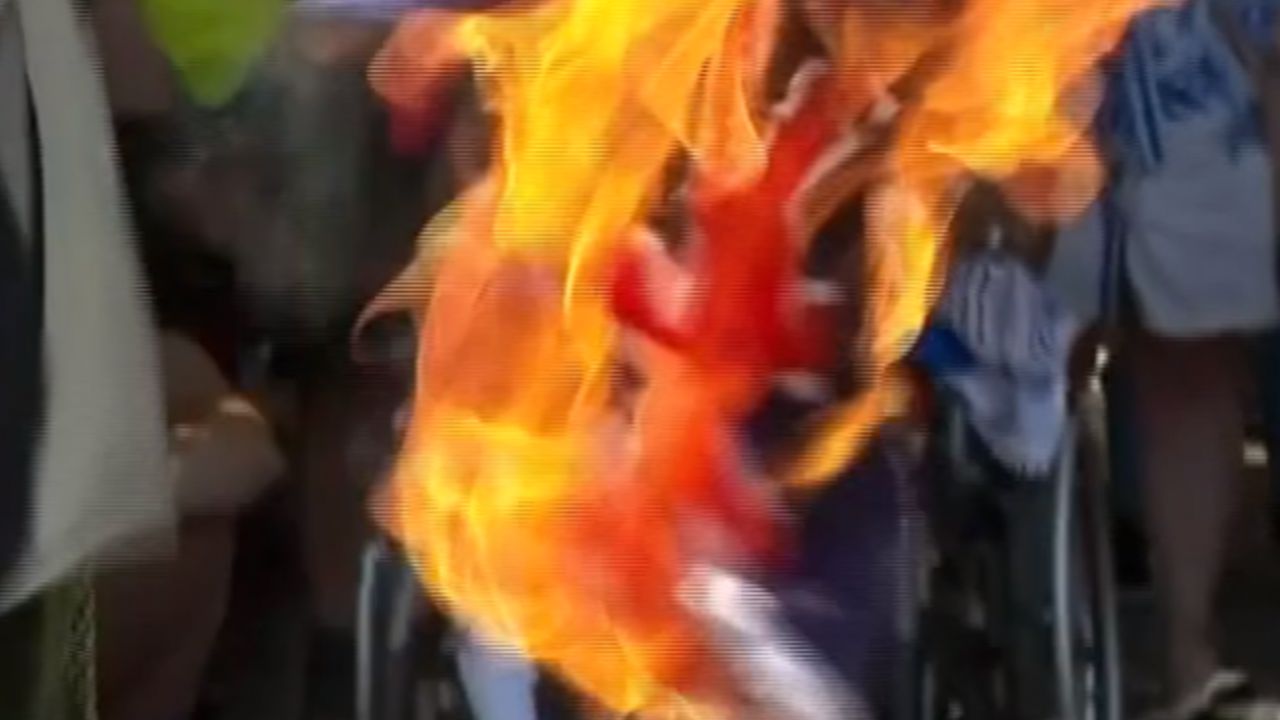
Two federal MPs have introduced separate bills that would criminalise the burning of the Australian National Flag, following an incident at an Invasion Day protest where a demonstrator set the national flag alight.
Nationals backbencher Pat Conaghan introduced an amendment to the Criminal Code seeking to prohibit “the burning, destruction, desecration or other serious dishonouring of the Australian National Flag or the Australian Red Ensign”.
Conaghan told the House of Representatives on Monday that his bill had “been called for by millions of Australians” and would impose “serious consequences” on those who desecrate national symbols.
“Mr Speaker, the Australian flag and the Australian Red Ensign are not abstract ideas,” he said.
“They are not props for political theatre. They are national symbols earned through sacrifice, service and a shared history.
“And when those symbols are burned or deliberately desecrated, it is not an act of harmless protest.
“It is an act that strikes at the heart of our nation, our respect and our cohesion.
“That is why we must seriously consider making the burning or desecration of the Australian flag and the Australian Ensign a criminal offence.”
Under the proposal, a first offence would carry penalties of up to $16,500 or 12 months’ imprisonment.
A second offence would attract a mandatory minimum sentence of 12 months, while non-citizens could also face visa cancellation.
Independent MP Rebekha Sharkie introduced a separate bill that would also extend protections to the Aboriginal and Torres Strait Islander flags.
Her proposal includes a maximum two-year prison sentence for a first offence and a minimum one-year sentence for subsequent offences.
“Burning a national flag is a criminal offence in many nations,” Sharkie told parliament.
“In France, the home of protest. In Germany, up to three years. Italy, Switzerland, Spain, Poland.
“Across Asia, it’s an offence in India, the Philippines, Singapore, South Korea, or indeed, Israel.
“Across the Americas, whether you’re in Argentina, Brazil, Cuba or Mexico or even Nicaragua, it recognises that to burn or desecrate the national flag is a criminal offence.
“And in New Zealand, our neighbours, it carries … up to a $5000 fine.”
Sharkie said she was “very surprised” the Albanese government did not support a previous opposition amendment to anti-hate law reforms that would have made burning the Australian flag a criminal offence.
“The government didn’t accept that,” she said.
“The government rejected that amendment.
“So this bill actually seeks to bring us all together to look at all three national flags and say the same rule should apply.
“And it also draws a line in the sand that says this behaviour is unacceptable.”
Both bills are scheduled to be debated in parliament on Tuesday.
Image: Sunrise