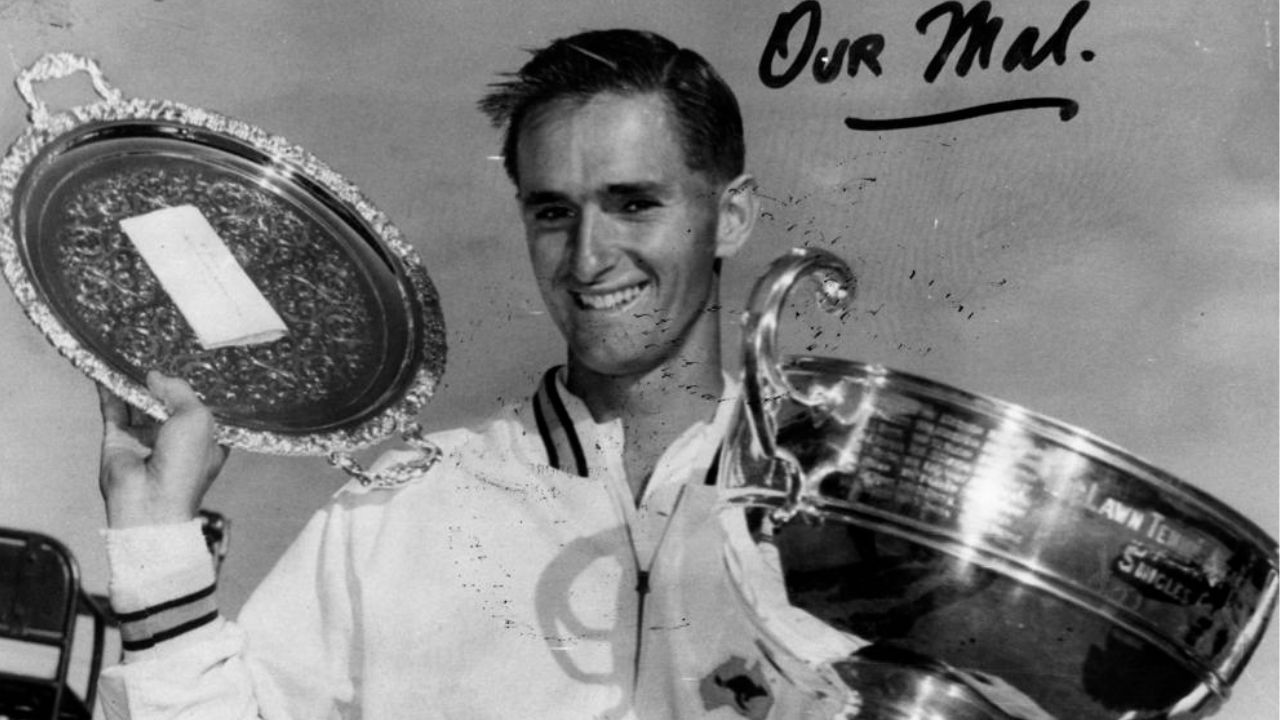
Four-time grand slam champion Mal Anderson has passed away aged 91.
The Queenslander, who grew up on a cattle station in the small town of Theodore, is known for winning the 1957 US Open singles title and three major doubles titles.
Growing up in the small town, Anderson’s father built him a tennis a court on the property out of dirt and ant nests. As a boy, he played against the Laver brothers, who had a similar court built on their family property near Rockhampton.
“I just loved tennis from the earliest age. I was addicted to it and it became my life,” Anderson once reflected.
His breakthrough came in 1956 when he played in the Australian Championships semifinal, where he lost to Ken Rosewall.
The following year he made his singles title win at the US Open and both the Australian mixed doubles and French doubles championship.
Anderson married fellow tennis player Roy Emerson’s sister Daphne, and the couple went on to have three children together.
“On his day Mal was capable of playing any shot in the book and he had a fantastic serve,” Roy Emerson said.
After a brief professional career, Anderson ran a successful tennis and squash centre in Brisbane.
While semi-retired in 1972, he came in second to Ken Rosewall at the Australian Open, and played in the early rounds of the Davis Cup the following year.
After retiring, Anderson mentored young aspiring tennis players including Pat Rafter, Scott Draper, Wally Masur and John Fitzgerald.
“I was really sad to hear of Mal’s passing. He was one of those people who helped shape my tennis from very early on,” Pat Rafter said.
“He took me overseas for the first time, over to Wimbledon, and introduced me to what the professional game looked like and what it meant to carry yourself properly around it. For a young Aussie kid coming through, that was a pretty special thing to have someone like Mal do for you.
“I still remember being at Queen’s Club in London and hearing the reception he got when his name was announced – the whole place stood up for him. That told you everything about the respect people had for him, not just here in Australia but around the world.
“He was a true legend of the game, but more importantly he was a terrific bloke – humble, generous with his time and always happy to help younger players along.
“Tennis in Australia has lost one of its greats, and a lot of us have lost a mate and mentor. I feel very lucky to have known him.”
Draper recalled how Anderson taught them to give back to the support, saying: “Mal was someone I looked up to from a very young age. I had my first tennis lesson from Mal at five. Our family spent every weekend playing tennis at his centre, it was a home away from home.
“In my teens, I was part of the Mal Anderson high-performance squad with my brother Mark. Mal was the epitome of fitness and professionalism and role-modelled the highest standards, inspiring all of us to be better.
“I was lucky to travel with him on his Mal Anderson Exhibition tours, which are an incredible legacy. He took tennis to the regions and took young wannabes like me with him. We learned how to coach and play exhibition matches. Mal was a joy to be around, humility personified and always took genuine interest in your life. A great bloke and his legacy will definitely live on in me.”
Masur remembered Anderson for his professionalism.
“I first met Mal when he took 10 youngsters on a satellite circuit around country NSW in about 1979,” Masur said.
“If you were out of the tournament he made you run at 6.30am, punishing runs that usually brought up the contents of my stomach. He did every one of those runs with us and did them easily.
“Then it was four or five hours on the practice court, and he hit for every minute of those hours. Never a critical word, just encouragement and he was with you every step of the way. I’ll leave it to his peers to judge where he sits in the pantheon of Australian tennis greats, but what a gentleman and an inspiration he was to a young player trying to make the tour.”
Former Davis Cup captain John Fitzgerald also paid tribute.
“He played a sliding-door role in my life when I was one of about 10 young guys who he took on a five-week Satellite Tour in the eastern states around 1978/79,” he said.
“He taught me what it took to train and work if you wanted to be a player. It was a light-bulb realisation for me and helped my direction enormously. That was when the penny dropped for me on what is involved if you want to be successful in this sport.”
Image: Wikimedia Commons