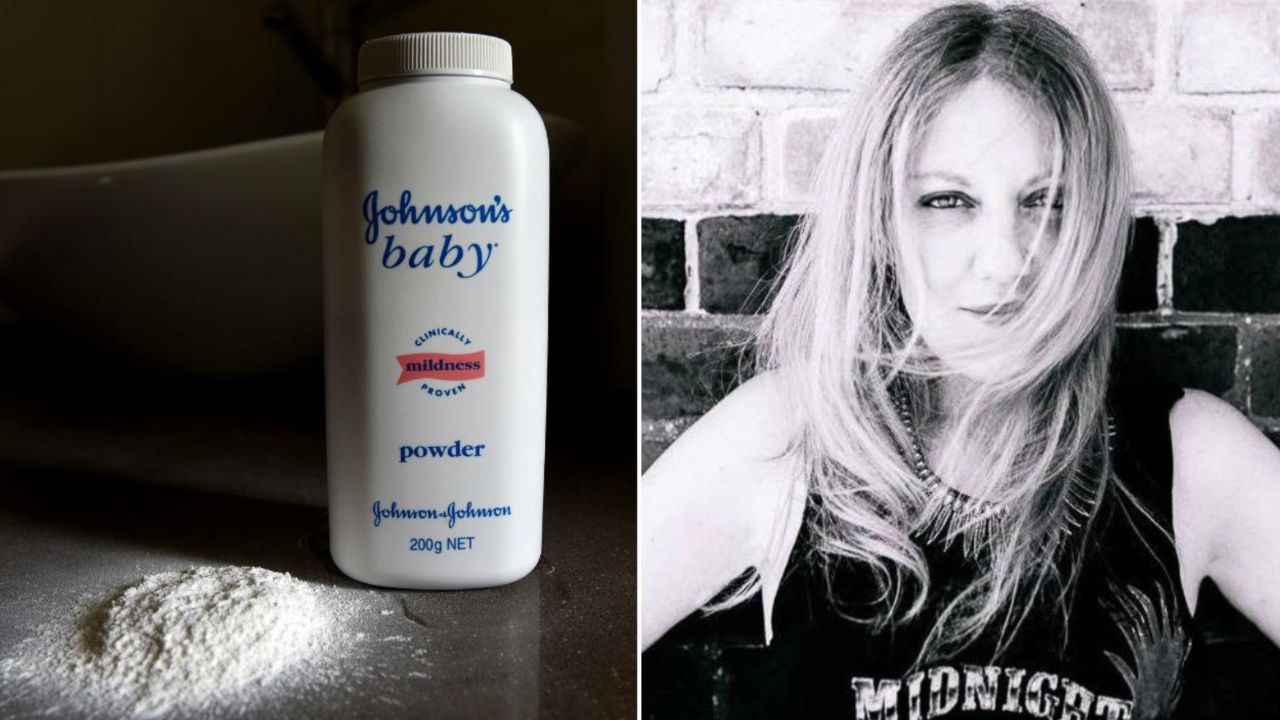
Amanda Bradley was only 34 when she was diagnosed with ovarian cancer, which “turned her life upside down”, as she was forced into early menopause and a complete hysterectomy.
Now aged 45, she is one of over 1,300 Aussie women who have registered for a Supreme Court of Victoria class action against Johnson & Johnson, claiming that their talcum powder caused cancer in women.
“I went from being a healthy young woman to a cancer patient overnight,” Bradley said.
“After experiencing severe bloating and a swollen abdomen, I was ultimately diagnosed with a large, cancerous, ovarian cyst, leading to aggressive treatment, and a complete hysterectomy.
“I live with the mental and physical impacts every day … I should have been thinking about starting a family — how does anyone ever recover from never being given the chance to carry their own children?!”
Talc, which is a naturally occurring mineral mined worldwide can sometimes be contaminated with asbestos, as they’re often found together underground.
Even with modern testing, experts say that eliminating asbestos from talc is extremely difficult.
The World Health Organization (WHO) and other authorities recognise that no level of asbestos exposure is considered safe.
The class action claims that Johnson & Johnson’s talcum powder products are linked to ovarian and other reproductive cancers, as well as mesothelioma – an asbestos-linked cancer of organ linings.
“Australians and people across the world trusted Johnson & Johnson’s products for decades, applying talc to their and their babies’ bodies under the assumption that it was safe to do so,” Shine Lawyers head of class actions Craig Allsopp said.
“To find out that it wasn’t safe is a deep betrayal of consumers’ trust.”
Shine Lawyers class actions practice leader Sarah Thomson said the class action will allege that Johnson & Johnson’s talcum powder products were “defective, unsafe and unfit for purpose and not of merchantable quality” under consumer law, and that the company was negligent.
“We have heard from numerous women like Amanda who believe their cancers were caused by applying Johnson & Johnson’s talc to their bodies, including their genital region,” she added.
“Some believe their cancer or mesothelioma was caused by inadvertently inhaling the talc when it was applied.”
“This class action seeks accountability and compensation for women and families who have suffered immensely.”
The law firm is urging woman who regularly used Johnson & Johnson’s talc between 1971 and 2023 and were later diagnosed with ovarian, fallopian tube, primary peritoneal, endometrial, uterine, vaginal or cervical cancer or mesothelioma to come forward and register their interest.
The Australian class action comes after the US courts delivered verdicts against the company over similar claims.
In California, Johnson & Johnson were ordered to pay US$966 million (about A$1.38 billion), including about $16 million in compensatory damages and $950 million in punitive damages to the family of a cancer victim after they were found liable for asbestos-linked cancer.
The company has fought to settle or shield claims through repeated bankruptcy strategies, but their proposals have been rejected.
The class action in Australia is ongoing, with the investigation first launched in 2023, and the hearings are expected to run over the coming months.
Image: Shine Lawyers