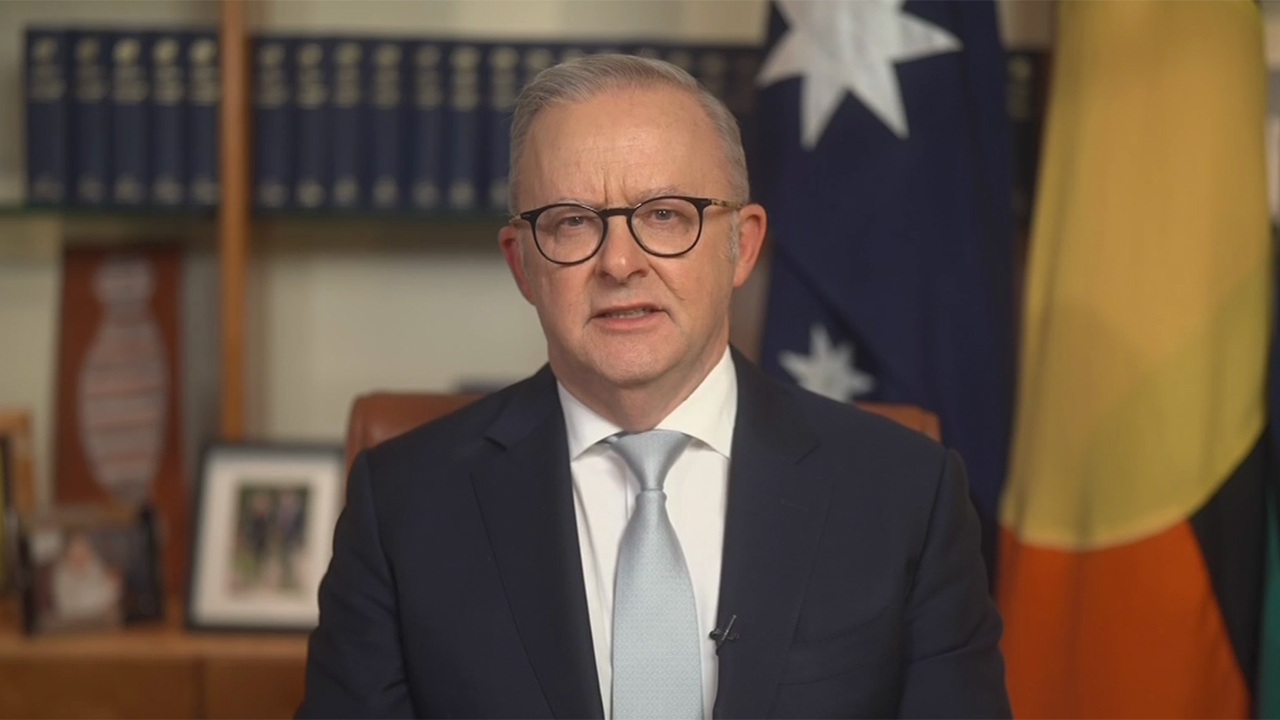
Prime Minister Anthony Albanese has warned Australians to brace for months of economic fallout from the war in the Middle East, urging households to conserve fuel where possible in a rare prime-time address to the nation.
In a short televised speech broadcast across all major networks, Albanese said the government would do “everything we can to protect Australia from the worst of it” as petrol and diesel prices surge to record levels.
While encouraging Australians to “go about your business and your life as normal”, the Prime Minister called for restraint ahead of the Easter holidays, asking motorists not to overfill and to consider public transport where practical.
“It’s hard to be positive,” he said, describing the conflict as having caused “the biggest spike in petrol and diesel prices in history”.
“Australia is not an active participant in this war, but all Australians are paying higher prices because of it.
“I know that you’re seeing this at the servo and at the supermarket, and I understand farmers and truckies, small businesses and families are doing it tough. The reality is, the economic shocks caused by this war will be with us for months.”
The address, however, drew swift criticism from Opposition Leader Angus Taylor, who said it lacked detail and failed to provide clarity on fuel supply.
“I think we needed more detail and we needed a clear plan,” Taylor said, arguing the speech repeated earlier messaging without addressing key concerns.
“There’s a lack of confidence around Australia. There’s confusion around Australia about the state of the fuel system.”
Taylor said the government should have outlined how it plans to manage fuel shortages and provided clearer information on national supply levels.
Concerns were echoed by National Farmers’ Federation president Hamish McIntyre, who said farmers were being left to make difficult decisions amid rising costs.
“We support all initiatives the prime minister has announced … but at the same time, Australian farmers are having to make very tough decisions at the moment,” he said.
Public reaction online was mixed, with some viewers expressing frustration at the lack of new information.
“Waited all day for that … could have been an email,” one commentator wrote, while another said: “What was the point of that?”
Economist Chris Richardson said the address offered general reassurance but stopped short of answering critical questions.
“The key question for families and businesses and the wider economy was that enough – did we need more detail of reassurance around the fuel coming in and what we can and should do with fuel?” he said.
Richardson noted that while governments can soften the blow, they cannot eliminate the economic impact of global conflict.
“Governments don’t have a magic wand to wave. The war in the Middle East has made families in Australia poorer, making it harder for our dollars to stretch,” he said. “Governments and the Reserve Bank can move around that pain, but they can’t make that pain disappear.”
Image: 9Now