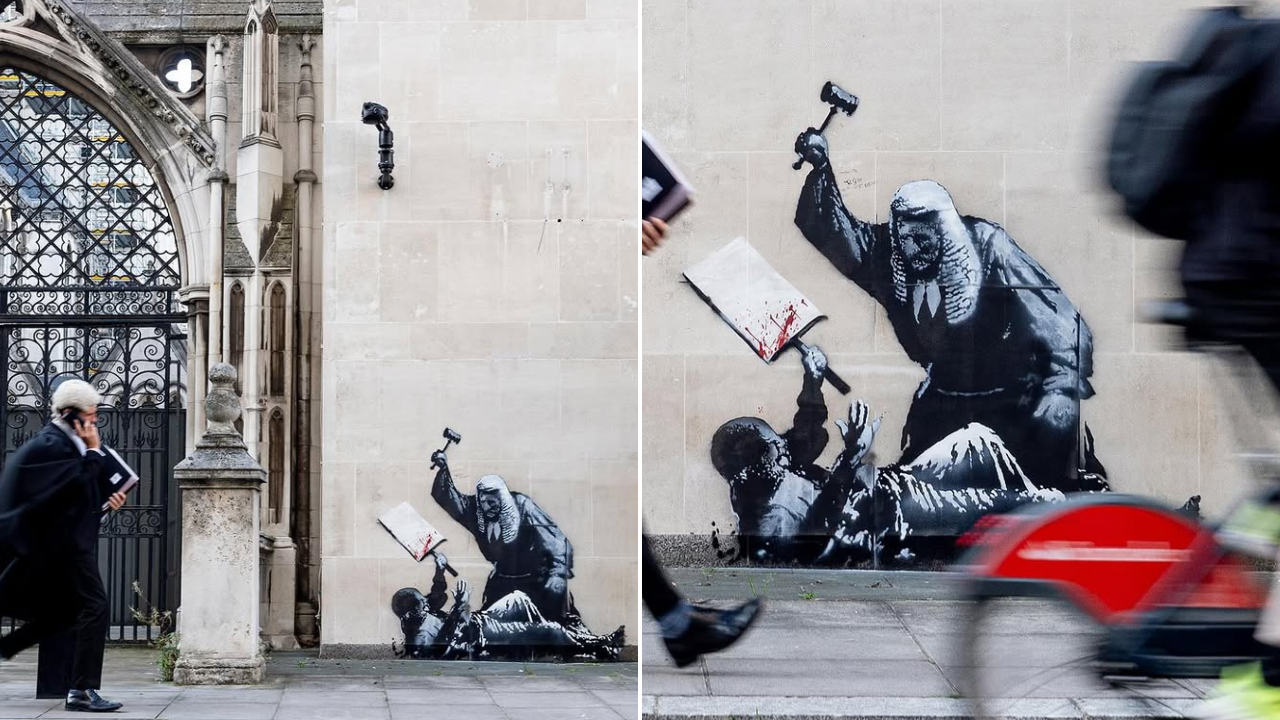
A new mural by the elusive street artist Banksy appeared overnight on the walls of the Royal Courts of Justice in London, only to be quickly covered by security.
The artwork is thought to respond to the recent arrests of hundreds of demonstrators supporting the banned group Palestine Action.
Banksy shared images of the mural on Instagram on Monday, September 8, captioned: Royal Courts of Justice London.
By midday, the artwork had been fenced off and hidden from view, with guards also installing CCTV cameras at the site.
The mural shows a judge striking a protester with a gavel, while the protester clutches a blood-stained placard as they are knocked to the ground.
The Instagram post has racked up millions of likes and thousands of comments, with fellow artist Arron Crascall writing, “He’s back!” and a flood of comments that simply read, “Free Palestine”.
It follows the arrest of nearly 900 people at a London demonstration on September 6 opposing Palestine Action’s ban. In recent weeks, hundreds of the group’s supporters have been detained at similar protests.
The Royal Courts of Justice, home to the High Court, is a Grade One listed building, giving it the highest level of historical protection in England.
Because the building is 143 years old, HM Courts and Tribunals Service (HMCTS) said the mural will be removed with care for its historical significance.
“The Royal Courts of Justice is a listed building and HMCTS are obliged to maintain its original character,” HMCTS said in a statement.
This is Banksy’s first artwork since May, when he created an image of a lighthouse on a wall in Marseille, France, accompanied by the stencilled words: I want to be what you saw in me.
While Banksy does not comment on his works, the London mural has been interpreted as a statement on the arrests of demonstrators opposing the proscription of Palestine Action as a terrorist group.
The UK government banned the organisation in July after members broke into a Royal Air Force base and damaged military planes.
Supporting or belonging to the group now carries penalties of up to 14 years in prison, putting it alongside organisations such as al-Qaeda and the self-proclaimed Islamic State.
Defend Our Juries, which organised the protest on September 6, said Banksy’s mural “powerfully depicts the brutality unleashed” by the government ban.
Police reported that hundreds of Palestine Action supporters have been detained in recent weeks under anti-terrorism laws, with more than 500 arrested in a single day in August. Many of those arrested were over 60.
London’s Metropolitan Police said individuals had been detained for a range of offences, including assaulting officers and supporting a proscribed organisation.
Human rights organisations have condemned the ban as excessive, saying it curtails freedom of expression and the right to protest peacefully.
Banksy has a history of highlighting conditions in Gaza. In 2015, when announcing more street art there, he described it as “the world’s largest open-air prison”, noting that Israel had largely controlled entry and exit from the Palestinian enclave for years.
In August 2005, Banksy painted several large murals on the controversial Israel-built separation barrier surrounding much of the occupied West Bank.
These included two boys making sandcastles beneath a painted gap showing a tropical beach, and a girl lifted over the wall by balloons.
In 2007, a Banksy stencil of a rat with a slingshot, later dubbed Slingshot Rat, appeared on the barrier, before being removed by unknown individuals and resurfacing in a Tel Aviv gallery in 2022.
Banksy opened the Walled Off Hotel in Bethlehem in 2017, marketed as having the “worst view of any hotel in the world”, overlooking the barrier. The hotel closed in October 2023, citing “major developments in the region” following the Hamas-Israel conflict that began on 7 October 2023.
Images: Instagram