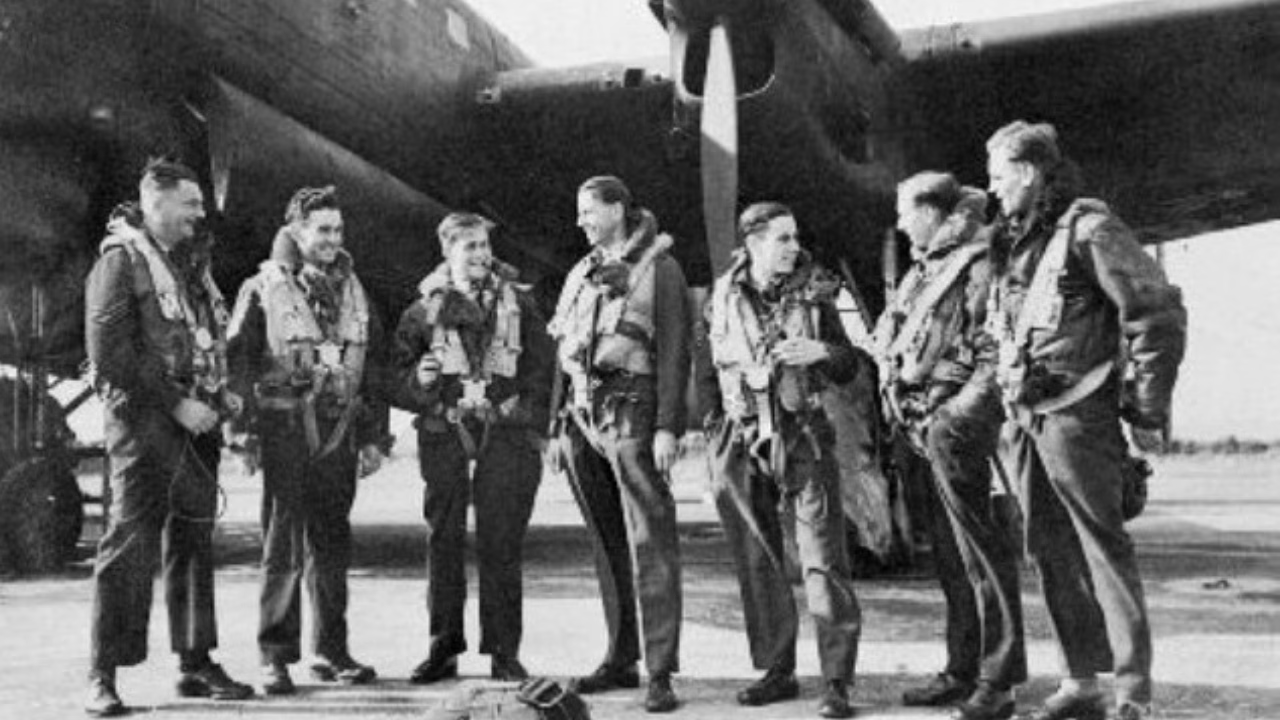
A young country boy who flew a B-24 bomber over Borneo in July 1945 did not live to see the end of World War II.
Warrant Officer Class 2 Frederick Balfe Emanuel passed away just weeks before Victory in the Pacific Day on August 15, when Japan announced its unconditional surrender to the Allies.
Emanuel, aged 22, had enlisted in the Australian army and served in Papua New Guinea before joining the Far Eastern Liaison Office, where he took part in high-risk reconnaissance missions.
He will be honoured at the Australian War Memorial on Friday as the country marks 80 years since the war touched its shores and ultimately came to a tragic end.
“His story is a heartbreaking reminder of how close some came to seeing peace yet never returned home,” memorial director Matt Anderson said.
“This is honouring a country boy who became a Sydneysider yet did not survive to finish his story.”
Other commemorations include a Royal Australian Air Force P-8A Poseidon aircraft conducting a flypast over the National War Memorial in Adelaide.
“Victory in the Pacific Day marks the end of a great darkness – brought on by the most devastating global conflict in human history,” Federal Veterans’ Affairs Minister Matt Keogh said.
“Today, we reflect on this enduring wartime legacy and remember what it took to get here, the sacrifice, the sorrow and the strength. Lest we forget.”
Australia played a major role in the Pacific theatre during World War II, fighting Japan from 1941 to 1945.
In the beginning, Australian forces were engaged in campaigns in Malaya and Singapore.
Following the bombing of Darwin in February 1942, efforts shifted to defending the Australian mainland and supporting the US-led counteroffensive in the Pacific.
RSL national president Greg Melick said the occasion was a significant moment to recognise the sacrifices of so many fallen soldiers.
“For Australians, that day meant that the Second World War was finally over,” he said.
“As the number of WWII veterans dwindle, it is vital that we commemorate their collective contribution to our liberty and way of life.”
He added that nearly one million Aussies, roughly one in seven of the population at the time, served in uniform during World War II, with almost 40,000 killed and 66,000 wounded.
Thousands more became prisoners of war, with 8,000 dying in captivity.
“The end of the war brought heartache for many families when, after years of waiting for news of the missing, they were told that their loved ones were not coming home,” Mr Melick said.
Images: Instagram