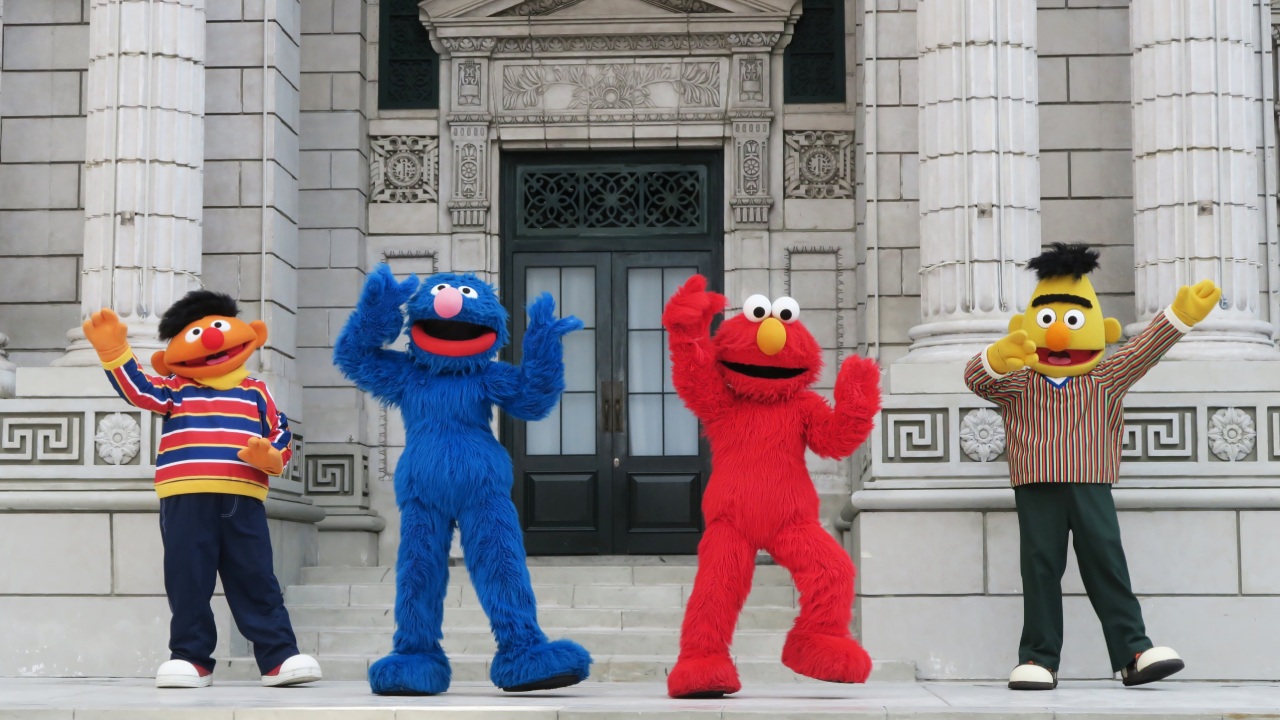
Associate Professor Helle Strandgaard Jensen based at Denmark’s Aarhus University, says while Sesame Street producers presented their content as both diverse and universal, the underpinning US values and assumptions about children often led to cultural clashes in other countries.
With children’s culture again at the centre of debates about banning or re-writing books and what makes for appropriate children’s television, Jensen says a historical approach can provide the opportunity for more informed discussions.
Sesame Street debuted on television in the US in 1969 (it came to Australia in 1971) and according to its US website: “…has made a positive impact in children’s lives ever since.”
The show says: “Sesame Street brings critical early education to children in 150+ countries”.
While Sesame Street’s universality was marketed to international audiences, Jensen says the show is shaped by US assumptions about children’s role in society, cognitive psychology and the role of media in education.
In European countries like the UK, Germany and Scandinavia there was a more progressive view about children, she says.
As a result, the program was sometimes met with hostility by foreign television producers and broadcasters.
In Jensen’s home of Denmark, Danish broadcasters rejected the show outright. Instead adapting their own children’s program Legestue to incorporate a frog named Kaj inspired by Kermit, but one that “loves jazz and talks back to adult authority”, she says.
In Germany, where ‘Sesamestraße’ is celebrating its 50th anniversary, local co-producers made their own content spliced together with US content, and added their own puppets including a piglet Purk, a snail Finchen and Leniemienie the mouse.
German produced content portrays the child at the centre, encouraging them to question authority, and often revealing the hypocrisy or flaws of adults, Jensen says. It was an approach that sometimes resulted in pushback from the US based Childrens Television Workshop, she says.
For instance, in one local clip, an adult is attending to some flowers in their garden, mowing an area of grass containing different flowers. The children ask, ‘which flowers are the good flowers?’
In another, a woman walks past a child having to do an emergency wee in public. ‘That’s disgusting!’ the woman says. But as she walks further, her dog relieves itself on the pavement, and the woman doesn’t pick it up the waste.
German Ministry of Education guides to accompany the show rejected traditional gender roles, taught children about the body and emphasised society based on collaboration, including unions.
In Europe, children’s television was seen as offering something separate to school, a way to empower children and support their own understanding of the world. The European view was more based in sociology and journalism – asking children directly about what they wanted – rather than cognitive psychology, Jensen says.
For example in the UK, television producers would survey children about what they were interested in, their views, and make content based on that.
Another key difference was the highly commercial landscape of television in the US, Jensen says. This was different to Europe and places like Australia where public broadcasters could afford to produce content for children that was more experimental.
She says reflecting on the past is important as children’s viewing is increasingly dominated by streaming platforms, many of which are based in the US and dominated by American programming.
The ABC began broadcasting Sesame Street twice-daily in 1971.
While Jensen’s book doesn’t specifically address the response to the show in Australia, she says a lot of her archival research included information shared between the public broadcasters the ABC and BBC, which had a strong co-production tradition.
“One of the ways the BBC learned about what happened in the Children’s Television Workshop and making Sesame Street was via their Australian friends in the ABC,” she says.
Jensen says as early as 1970 an Australian journalist at The Bulletin was questioning whether the show imposed American culture on children in other countries.
In the article, ‘Entertaining Australians to be Americans’, Sesame Street founder Joan Ganz Cooney says she had few reservations about imposing US culture on Australian audiences. “For good or ill the whole world is being Americanised,” she says.
Children’s Television Workshop describes the sale of Sesame Street to 26 foreign countries, including Australia, as an opportunity to study the universality of the program, according to The Bulletin.
Sesame Street: A Transnational History is set for release in Australia in May.
This article was originally published on Cosmos Magazine and was written by Petra Stock. Petra Stock has a degree in environmental engineering and a Masters in Journalism from University of Melbourne. She has previously worked as a climate and energy analyst.