The Olympics are over and as a country we are so proud of our athletes and their achievements. Sixth in the medal tally, 9 record Golds in the pool, plus we branched out into new sports. Here’s a look back at the Games that was – and why we did so well!
It’s been 16 days of non-stop action and we’ve said all of our goodbyes to what was possibly one of the most interesting Olympic Games ever held.
It can be a sad time because you can get used to watching inspiring performances every day. But the good thing is there’s only three years until we all get to watch our favourite athletes take the stage again in Paris. Plus, the Paralympics will start on the 24th August – held in Tokyo again – and that will be just as inspiring.
But back to what we’ve just witnessed at Tokyo for the 2020 Olympics. There were amazing feats achieved by athletes from many countries. As well as celebrating these, we also celebrate the countries which scored the most medals.
The countries taking part in the Olympics are officially ranked by their gold medals. If two countries equal gold medals, silver medals are counted, then bronze.
The United States of America edged out China to be the winner of the Tokyo Olympics, claiming 39 gold medals and 113 combined.
The People’s Republic of China finished in second with 38 gold medals and 88 combined.
Here in Australia, we had our enjoyed its equal-most successful Games in history with 17 gold medals, 7 silver, and 22 bronze, combining for a total of 46 medals.
This was equal to the number of gold medals we won at the Athens Summer Olympics in 2004 so it’s our equal best performance as a country.
Here’s where each country ranks after the completion of the Tokyo 2020.


Our gold rush in the pool
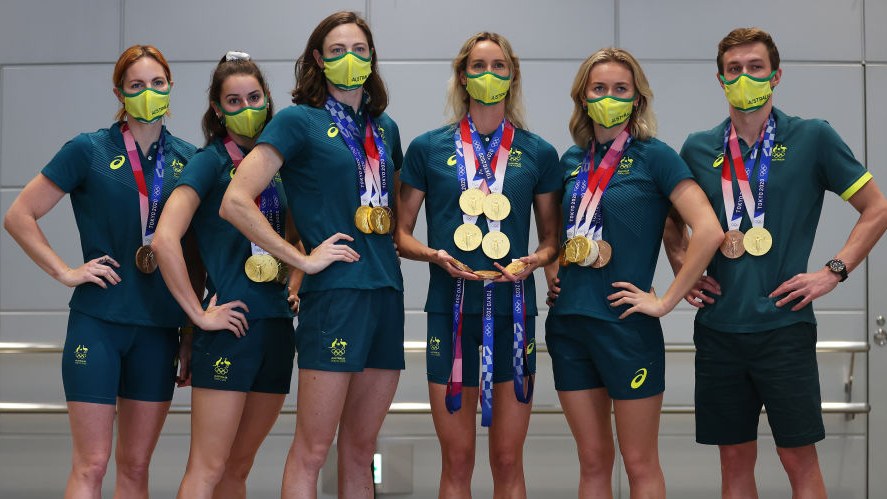
Obviously, our swimming team performed extremely well with Emma McKeon and fellow swimmers claiming nine gold medals – more than Australia’s entire Olympic team managed at each of London 2012 and Rio 2016.
This gold rush in the pool possibly reflected the relative normality that many Australians enjoyed compared to counterparts during the past 18 months.
But it led to us winning a wider range of medals. We won gold in the male and female coxless fours, gold in the men’s double kayak, gold in the canoe slalom, gold for skateboarding, gold in the BMX bike riding and two golds in the men’s sailing.
As Australia’s chef de mission for these games, Ian Chesterman said: “Success breeds success, everyone rode the wave of our early results.”
Chesterman gave some other statistics to show you how well we went. We won 46 medals from 15 sports with 59 percent of our medallists on their Olympic debut. As well, we had 118 Australians finishing fourth or fifth across individual and team events.
When asked to give his rating of this Olympics out of 10, Chesterman said: “I’d give it an 11.”
Why did we do so well this year?
The pundits are questioning what was it that helped our athletes perform so well. Was it the extra year of training – or the absence of high expectations from the Australian public because we’re caught up with lockdowns and the pandemic.
Or was it the thought of so many Australians stuck at home in lockdown which actually spurred the athletes on? Whatever it was, there’s no question the Tokyo 2020 Olympics were a huge success.
Asked this question, Chesterman said: “It’s such a complicated answer.” But he added it could have had something to do with the holistic approach to Games village life.
Others have talked about the camaraderie in the athletes’ village, which by all accounts was of a genuine level that surpassed the past two games.
This time, the Australian team had a barista, all types of nutritional treats, ice baths and as many extra services as possible. Chesterman said: “That created lots of spaces where people crossed over … people tell me the feeling we created in the village did have an impact.”
Now we have the challenge of making sure we duplicate or improve on this great success at Paris in three years’ time in 2024. After that it’s Los Angeles in 2028 and then it will be Brisbane in 2032.
But with so many young Australians inspired by the past days of inspirational performances, there’s good reason for us all to feel optimistic.

Here’s a list of Australia’s Tokyo 2020 Olympic Medallists
GOLD MEDALLISTS
- Jessica Fox
- Logan Martin
- Matt Wearn
- Keegan Palmer
- Izaac Stubblety-Cook
- Kaylee McKeown
- Emma McKeon
- Ariarne Titmus
- Bronte Campbell
- Meg Harris
- Cate Campbell
- Chelsea Hodges
- Jean van der Westhuyzen
- Thomas Green
- Lucy Stephan
- Rosemary Popa
- Jessica Morrison
- Annabelle McIntyre
- Alexander Purnell
- Spencer Turrin
- Jack Hargreaves
- Alexander Hill
- Mat Belcher
- Will Ryan
SILVER MEDALLISTS
- Nicola McDermott
- Taliqua Clancy
- Mariafe Artacho del Solar
- Kyle Chalmers
- Jack McLoughlin
- Ariarne Titmus
- Kevin McNab
- Shane Rose
- Andrew Hoy
- Lachlan Sharp
- Tom Craig
- Tom Wickham
- Matthew Dawson
- Joshua Beltz
- Edward Ockenden
- Jacob Whetton
- Blake Govers
- Dylan Martin
- Joshua Simmonds
- Tim Howard
- Aran Zalewski
- Flynn Ogilvie
- Daniel Beale
- Trent Mitton
- Tim Brand
- Andrew Charter
- Jeremy Hayward
BRONZE MEDALLISTS
- Patty Mills
- Joe Ingles
- Matthew Dellavedova
- Aron Baynes
- Jock Landale
- Matisse Thybulle
- Chris Goulding
- Josh Green
- Nathan Sobey
- Dante Exum
- Aron Baynes
- Duop Reath
- Nick Kay
- Ash Moloney
- Kelsey-Lee Barber
- Harry Garside
- Jessica Fox
- Rohan Dennis
- Melissa Wu
- Andrew Hoy
- Kareena Lee
- Owen Wright
- Brendon Smith
- Emma McKeon
- Cate Campbell
- Emily Seebohm
- Kaylee McKeown
- Izaac Stubblety-Cook
- Matthew Temple
- Alexander Graham
- Kyle Chalmers
- Zac Incerti
- Thomas Neill
- Ariarne Titmus
- Madison Wilson
- Leah Neale
- Ash Barty
- John Peers
- Jack Cleary
- Caleb Antill
- Cameron Girdlestone
- Luke Letcher
- Ria Thompson
- Rowena Meredith
- Harriet Hudson
- Caitlin Cronin
Images: Getty Images