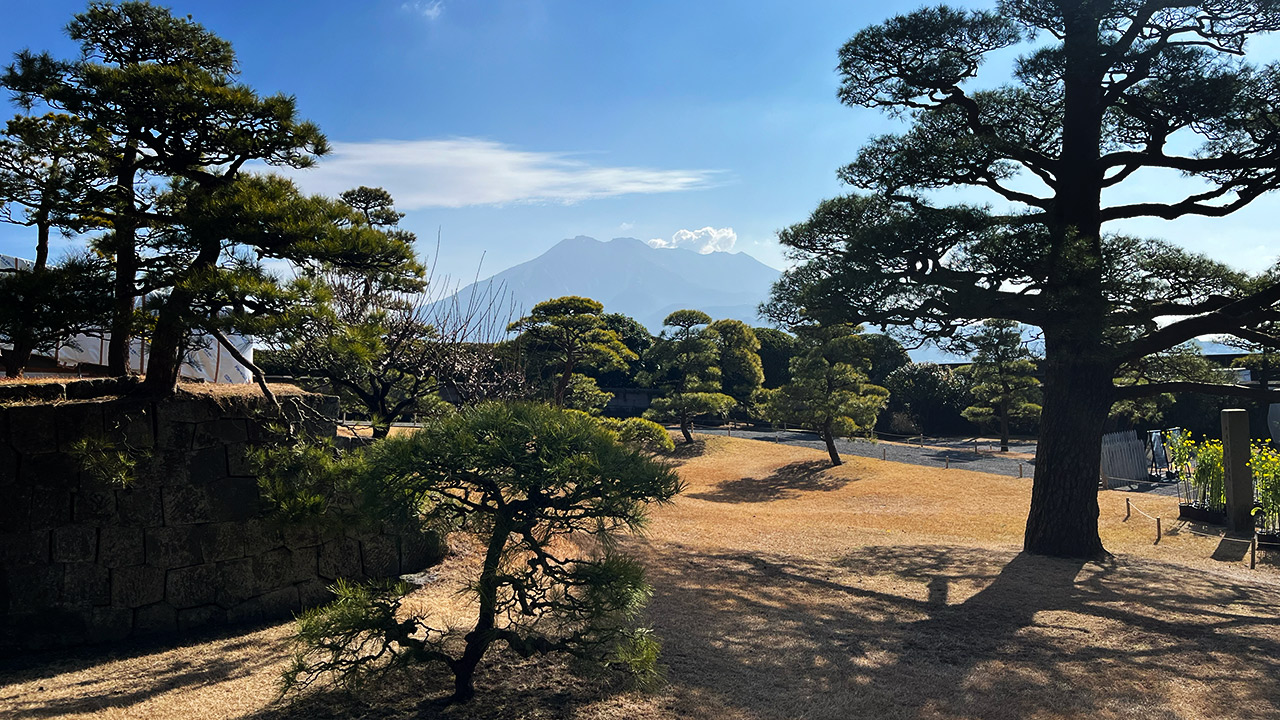
In Part III of our epic tour of Japan’s Kyushu Island, we take you into Kagoshima Prefecture – where the smoke-plumed bulk of Sakurajima looms over gardens, lava fields and late-night shochu bars alike.
Crossing into Kagoshima prefecture felt like finally stepping onto the very edge of the world. Right from the first glimpse, the great summit of Sakurajima loomed in the distance in the middle of Kagoshima Bay, still a good two hours’ drive away yet ominous steam curling visibly from its peak.
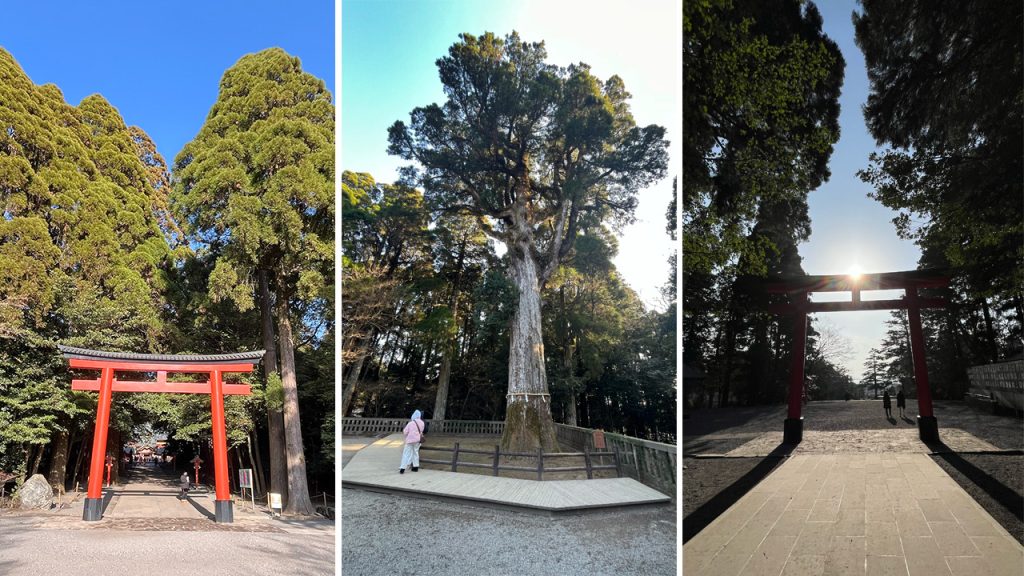
I first caught sight of it from a viewing platform at Kirishima Shrine, tucked high up in a forest where shafts of sunlight pierce the canopy. A solitary cedar in the grounds of the shrine is particularly enormous, centuries old, its weather-beaten trunk hinting at the storms and celebrations it has witnessed.
A short drive brought me to Kirishima Onsenkyo, where the town’s hot spring culture is laid bare in all its steaming glory. In fact, it’s possible to purchase naturally steamed eggs, vegetables and other items here at the steamed food stall in the plaza of Kirishima Onsen Market – where you can also take a valuable pause from travelling to soak your feet in a hot sulfur footbath, an experience not to be missed.
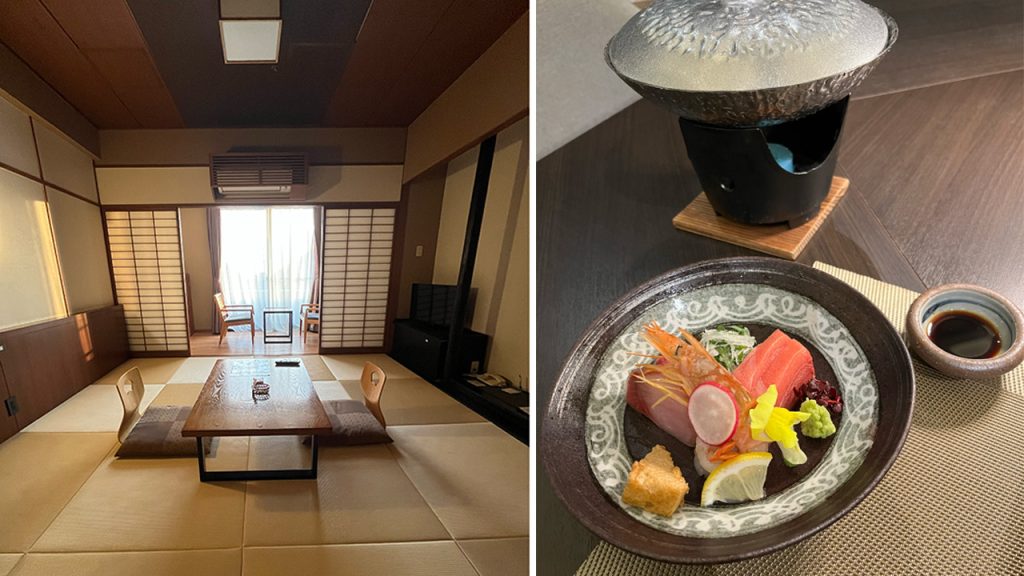
That night, I stayed at Aubegio Kirishima Kanko Hotel, traditional Japanese style. The rooms were sparse but perfectly composed: tatami mats, futon folded in precise rectangles and a kimono tucked in the cupboard with step-by-step instructions that made me feel part novice, part participant in some ancient rite. Dinner featured Kurobuta pork shabu-shabu, rich, silky and almost absurdly tender. I found myself marvelling not just at the food, but at the ceremony surrounding it; it’s so fun to dip slices in simmering broth and cook them yourself at the table, lifting them with chopsticks as if they were precious scrolls.
A post-dinner onsen from the fourth floor of the hotel provided – again – stunning views of Sakurajima, inviting me to hurry up and get over there to finally explore its smoke-streaked slopes, twisted lava fields and the slightly terrifying presence that watches over the city at all times.
The next morning we drove south toward Sengan-en Garden, which lies directly opposite Sakurajima. Inside the majestic gates, paths wind past koi-filled ponds and intricately pruned trees, before opening onto the historic residence, a stately home that feels both museum and lived-in memory of Satsuma nobility.
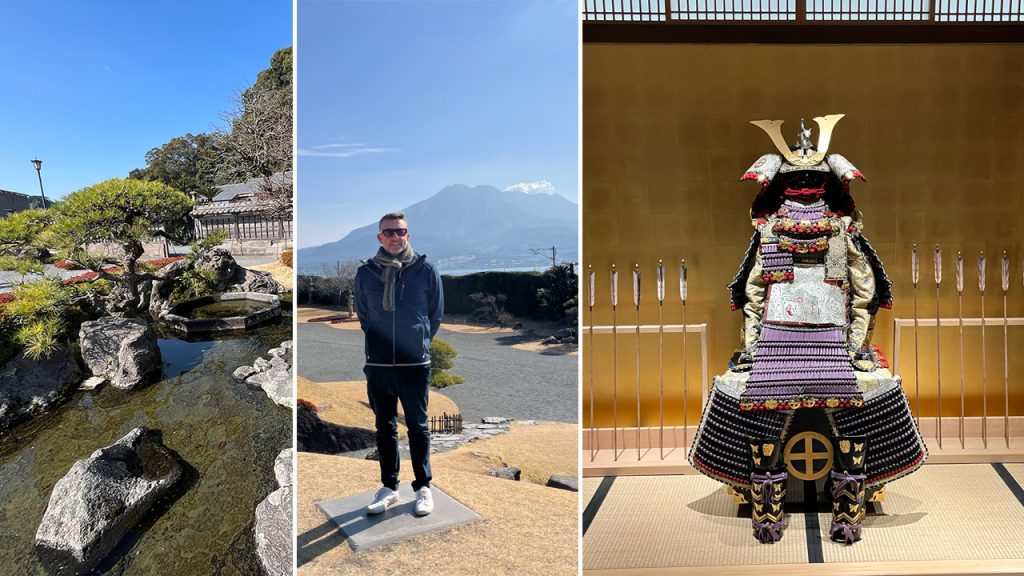
Built in the Edo period as a secondary residence for the Shimazu clan, it was designed both to impress visitors and to provide a quiet escape from the rigours of ruling – a holiday home by the sea. Inside, tatami floors and sliding doors open onto verandas that perfectly frame Sakurajima, as though someone had deliberately arranged the volcano for maximum dramatic effect. In fact, the reverse is true, with the garden’s makers using what’s called shakkkei, or “borrowed scenery”, which incorporates the distant volcano and surrounding landscape into the composition of the garden itself, making it feel far larger and more dramatic. It’s a clever trick; the landscaping equivalent of borrowing your neighbour’s view, if that neighbour happened to be a god with a volcano.
Painted sliding doors depict seasonal landscapes, delicate wooden carvings on ceilings hint at wealth and exquisite craftsmanship. There’s a secluded study where the master of the residence spent most of his days which seems to retain the ancient scent of old ink, a reception hall once used to entertain important guests, and the entire place bears the faintest traces of wood mingled with the earthy aroma of tatami mats.
Right next-door is the Satsuma Kiriko Gallery and adjoining glassworks factory, where young master glassblowers and engravers let you watch the entire process, even responding to questions from visitors thrown at them randomly from behind the knee-high guide ropes separating us from the intense heat of their factory floor.
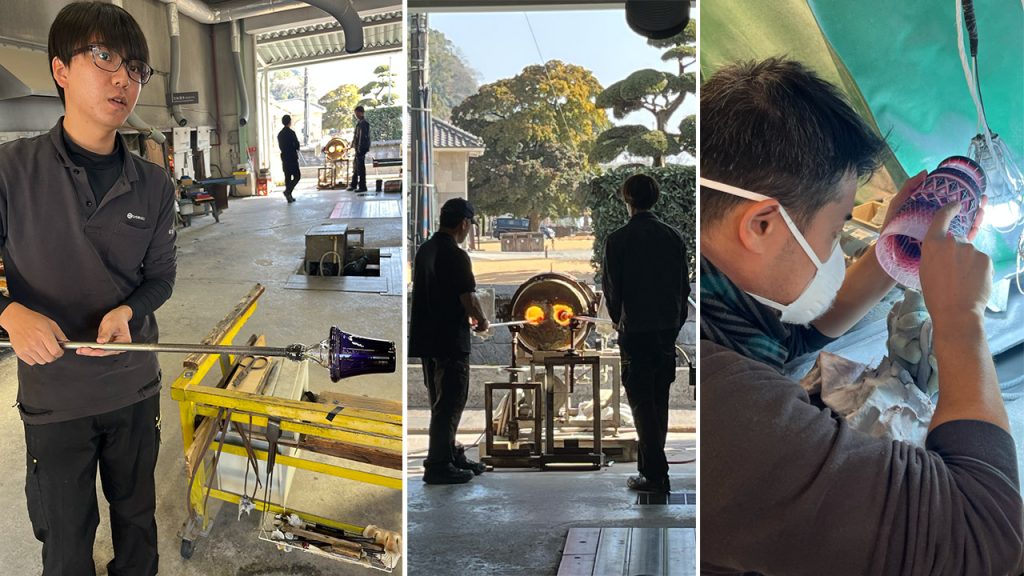
Seeing them work is mesmerising; the glowing liquid forms, the whirling cutting machines, the precision required, all done at an incredible pace right in front of your eyes. Within Sengan-en Garden there is also an experience facility where you’re given the opportunity to try your own hand at engraving, using a cutting machine to craft designs into a piece of jewellery to keep as a memento. Mine came out a little ugly, a little wobbly, but completely mine, which somehow made it more satisfying.
Lunch was at Tonkatsu-to Shabushabu Kurobuta Fukuya, a spot famous for Kagoshima’s prized Kurobuta pork, the local black-haired breed known for its marbling and rich, buttery flavour. The pigs are raised carefully on local feed, giving the meat an amazing depth and sweetness that has made it a source of prefectural pride for generations. Each bite was so good, I may have audibly sighed more than once.
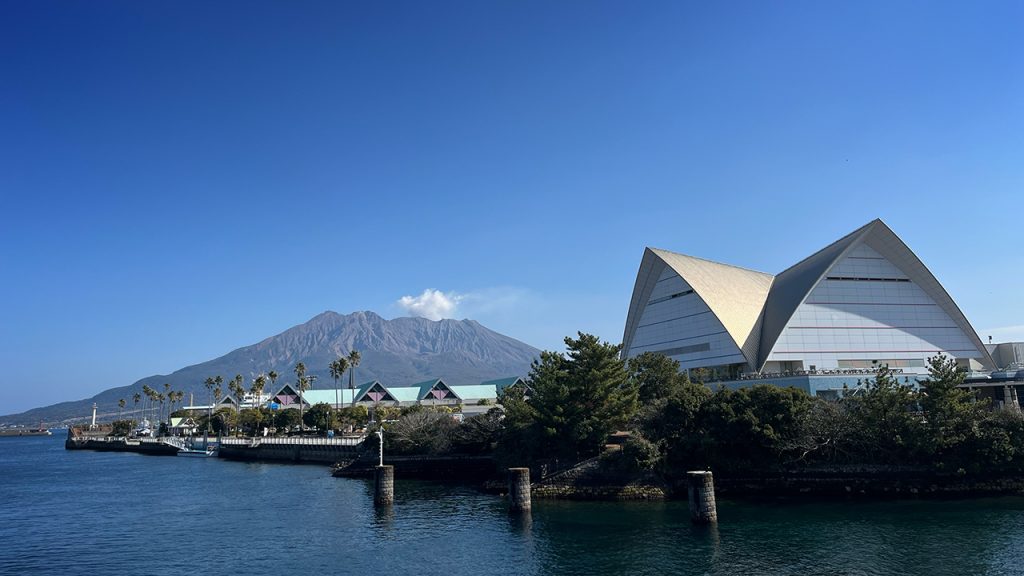
By early afternoon, it was time to finally confront Sakurajima in person. The ferry ride across is brief but theatrical; a building perched on the port looked so much like a tiny version of the Sydney Opera House that I couldn’t help but laugh out loud – a little reminder that the world often makes unexpected visual jokes – but my guide assured me that it was a complete coincidence.
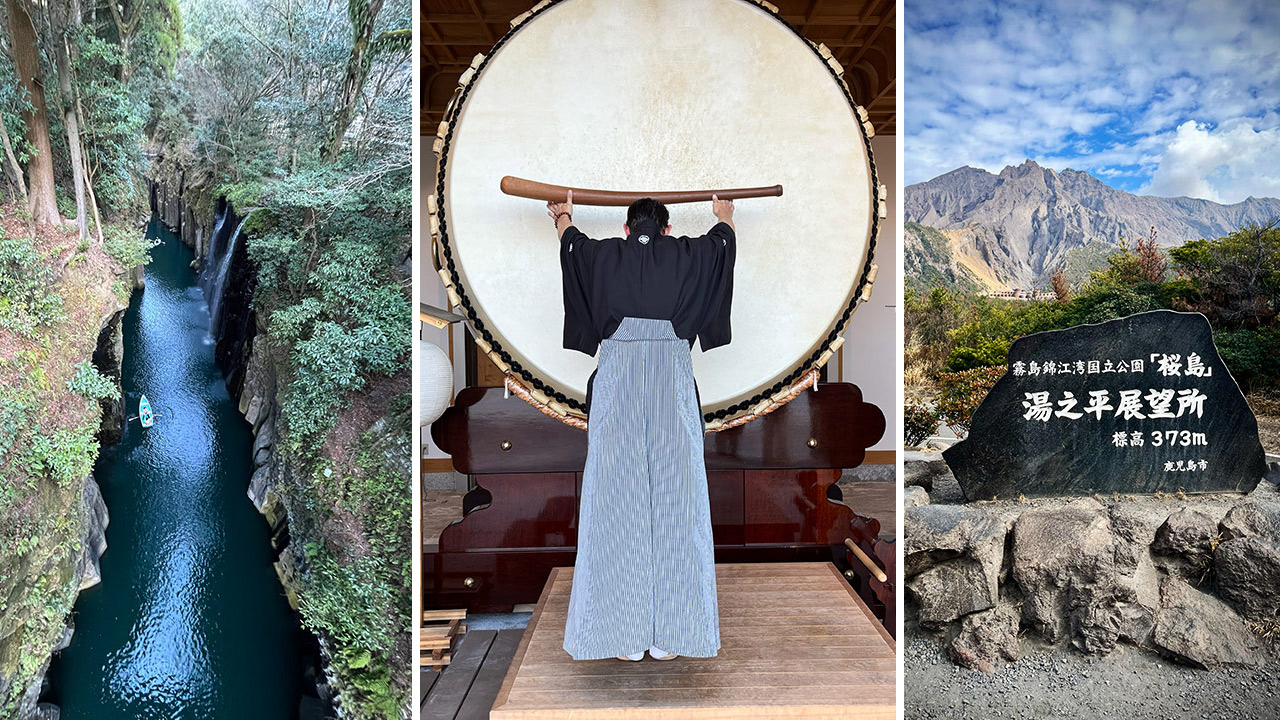
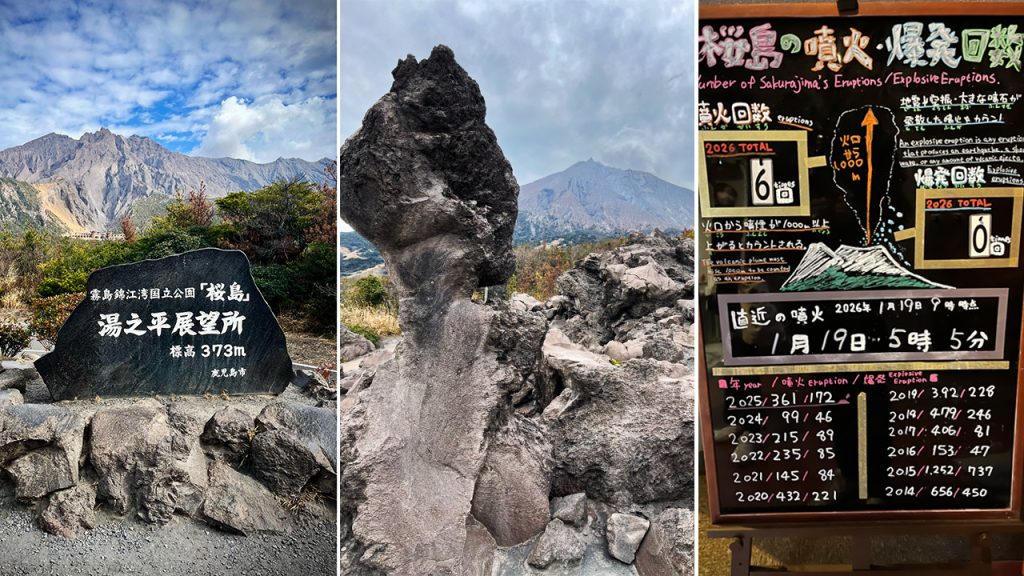
Once on the island, the sheer scale of the volcano is impossible to overstate. At Yunohira Observatory and Arimura Lava Observatory, its presence is immediate: twisted lava rocks litter the slopes, and the fields of Sakurajima daikon look almost absurdly hardy, flourishing in ash-laden soil.
Like Mt Aso, Sakurajima is far from dormant: in 2025 alone it erupted 361 times, 172 of those “explosively”, which is defined as a more intense, larger-scale eruption accompanied by volcanic ejecta and seismic activity. However, this activity is rarely felt on the island or throughout the wider Kagoshima region.
In fact, “island” is now a bit of a misnomer for Sakurajima’s home: a massive eruption in 1914 caused great rivers of lava to spill across the strait separating it from the mainland, permanently joining it to the Osumi Peninsula, its rugged slopes still dotted with the oddly shaped jagged lava rocks left behind by centuries of eruptions.
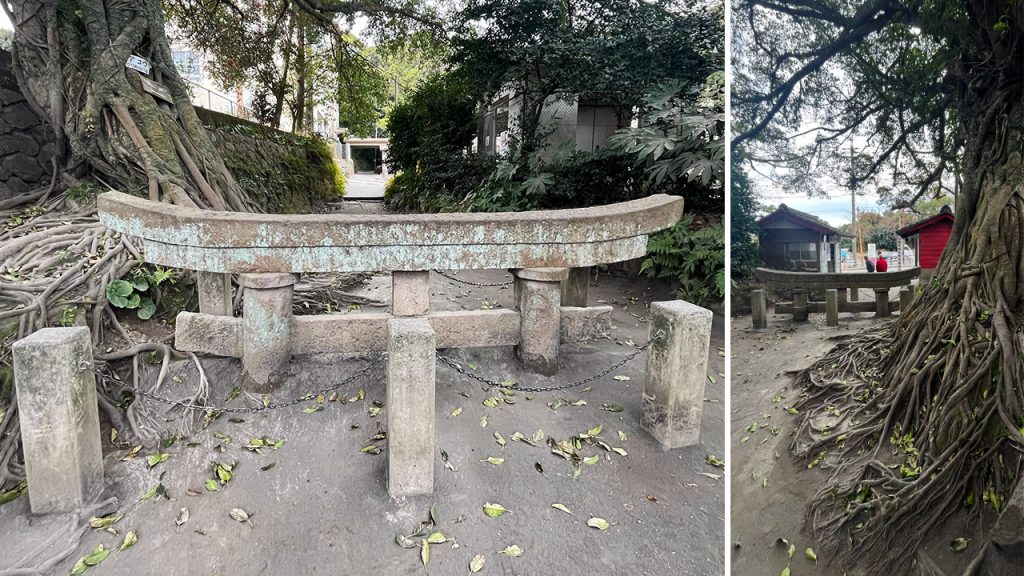
Close to where the island now joins the mainland, the Kurokami Buried Torii Gate serves as a stark reminder of Sakurajima’s ferocity. Originally standing at the entrance to a local shrine, only the very top of it remains visible, the rest buried in compact volcanic ash.
Despite the lava, ash and occasional showers of volcanic grit – or rather, because of them – Sakurajima’s soil is remarkably well-drained and rich in minerals. So much so that the locals have turned centuries of eruptions into a very tangible advantage: the region’s daikon radishes are legendary as a result, some growing to the size of small children, and there are even annual competitions to see who can cultivate the heaviest or most perfectly shaped specimens. Walking past the fields, it’s hard not to admire the ingenuity of farmers who took what could have been a constant source of frustration and transformed it into a point of pride.
The evening – my last in Kyushu – offered immersion of a completely different kind: a night of Kagoshima spirits and nightlife with a Shochu Meister as guide. We began our bar-hop in Meizan then wandered through Tenmonkan, sampling local spirits in ways I hadn’t imagined: neat, diluted, warmed, paired with miso peanuts and light bites. My English-speaking guide also taught me a few handy Japanese slang phrases, and suddenly I was no longer a visitor, but part of the vibe of the city, even for just a few hours.
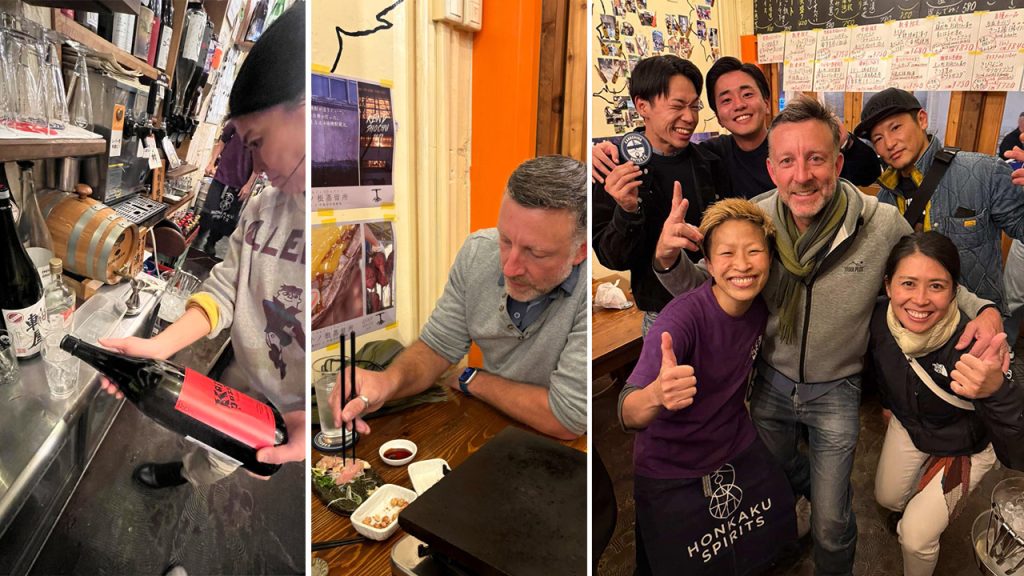
My favourite stop for the evening was at Yokaban, where the owner, Reina-san, a former high-level soccer player with a laugh that filled the room, finally inspired me to try raw chicken sushi (I needn’t have been afraid; it was delicious). Then, much later – after the amazing three-hour bar-hopping tour was officially over – we wound up at a bar called BeatNik on the fifth level of a high-rise building. The owner discovered I was an Aussie and spent the rest of the evening pumping AC/DC across the crowded room – and as everyone cheered and nodded along, I no longer felt like the only foreigner in the room, but like a local, even if only temporarily, laughing, learning and clinking glasses.
By the time I finally turned in for the night, it struck me how much this trip had quietly changed me. Calm, ordered gardens, myth-heavy gorges, endless volcanic chaos, surprisingly lively nightlife… despite the whirlwind pace, almost every interaction in Japan asks that you also give yourself over to moments to pause, reflect and pay respect – to the land and to every person you meet. That lesson alone will stick with you long after you leave.
Click below for Part 1 and Part 2 of our epic journey through southern Japan:
Beyond the guidebook: a journey through southern Japan Part 1 – Kumamoto
Beyond the guidebook: a journey through southern Japan Part 2 – Miyazaki
This is a sponsored article produced in partnership with Visit Kyushu