In Part 2 of our epic tour of Japan’s Kyushu Island, we take you through Miyazaki Prefecture – where sun goddesses hide in cliffside caves, Kagura dancers summon ancient myths to life, and salt-tinged shores prove legend still lingers in the everyday.
If Kumamoto feels quietly assured, Miyazaki feels deeply soaked in myth. This is a landscape where stories aren’t decorative additions to the scenery; they are the scenery. Forests, gorges, shrines and ancient caves don’t have typical histories here – they have backstories stretching back millennia, complete with gods, heavenly rivalries and carefully preserved legends.
My introduction to all this riveting drama came in Takachiho, a region that occupies a central place in Japanese mythology and somehow manages to make even the most extraordinary origin stories feel entirely reasonable.
The approach to Amanoiwato Shrine and nearby Amanoyasukawara set the tone immediately. A shaded forest walk follows a clear-running river, the air cool and damp, the ground soft underfoot. It feels deliberately removed from the modern world, as though mobile reception was never invited here in the first place.
Amanoyasukawara itself is a shallow cave said to have hosted a divine summit attended by eight million gods – a figure that seems excessive until you round the corner and see the thousands of tiny stone cairns stacked by visitors over countless years. Each one is a quiet offering, a wish, a thanks or perhaps just proof of having been there.
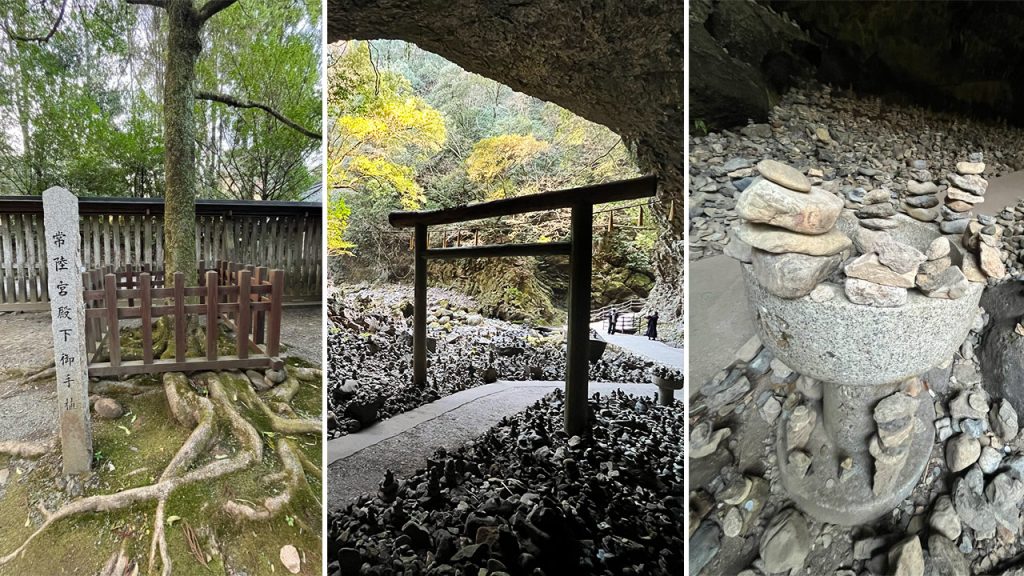
Across the other side of the river and high up the cliff wall sits another the cave where the sun goddess Amaterasu-Omikami – “Japan’s top god”, as my guide explained – is said to have hidden herself, plunging the world into darkness and leaving both gods and humans in confusion and despair.
According to legend, Amaterasu-Omikami had retreated there after her brother Susanoo, the storm god, caused havoc in the heavenly realm. After forming the aforementioned summit at Amanoyasukawara to decide how to solve the whole no-sunlight issue, the throng of deities gathered outside the cave to dance, sing and cause an absolute cahoot – even hanging out a mirror to catch Amaterasu-Omikami’s eye, hoping to coax her out.
Eventually, Amaterasu-Omikami did peek out, drawn by all the laughter and commotion, and the sun returned to the world. To ensure she could not simply retreat again, Ame‑no‑Tajikarao (Japan’s Hercules), is said to have seized the cave’s rock door and hurled it across Japan, landing at what is now Mount Togakushi in the distant Nagano Prefecture – which is like throwing the Sydney Harbour Bridge all the way down to Melbourne.
Standing there, looking up at the narrow slit in the cliff face where she is said to have hidden, it’s easy to understand why the site has been treated with reverence for so many centuries. Photography of that special cave is strictly forbidden, and for once it doesn’t feel restrictive. Being allowed to simply stand, gaze across the gorge below and absorb the moment felt like a privilege rather than a rule.
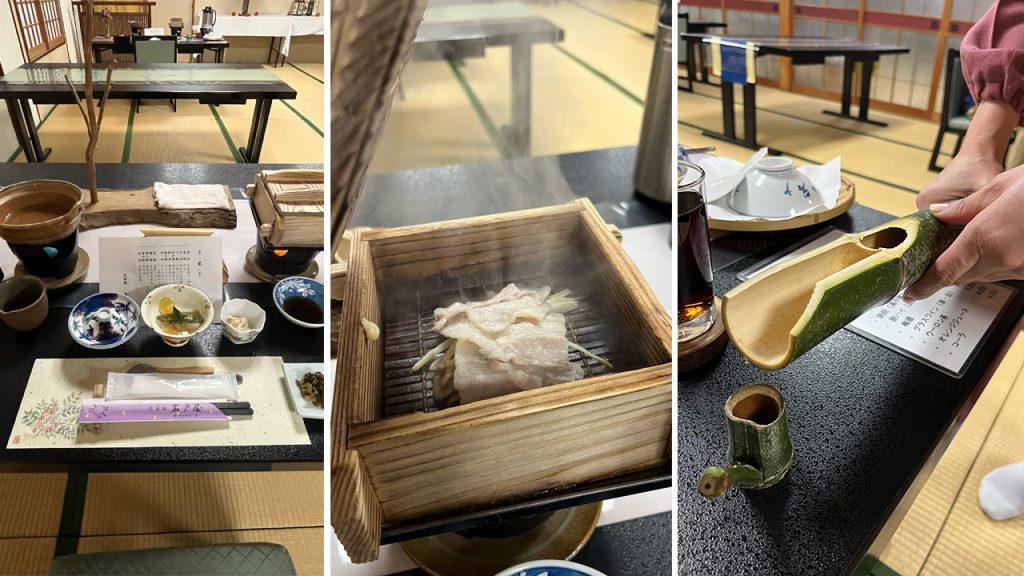
That night was spent at Iwatoya, a traditional ryokan where dinner is treated with the seriousness of a ceremony – to the point where I found myself surreptitiously sneaking sideways glances at adjoining tables to see if I was putting the right morsel with the correct broth in the appropriate and respectful order.
The meal showcased local ingredients, including my first encounter with hot sake served through a long bamboo sleeve, which felt faintly theatrical until I realised how perfectly it suited the setting. Warm food, warm drink and the kind of deep relaxation that abounds in Japan.
So how does Japan change the way you behave? Well, it was after dinner, preparing for an onsen, that something genuinely unexpected happened. After carefully folding my trousers and laying them on the bed, I instinctively began to bow. Not mocking or frivolous; I was entirely alone in the room. I stopped mid-motion, startled, and laughed out loud. Not because it was ridiculous, but because it was unthinking. Somewhere along the way, the habitual Japanese practice of respect, consideration and gratitude had lodged itself deeply enough that it surfaced on its own. It struck me then how easily the frenetic pace of everyday life had been replaced by something calmer, more deliberate – and how much better that felt. This place was really growing on me.
Later that same evening, I attended a night Kagura performance in a small hall within the Takachiho Shrine, attended by a handful of locals. Kagura is a ritual dance-drama rooted in Shinto mythology, traditionally consisting of 33 performances that can stretch through all the night and well into the following day.
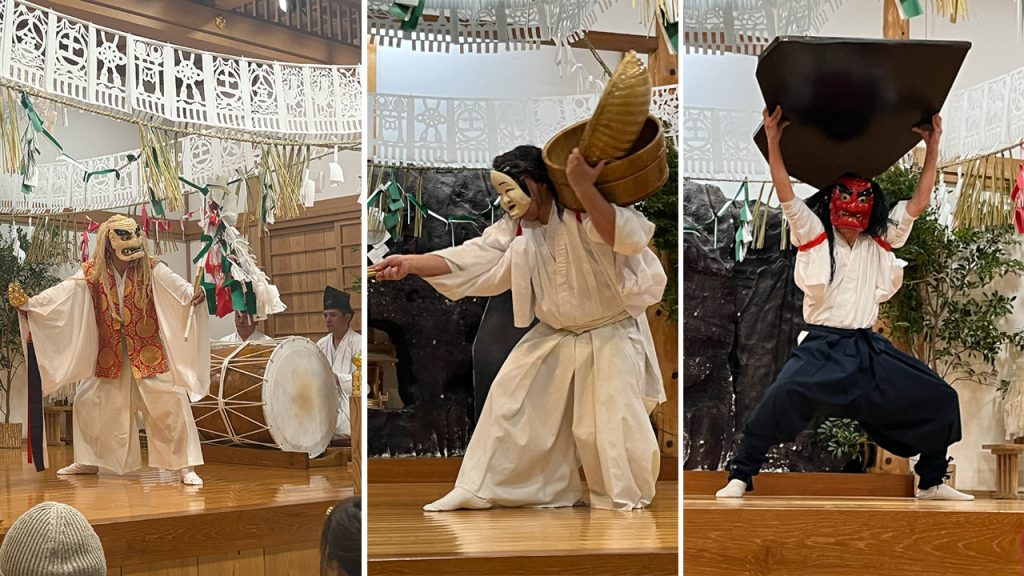
What I saw was a shortened, nightly version, but it was no less absorbing. Masked dancers re-enacted key moments from the very myths I had just learned about in the forest: creation tales, battles between gods and demons, and, best of all, the story of Amaterasu’s retreat into the heavenly cave and the elaborate divine scheme to coax her back out – which in the full 33-act version is carefully timed to coincide with the actual rising of the sun. The music was rhythmic and hypnotic, the movements stylised and powerful, the atmosphere gripping and intense. Even without understanding every symbolic detail, the sense that these stories had been told in just this way for centuries was palpable, and watching even this shortened version felt like stepping inside the very myths that had shaped the land I’d been exploring all day.
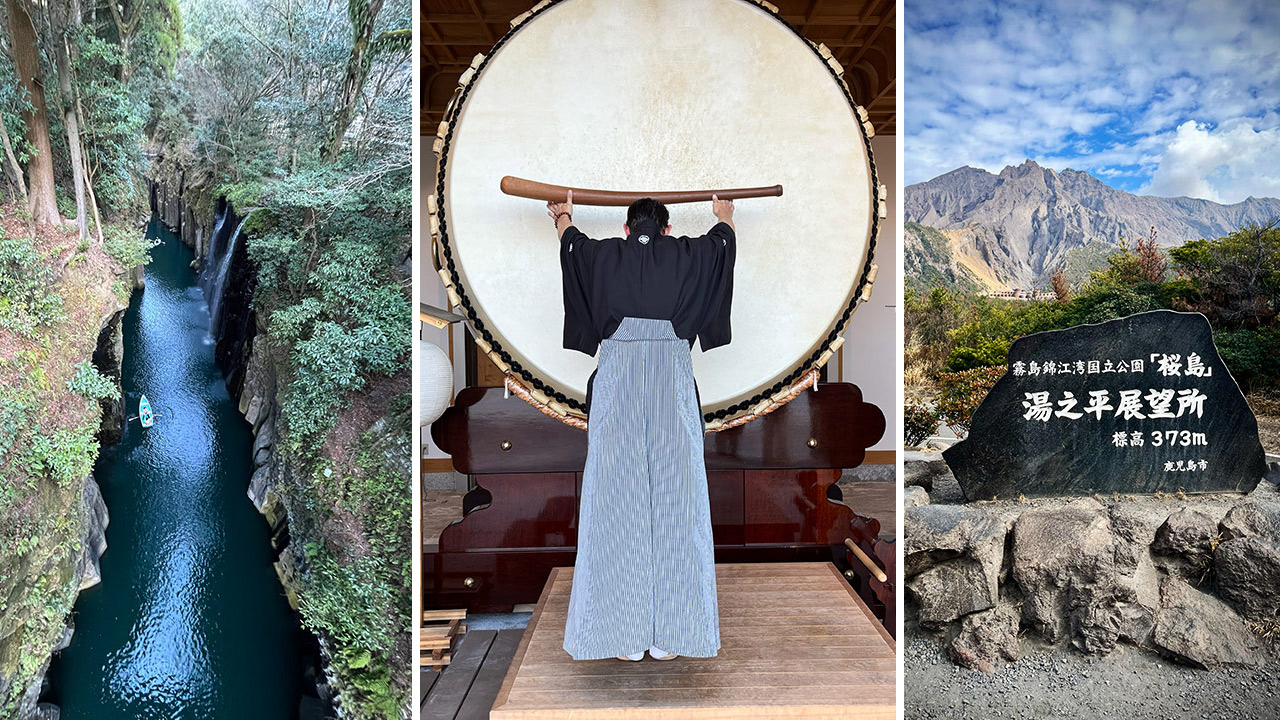
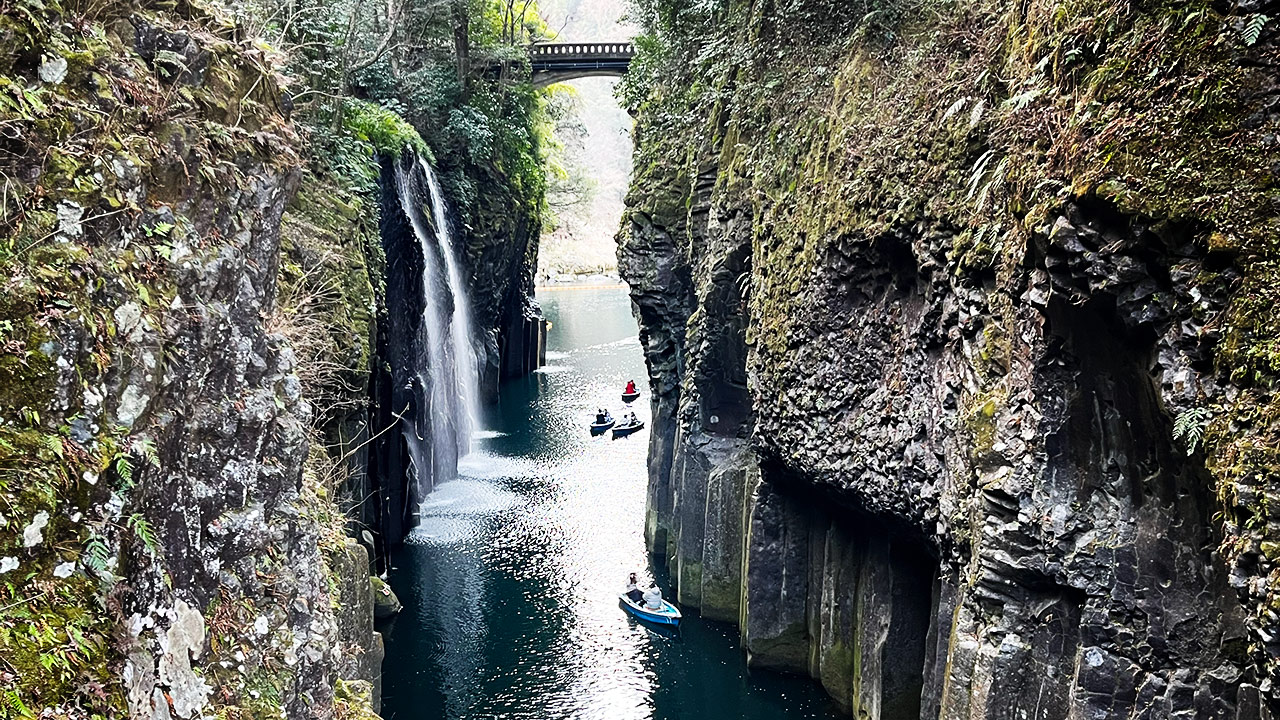
Early the next morning, I found myself rowing a small boat through Takachiho Gorge, the air sharp and clear, the water startlingly cold and glassy. Cliff walls formed from striking columnar joints rose steeply on either side, the result of ancient pyroclastic flows softened over time by moss and trickling waterfalls.
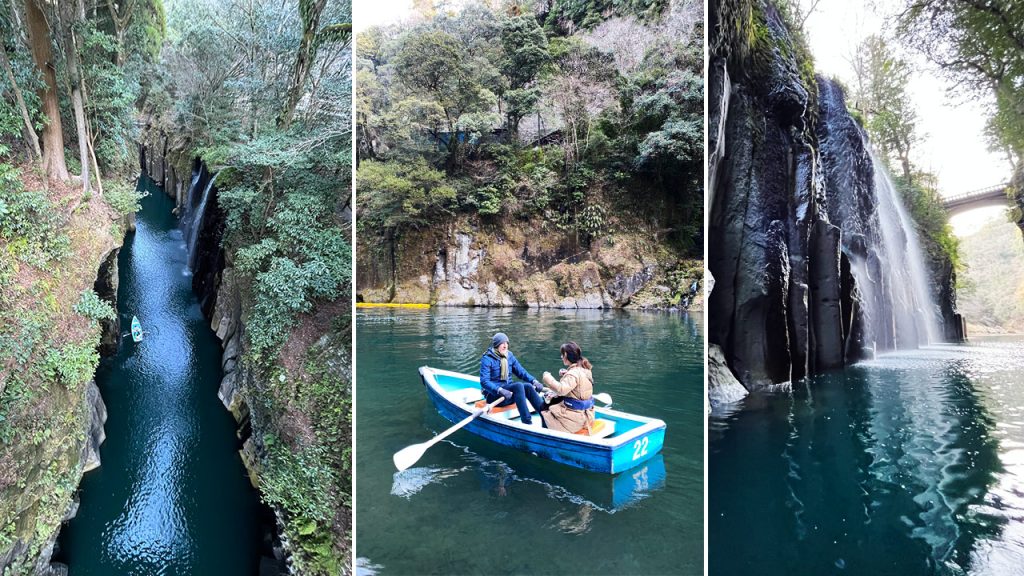
Above, walking paths traced the rim of the gorge, dotted with nearby ponds that held improbably large, well-fed koi and other graceful, coloured fish being farmed for ornamental purposes. It was one of those places where silence feels just right, broken only by the splash of an oar or the distant sound of falling water.
From there, a pleasant two-hour coastal drive south from quiet Takachiho Town to bustling Miyazaki City ended at the renowned restaurant of Miyachiku at Oyodo Riverside for a very special lunch indeed. Miyazaki beef is a source of immense local pride, and with good reason. Every five years, Japan’s prefectures compete in a fiercely contested national wagyu competition, judged across a dizzying array of categories – marbling, texture, flavour, fat quality, even the way the cattle are raised and cared for. The steaks are, quite literally, high.
Miyazaki has taken out the Prime Minister’s Award at the last four competitions, a fact my guide delivered with the quiet confidence of someone stating an incontrovertible truth, while also conceding that any guide I met later in Kagoshima would likely make the same claim about their own beef! Either way, it was clear that in this particular rivalry, everyone was playing for keeps.
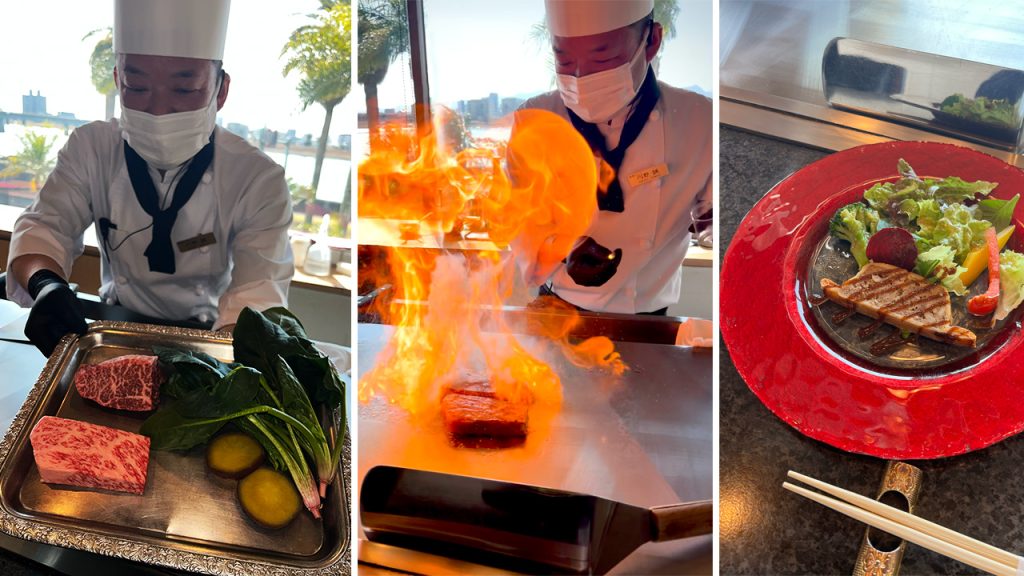
Our incredible meal unfolded in front of us on a hotplate, cooked by a personal chef with all the flair and intensity of a Samurai warrior. Flames leapt, knives flashed and each delicate bite justified the reputation entirely.
My final stop in Miyazaki was Aoshima Shrine, set on a small island just off the coast and surrounded by the jagged wave-like rock formations known as the “Devil’s Washboard”, formed strangely enough NOT by lava this time, but by eons of erosion.
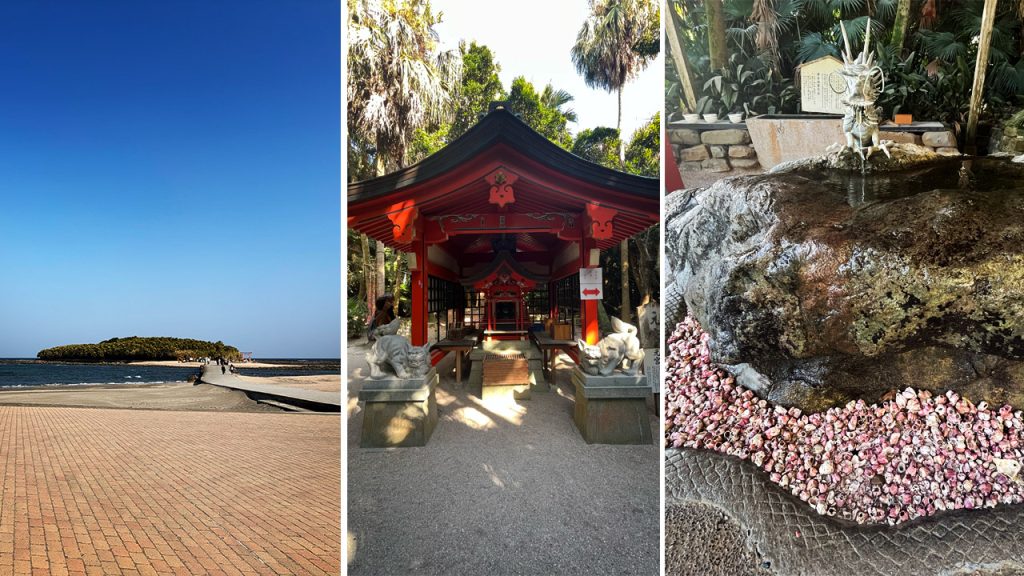
Unlike Takachiho, Aoshima’s myths revolve around the sea rather than the sun: here, the hunter Hikohohodemi no Mikoto married the sea goddess Toyotama-hime, and the shrine became a place to pray for safety at sea, for fertility and for family prosperity. Walking the narrow causeway onto the island, hearing waves lapping against the unusual rocks, it was easy to imagine the divine couple watching over the waters for centuries. It’s a quieter, gentler sort of awe. No less mythic, but one that feels tied more tied to the rhythm of the tides than the breaking of dawn.
Miyasaki is strangely subtropical and salt-tinged (their surf culture is almost as pervasive as Australia’s!) and feels so different again from the forests of Takachiho and the mountains of Kumamoto. It was a fitting place to pause, reflect and take stock of how much ground had been covered in such a short time.
From volcanoes and gods to gorges and beef competitions, Miyazaki had a way of quietly widening the scope of the trip, before the road twisted southwest toward Kagoshima, and whatever surprises the final prefecture had in store.
Ready to continue onwards to Kagoshima to complete the trip? Click below for Part 3 of our epic journey through southern Japan, or Part 1 to go back to the beginning!:
Beyond the guidebook: a journey through southern Japan Part 3 – Kagoshima
Beyond the guidebook: a journey through southern Japan Part 1 – Kumamoto
This is a sponsored article produced in partnership with Visit Kyushu