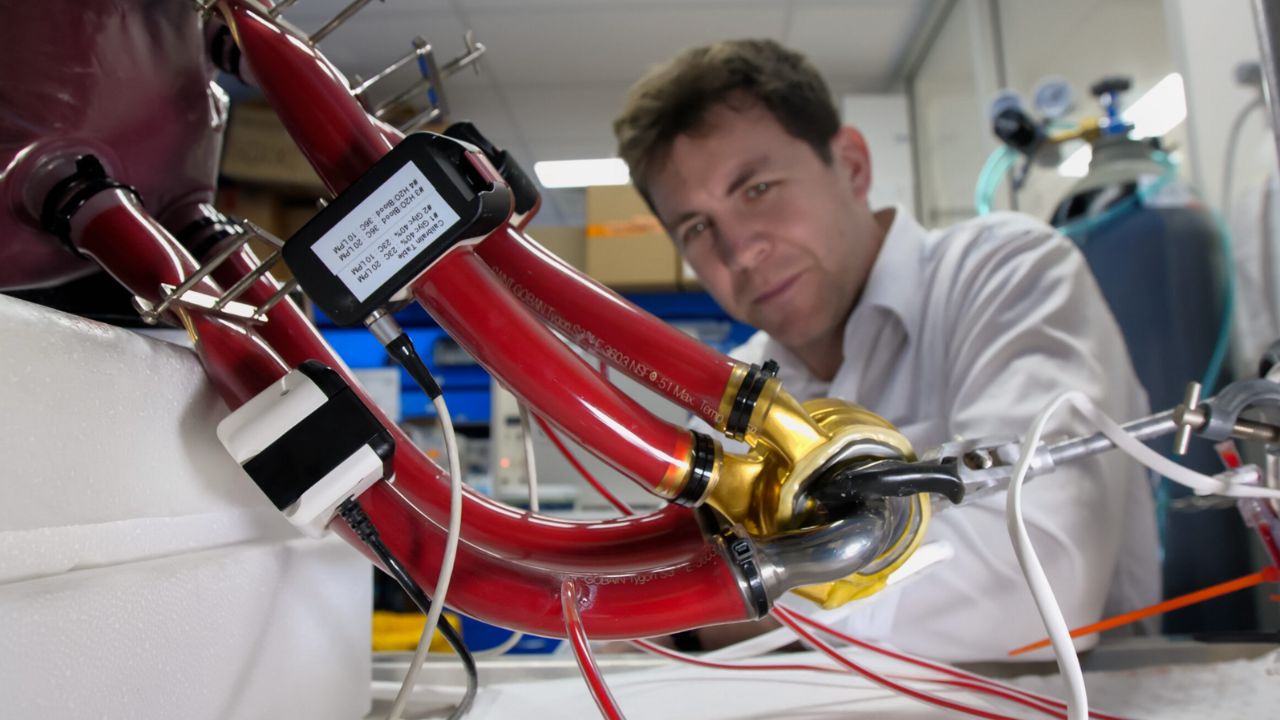
An Australian doctor who built his first artificial heart model using pipes from Bunnings has created a groundbreaking device that could save thousands of lives.
Dr Daniel Timms’ titanium device is designed to keep patients with severe heart failure alive until a donor heart becomes available.
The idea came from his father, a plumber who was diagnosed with severe heart failure and sadly died before the invention was ready for use.
He developed the invention through his company BiVacor, which has already conducted successful trials in Australia and the US and is now calling for stronger government support to ensure world-leading medical research and technology remain in Australia.
A Texan businessman known as “Mattress Mack” provided the crucial financial backing to help bring the project to life, but Dr Timms says if the funding had been available at home, he might never have left.
Speaking at the National Press Club on Wednesday, Dr Timms said Australia must do more to invest in its innovators.
“Having that foresight from government to say, ‘we want to be part of this, this is Australian innovation,’” he said.
“It’s very insightful to say ‘OK, here’s some funding that can support this technology.’”
In March, a Sydney man became the first patient to leave hospital with the implant and lived normally for more than 100 days before receiving a transplant.
Although convincing patients to accept an experimental device can be challenging, Dr Timms said most are eager for any potential solution.
“It looks like it came out of a 1974 Datsun, you’re going to put that in my chest?” he said.
“But you’ll be surprised how well-read the patients are … they see the previous technologies and say, ‘I don’t want that, I want the shiny titanium.’”
Dr Timms, a former Australian of the Year finalist, hopes to see more of the $24 billion Medical Research Future Fund directed toward supporting researchers.
“Despite the fund’s growth, the available annual allocation, approximately $650 million, has remained stagnant,” he said.
While manufacturing the device on a larger scale remains a major challenge, Dr Timms is confident about the road ahead.
“We are on the cusp of a future where a diagnosis of heart failure is no longer a death sentence,” he said.
Image: BiVacor