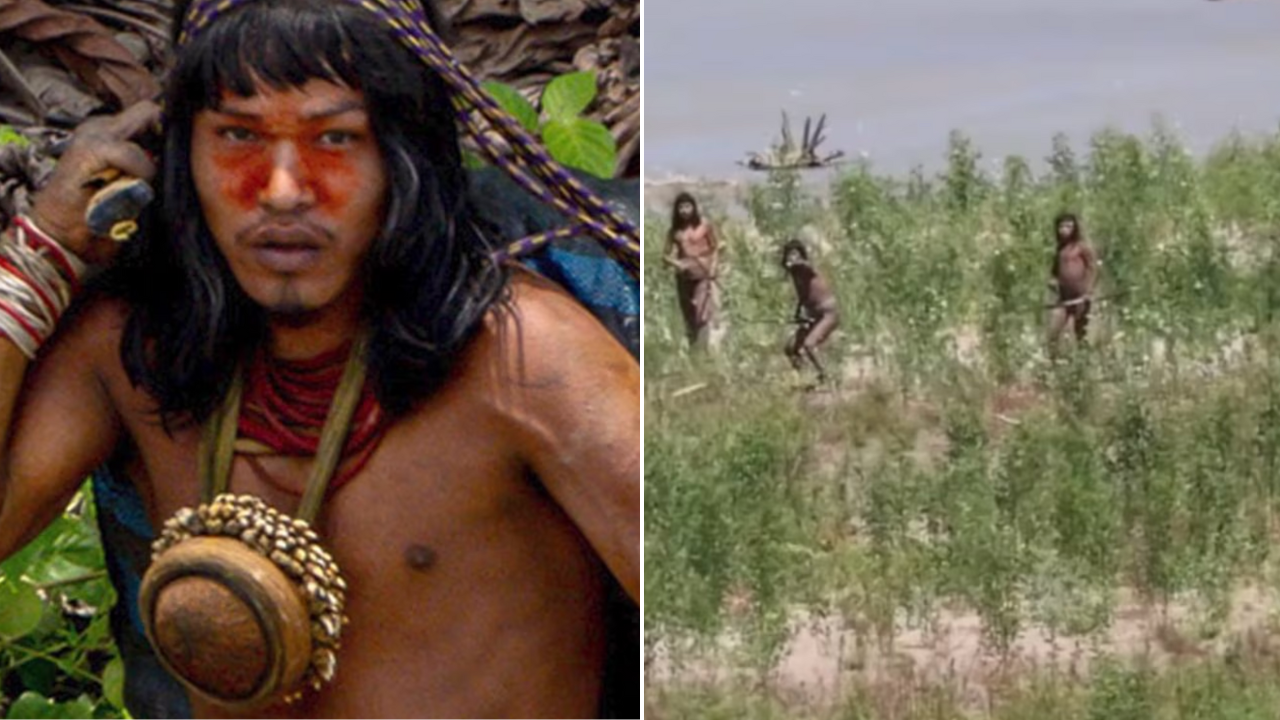
Never-before-seen high-definition footage of an uncontacted Amazonian tribe has emerged during a recent interview between American conservationist and author Paul Rosolie and podcaster Lex Fridman.
Rosolie, who has spent more than 20 years working in the Amazon rainforest, said the moment was one of the most profound experiences of his life.
“In order for any of this to make sense, I had to show you this footage … This has not been shown ever before. This is a world first,” he told Fridman.
Until now, images of uncontacted tribes have typically been low-resolution and taken from a distance, often using outdated equipment.
“The only thing you’ve ever seen are these blurry images … from 100 meters away … and we’re sitting there with, you know, 800mm with a 2x teleconverter,” Rosolie said.
The footage shows members of the tribe emerging onto a riverbank through a dense cloud of butterflies. The group advances cautiously, moving in a coordinated formation as they observe the outsiders and assess the potential threat.
Rosolie said he closely watched their body language as several members approached with weapons drawn.
“Look at the way they move. Look at the way they point. Look at him with his bow,” he said, pointing to a man nocking an arrow.
Rosolie called closely watching the group’s body language as they gathered into a tight formation with weapons in hand.
“Look at the way they move. Look at the way they point. Look at him with his bow,” he said, pointing to one man nocking an arrow.
He said initially it seemed as though things might escalate and turn violent.
“I’m looking in every direction … going, ‘Which way is the arrow coming from?’”
However, as the distance between the two groups closed, the tribe began to lower their weapons.
“As they come closer, they start laying down their … See, he’s laying down his bow and arrow. They understand. No, no more.”
The tense standoff gradually gave way to curiosity, with some members of the tribe seemingly relaxed and even smiling.
“These are warriors … it really looked like they’re ready for violence. And now they’re all standing in a relaxed … and smiling,” Rosolie said.
Researchers estimate that nearly 200 uncontacted Indigenous groups still exist worldwide, the majority of them living in the Amazon rainforest across Brazil and Peru.
Because direct contact can be fatal, information about these communities is largely gathered through satellite imagery, aerial surveys and reports from neighbouring Indigenous groups.
In 2018, 26-year-old American missionary John Allen Chau was killed after attempting to contact the Sentinelese people on North Sentinel Island, one of the world’s most isolated Indigenous communities.
Despite India’s strict ban on approaching the island, Chau paid fishermen to transport him there. He tried to introduce himself and preach Christianity, leaving gifts and recording the encounter in his journal. The Sentinelese, who are known to fire arrows at intruders, killed Chau shortly after he landed.
His body was never recovered.
History has proven that even brief encounters can introduce common illnesses that are harmless to people in developed nations but potentially fatal to uncontacted tribes with no immunity.
Biologists fear that exposure to viruses could lead to rapid and, in some cases, total population collapse among these communities.
Recent sightings of uncontacted groups have increased as industrial activity expands deeper into remote forest regions. Illegal logging, mining and drug trafficking routes have eroded buffer zones that once kept these tribes isolated.
As a result, some groups have been seen along riverbanks or near settlements, often responding defensively to intrusions into their territories.
One of the most prominent examples is the Mashco Piro of southeastern Peru, who were photographed repeatedly between 2023 and 2025 near logging operations.
In Brazil, government agencies have also released rare images of uncontacted groups in regions such as Massaco.
Conservationists warn that contact itself remains one of the greatest threats to these tribes. Beyond the risk of disease, encounters can trigger violence, disrupt social structures and accelerate cultural loss.
Organisations including Survival International and Brazil’s Indigenous affairs agency FUNAI continue to advocate for a strict no-contact policy, supported by robust enforcement of Indigenous land protections.
Images: Lex Fridman / YouTube