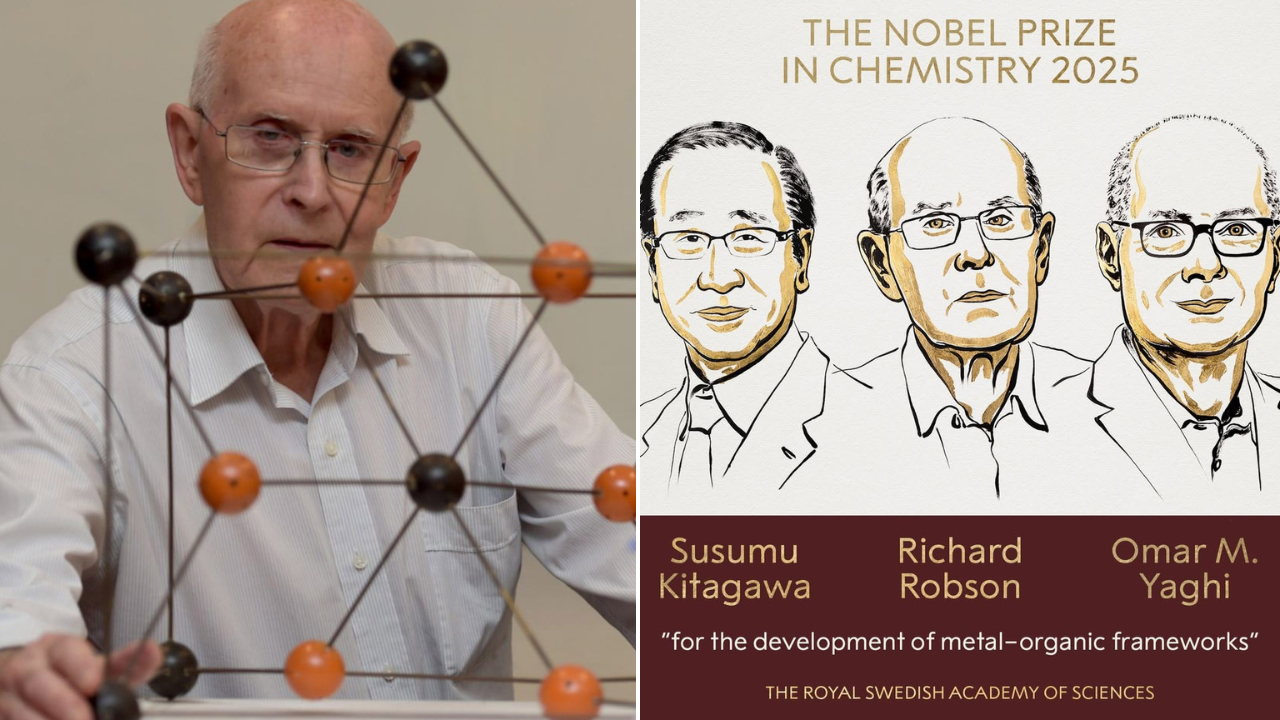
An 88-year-old University of Melbourne professor is among three scientists awarded the 2025 Nobel Prize in Chemistry for pioneering a new form of molecular architecture – a breakthrough with applications that could address global challenges such as climate change and water scarcity.
The Royal Swedish Academy of Sciences announced this year’s recipients as Australia’s Richard Robson, Professor Susumu Kitagawa of Kyoto University in Japan, and Professor Omar Yaghi from the University of California, Berkeley, in the United States.
The trio were recognised for their contributions to the development of metal-organic frameworks (MOFs) – molecular structures with exceptionally large internal spaces that allow gases and chemicals to pass through.
These materials can be used to harvest water from arid air, capture carbon dioxide, or store toxic substances.
The committee said some of these materials had a remarkably large surface area – a porous material roughly the size of a small sugar cube could contain as much surface area as a large football pitch.
“A small amount of such material can be almost like Hermione’s handbag in Harry Potter. It can store huge amounts of gas in a tiny volume,” said Olof Ramstrom, a member of the Nobel Committee for Chemistry.
Though the laureates worked independently, their research collectively advanced the field over decades, beginning in 1989 with Robson’s foundational work.
Speaking to the Associated Press following the announcement, Robson said he was “very pleased of course and a bit stunned as well.”
“This is a major thing that happens late in life when I’m not really in a condition to withstand it all,” he added.
“But here we are.”
Kitagawa, 74, also expressed gratitude via phone after learning of the award.
“I’m deeply honoured and delighted that my long-standing research has been recognised,” he said.
Since the initial discoveries, chemists have developed tens of thousands of MOFs, some of which “may contribute to solving some of humankind’s greatest challenges,” the Academy said.
Among emerging applications are filtering out toxic PFAS, known as “forever chemicals,” from water and breaking down trace pharmaceuticals in the environment.
Robson, originally from the UK, moved to Australia in his late 20s.
Kitagawa is Japanese, and Yaghi, 60, is Jordanian-American. Born to Palestinian refugees in Amman, Yaghi immigrated to the United States as a teenager.
Yaghi’s team succeeded in creating a durable, crystal-like MOF using metal atoms, demonstrating both structural robustness and extreme porosity.
“That basically was the spark that ignited the field,” he said in a statement released by the University of California, Berkeley.
The Nobel Prize in Chemistry – one of the oldest and most prestigious scientific honours – was established by the 1895 will of Swedish industrialist Alfred Nobel, who made his fortune through inventions in the field, including dynamite.
The 2025 chemistry prize is the third award announced this year, following prizes for medicine and physics earlier in the week.
The literature prize is expected Thursday, followed by the Peace Prize on Friday and the economics award on Monday.
Winners of the Nobel Prize in Chemistry will share a monetary reward of $A1.8 million, in addition to global recognition for their achievements.
Images: Instagram