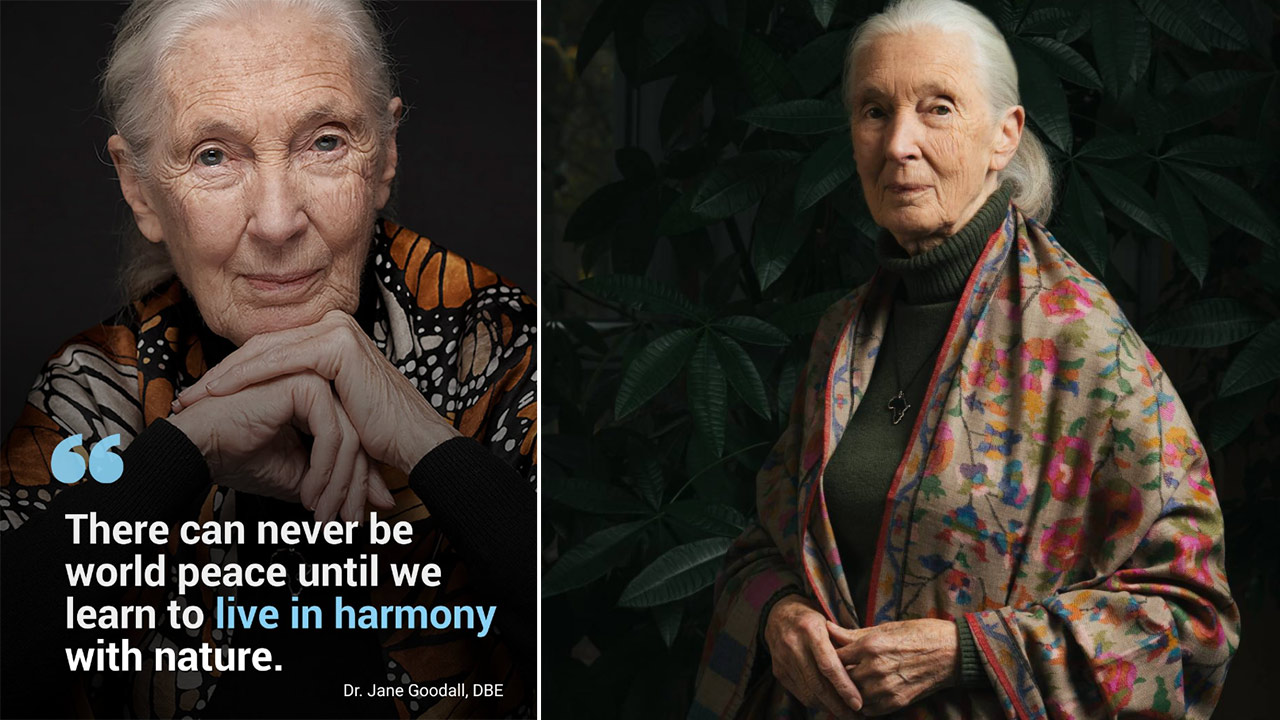
Dame Jane Morris Goodall, the pioneering conservationist whose life’s work reshaped humanity’s understanding of animals and our place in the natural world, has died at the age of 91.
The Jane Goodall Institute announced her passing in a heartfelt message on Instagram, calling her a visionary whose discoveries “revolutionised science” and whose tireless advocacy “inspired generations to protect and restore our natural world”.
Goodall first rose to international prominence in the 1960s after living among chimpanzees in Tanzania’s Gombe Stream National Park. With quiet patience and empathy, she documented the primates not only fashioning tools but also revealing individual personalities and emotional depth, findings that shattered scientific dogma and redefined the line separating humans from other animals.
Her research made her a household name, through magazine profiles and documentaries, but it was her ability to translate science into compassion that resonated far beyond academia. “Out there in nature by myself, when you’re alone, you can become part of nature and your humanity doesn’t get in the way,” she told the Associated Press in 2021. “It’s almost like an out-of-body experience… you’re actually part of this amazing tapestry of life.”
News of her death has prompted tributes from across the world. UNESCO director-general Audrey Azoulay said Goodall “changed the way we see Great Apes,” while Humane World for Animals called her influence on the global animal protection movement “immeasurable.”
Her death was felt especially keenly in California, where she had been scheduled to meet with students this week to launch a project planting 5,000 trees around wildfire burn zones. As word of her passing reached the EF Academy in Pasadena, the first tree was planted in her name after a moment of silence. “I don’t think there’s any better way to honour her legacy than having a thousand children gathered for her,” said event spokesperson Shawna Marino.
Goodall spent her later decades as a globe-trotting advocate, delivering urgent warnings about the climate crisis while insisting that hope—and especially the actions of young people—could shape a better future. Even into her 90s, she travelled nearly 300 days a year, her gentle British voice captivating packed halls as she urged humanity to act.
She balanced gravity with warmth, often breaking up her speeches by whooping like a chimpanzee or joking that Tarzan had chosen the wrong Jane. But her message was unwavering: humans had a responsibility to live in harmony with the natural world.
Her work earned the world’s highest honours, from the Templeton Prize in 2021 to the US Presidential Medal of Freedom in 2025, bestowed by President Joe Biden. She was a United Nations Messenger of Peace, a bestselling author – including her memoir Reason for Hope – and a figure who inspired millions through science, storytelling and action.
“Her groundbreaking discoveries have changed humanity’s understanding of its role in an interconnected world, and her advocacy has pointed to a greater purpose for our species in caring for life on this planet,” the Templeton Prize citation declared.
Though Jane Goodall is gone, the seeds she planted – in forests, classrooms and the hearts of countless admirers – will continue to grow.
Images: Instagram