My friend was in Tehran during protests after the death of Mahsa Amini while in the custody of the morality police (Gasht-e Ershad). My friend went into a grocery shop intending to buy milk. The seller refused to sell anything to her. “Why are you refusing?” she asked. “I can see that you have milk.” “Because you are wearing a hijab,” the seller responded.
This is part of a backlash by those who see themselves as oppressed by the Islamic Republic’s discriminatory hijab law, which prosecutes women for not “covering up”. The term hijab is an Arabic word meaning cover. It’s used to refer to different types of covering, from a long-sleeved coat, pants and scarf to the Islamic government’s preferred form of dress, chador, which is a loose-fitting black cloth worn over the entire body. After Mahsa Amini’s killing in September, mass protests broke out over this law and its enforcement.
Wearing hijab became obligatory for all Iranian women from April 1983, after the 1979 revolution. Since then, all women have been forced by law to wear hijab (a covering of hair and or body) in public, even non-Muslims and foreigners visiting Iran. If they don’t they face prosecution.
The government of Iran, the Islamic Republic, argues that God commands women to wear hijab. This is a government which has leaders who are members of the clergy and merged religious beliefs into state law. But even some Islamic scholars argue that the Qur’an does not suggest that hijab should be compulsory.
Mahsa Amini’s case is polarising Iran: those who rigorously advocate the hijab and religious law are set against those who prefer a secular state, not run by religious values.
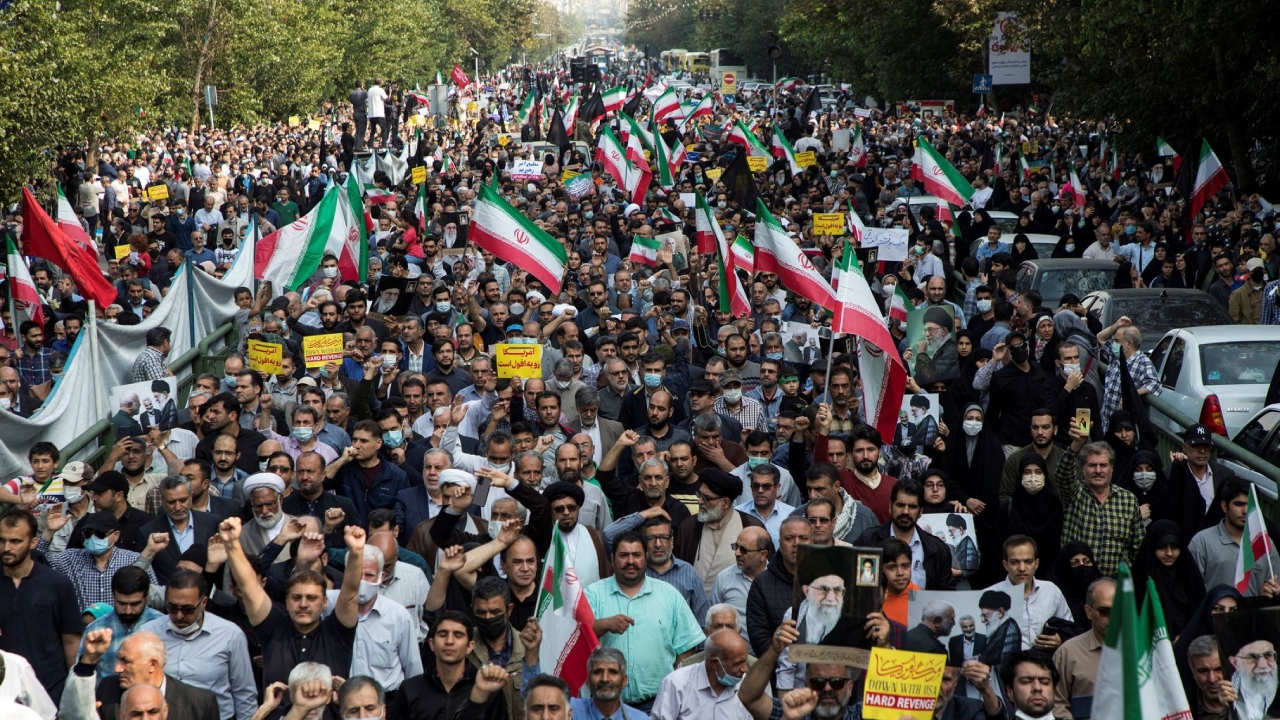
This has led the nation to the current upheaval, with vast protests across the country, and people being killed.
At many protests the Iranian resistance chant is Zan, Zendegi, Azadi (#WomenLifeFreedom) is heard. The protesters call for life and liberty to be applicable to everyone (religious and non-religious). A big part of the motivation behind these protests is to challenge how the current religious law takes away the right of women to choose what to wear.
What is secularism?
Secularism is the idea that states should be neutral about religion. The state should not back a specific religion over others. A secular state provides equal opportunity for religious and non-religious citizens to pursue their lives. The state must respect everyone’s values (including minorities), not just some people’s values.
Secularism seems reasonable to many because it is unusual for an entire nation to believe in a religion as one source of law. Some scholars of Islam disagree with the established interpretation of the Islamic Republic about whether God has commanded a mandatory hijab. As a result, they claim that hijab is not about covering hair but about “modesty”. Some others challenge the way the morality police treat women in the street.
While some people might be railing against women being forced to wear the hijab, others continue to feel strongly about its continued use. Reports say that Iranian authorities have closed some coffee shops because of the “improper” hijab of some female customers. And more recently, a woman was arrested for eating breakfast in a café with no hijab.
Iranian history of secularism
Modern debates about secularism in Iran can be traced back to the Constitutional Revolution in 1906. It advocated liberalism and secularism and began conversations about a society without religious rules for all.
Iranians experienced enforced secularisation shortly after Reza Shah Pahlavi was crowned in 1925. In 1936 he issued a decree Kashf-e hijab that any public expression of religious faith, including wearing hijab, was illegal. Again, this was a leader was telling women what to wear. However, his attempt to militantly secularise and westernise Iran faced resistance from society.
The overthrow of the Pahlavi dynasty in 1979 led to the establishment of a militant Islamic government based on Shia Muslim teachings. After the hijab became mandatory, it became a symbol of compulsory faith. It has also played a significant role in pushing some parts of the Iranian population towards a more secular state.
In 2022 Iran is experiencing some dramatic shifts, including what appears to be a shift towards secularism. Some argue that secularism is an enemy of religion or a product of western colonisation. Despite the majority of Iranians considering themselves religious, some evidence shows that Iranians are less religious than before.
Since the Islamic revolution there’s been a lot of research about how Iran could work as a secular society and about religious tolerance.
The current protest movement, led mainly by Gen Z in Iran, is growing partly because of its use of the internet and social media to communicate and share information. People can also learn from other nations’ experiences of secularism through social media. This is why the regime is shutting down the internet and censoring YouTube, Instagram and Twitter.
One poll suggests that more than 60% of Iranians now want a non-religious state, the question is whether those in power are willing to give it to them.
This article originally appeared on The Conversation.
Image: Sky News