The superannuation statement usually lands sometime between October and December, just as Christmas spending starts eating into the household budget. Buried inside the jargon is often a single phrase that gets skimmed past without a second glance: managed fund. For anyone weighing up what to do with a lump sum before the year’s spending ramps up, or simply trying to understand where their superannuation balance actually sits, that phrase is worth slowing down for.
By the end of this piece, a managed fund stops being a mystery term on a statement and becomes something concrete: what it is, how its value moves day to day, and the specific questions MoneySmart says to check before any money goes in.
What is a managed fund?
A managed fund pools money from many investors and invests it according to a stated strategy, run by a professional fund manager. The fund itself is legally operated by what is called a “responsible entity”, sometimes referred to as the fund operator, which is answerable for how the pooled money is handled.
Investors in a managed fund do not own the underlying shares, property or bonds directly. Instead they hold a stake, or units, in the fund – and the value of that stake rises or falls with the fund’s overall performance. The same structure goes by several names: unit trust, mutual fund, managed investment scheme, or Corporate Collective Investment Vehicle (CCIV).
The five main types
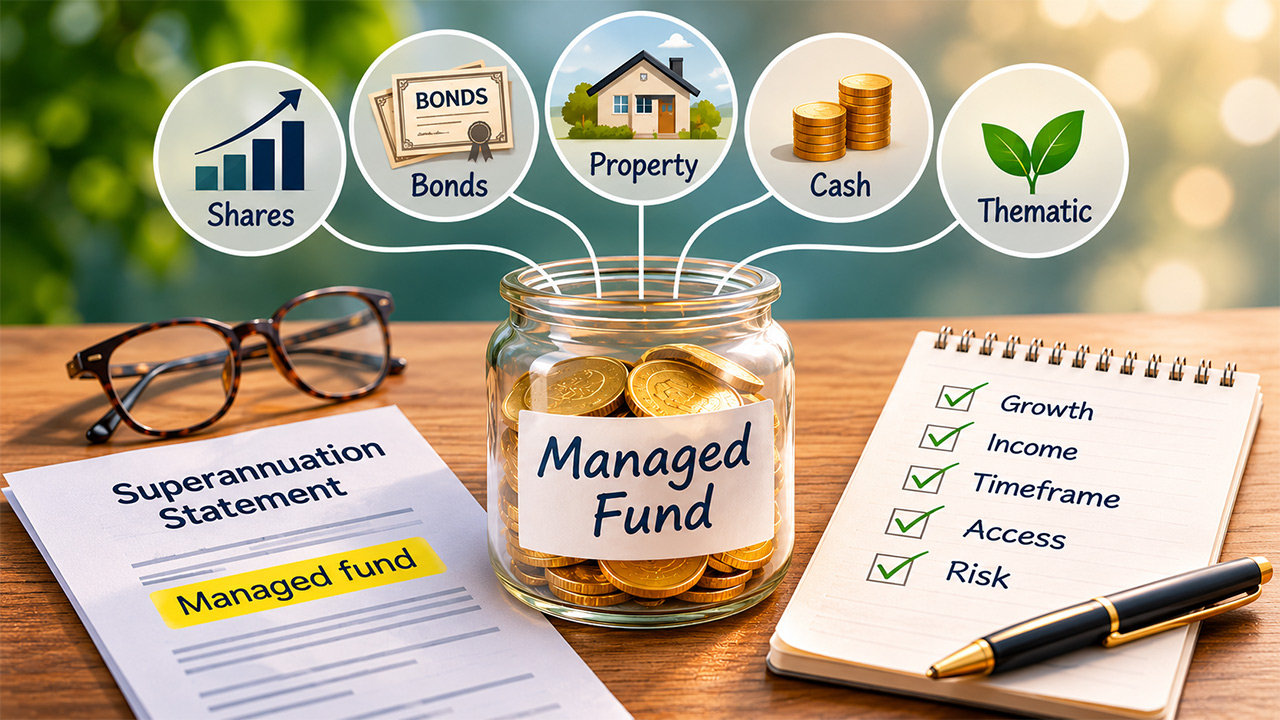
Managed funds fall into broad categories. Growth funds invest mainly in shares, aiming for higher long-term returns alongside higher volatility. Income funds hold bonds, credit or cash. Balanced or diversified funds mix growth and income assets, while cash and bank-bill funds prioritise safety and quick access to money. Sector or theme funds focus on a single area such as property, technology or ethical investing.
Some funds invest in a single asset class; multi-asset or diversified funds spread money across several asset classes inside the one fund, giving exposure to cash, fixed income, property and shares with a smaller outlay than buying each one separately. Active funds try to outperform the market and typically charge higher fees; passive funds aim to track an index, such as the S&P/ASX 200, and typically charge lower fees.
How the price actually moves
A managed fund’s unit price can move daily as the value of its underlying assets changes. That movement is more visible in growth-oriented funds than in cash or bank-bill funds, where swings are smaller by design. Some funds also pay periodic income to investors, called distributions, and some – including exchange-traded funds (ETFs) – are bought and sold on an exchange such as the ASX rather than through the fund manager directly.
Fund operators and superannuation trustees report unit-pricing and regulatory data to the Australian Prudential Regulation Authority (APRA), which reviews how unit prices are calculated across the industry. A joint review by APRA and the Australian Securities and Investments Commission (ASIC) examined pricing issues at more than 40 entities going back to 2000, surveying 95 entities with an 85% response rate. Its conclusion was measured: “for the thousands of unit prices calculated by industry each day, most will be correct, or if found to be in error will be quickly corrected,” APRA/ASIC found.
Already invested, without necessarily realising it
Anyone with an Australian superannuation account is highly likely already invested in managed funds, since super funds typically invest member contributions through pooled fund structures of exactly this kind. The same mechanics – a professional manager, a stated strategy, a unit price that moves with the market – sit behind most retirement savings in Australia, whether the account holder has ever used the term “managed fund” or not.
There is also a tax dimension worth knowing. To qualify as a managed investment trust (MIT) for tax purposes, a trust needs an Australian-resident trustee or central management in Australia, cannot run an active trading business, must be a managed investment scheme, and has to meet widely-held and closely-held ownership rules – a status defined by the Australian Taxation Office (ATO), with its guidance last updated 23 July 2025.
Questions worth checking before investing
MoneySmart frames the decision around four questions: “am I investing for growth, income or both?”, “how long do I plan to leave the money invested?”, “what if I need quick access to this money?” and “could I cope if the value falls for a while?” Those four questions sit alongside a longer checklist covering what the fund actually invests in, whether that mix suits the goal, the recommended investment timeframe, the minimum investment amount, how easily the money can be withdrawn, the fees charged, the risks involved, and how to make a complaint.
Almost all of that information sits inside the fund’s Product Disclosure Statement (PDS), a document every managed fund is required to produce. Fees, minimum investment amounts and risk levels are not standard across “managed funds” as a category – they are fund-specific, and the PDS plus MoneySmart.gov.au are the places to confirm the current figures for any particular fund before committing money.
What that checklist ultimately offers is clarity about a trade-off that is easy to miss on a statement full of percentages. Buying into a managed fund means handing the decisions about which assets to buy, sell and when over to someone else – and reading the PDS before the money moves is what turns that from a leap of faith into a choice made with the facts in hand.