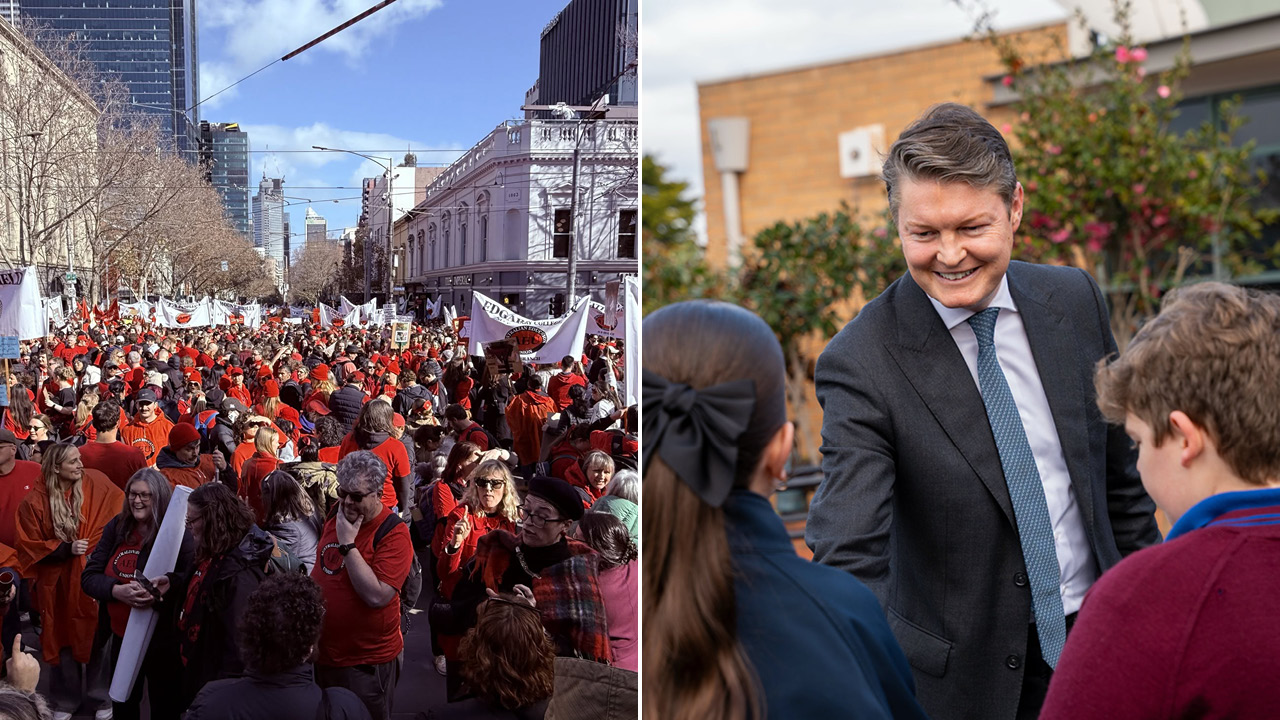
Australian Education Union members have voted to accept the Victorian government’s latest wages and conditions proposal, cancelling a third statewide school strike at the last moment.
On Monday, teachers, principals and support staff endorsed an offer delivering a minimum 28.3 per cent pay rise across four years. The vote also led members to abandon planned industrial action on Wednesday, which would have seen public school teachers walk off the job for 24 hours for the third time this year.
Victorian union boss Justin Mullaly said 79 per cent of members had backed the government’s offer.
“Congratulations, well done on your campaign,” he said in an address to members on social media.
Under the Fair Work Act, the agreement must now go to a vote of all employees.

When the agreement begins, educators will receive a $2000 bonus. Staff at the top of their salary range will also get an annual payment worth 1 to 2 per cent of their salary. The deal will also reduce after-school meeting time to a cap of 40 hours a year, down from 80.
The offer also secures existing maximum face-to-face teaching loads within the agreement itself rather than in a deed. Those limits are 18.5 hours for secondary teachers and 21 hours for primary teachers.
Graduate teachers will be paid $96,589 from November next year under the new agreement, up from $79,589 now.
The union had initially pushed for a 35 per cent pay rise over three years. Under that claim, graduate teachers would have started on more than $107,400 by 2028, while experienced teachers would have earned more than $159,300 by 2028.
Accepting the latest offer, the first put forward by Education Minister Gabrielle Williams, brings to an end tense negotiations between Labor and the influential teachers’ union that started in July last year.
The deputy premier, who nominated herself for the education portfolio, is due to address the media later on Monday.
Labor will continue to face pressure from the union to strike a deal with the Commonwealth to fully fund public schools under the Gonski model. Premier Ben Carroll has said publicly that reaching such an agreement is a priority, but he has not committed to doing so before the November 28 election.
The outcome of the public school pay talks is expected to have wider consequences across the education sector, including for about 40,000 Catholic school staff who are negotiating their own enterprise agreement. Catholic teachers have had pay parity with Victorian public school teachers since the 1990s.