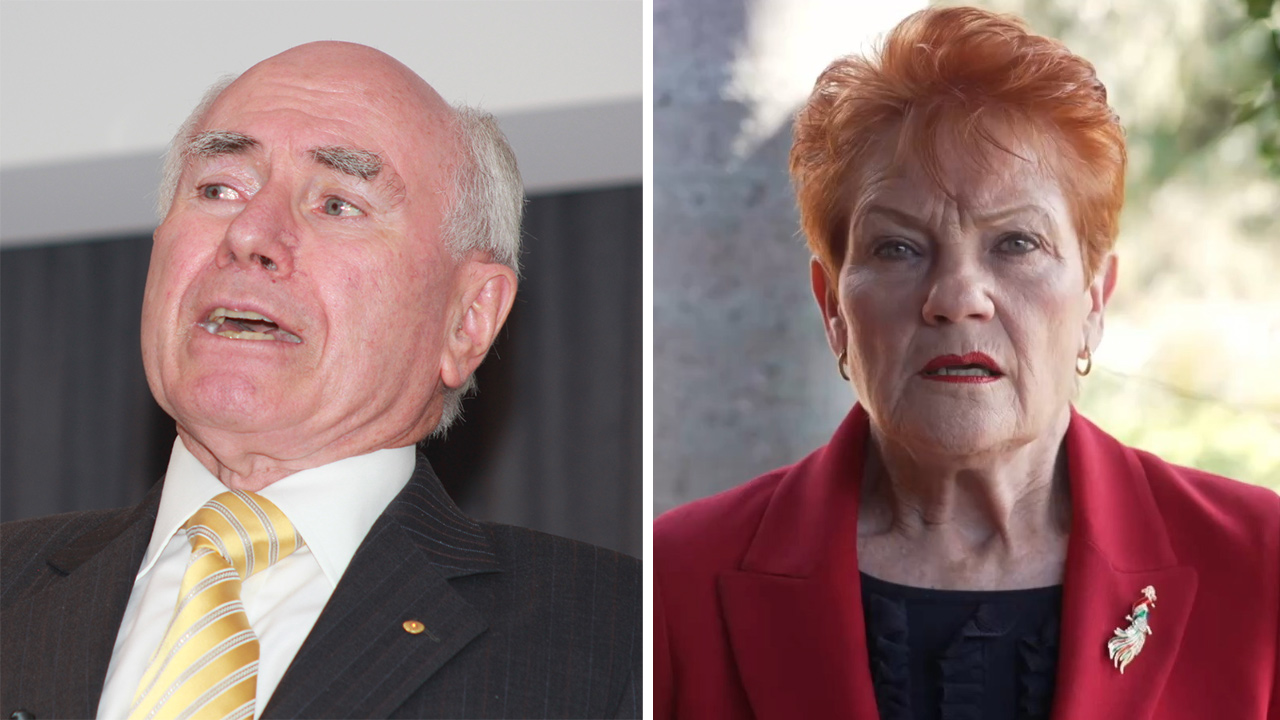
Former prime minister John Howard has delivered some pointed advice to the Liberal Party as it struggles to win back voters who have shifted their support to Pauline Hanson’s One Nation.
With One Nation continuing to make significant gains in the polls, the former Liberal leader has urged his party not to respond by pursuing a formal alliance with its conservative rival.
Instead, Howard believes the Liberals need to give Australians a compelling reason to return.
Speaking as the Coalition confronts some of its weakest polling in recent history, Howard said the answer was to develop strong alternative policies and present voters with leadership they could believe in. “I just say to people, if you want a good centre-right alternative to this miserable rotten mob you’ve got now, then support a Coalition that’s working hard on policy alternatives,” he told the Sydney Morning Herald.
The latest Newspoll has One Nation and Labor level on 29 per cent of the primary vote, while the Coalition sits well behind on 18 per cent.
Those numbers have intensified debate within conservative ranks about how Opposition Leader Angus Taylor should respond to One Nation’s rise, particularly given that many of the party’s supporters are voters who might once have backed the Liberals or Nationals.
Howard, however, has cautioned against trying to solve the problem by joining forces with One Nation.
He said the Liberal Party’s natural and established governing partnership remained with the Nationals and argued there should be no consideration of bringing One Nation into a formal coalition.
His message comes with some historical weight.
Howard was prime minister during One Nation’s first major surge in the late 1990s and ultimately oversaw a Coalition that successfully competed for many of the conservative voters attracted to Pauline Hanson’s party.
His advice now is that the Liberals need to compete again rather than accommodate.
That means offering clear policy differences with the Albanese Government while convincing disillusioned voters that the Coalition represents a credible alternative government.
Howard reportedly praised Taylor’s recent budget reply and his approach to immigration as signs that the Opposition Leader was beginning to establish clearer policy ground.
Taylor has so far resisted calls from some figures on the political right to consider closer ties with One Nation.
Howard acknowledged that the parliamentary arithmetic could eventually require parties to negotiate with one another if an election produced no majority government. But he drew a distinction between dealing with elected MPs in parliament and establishing a formal political coalition with One Nation.
The challenge for the Liberals is increasingly urgent.
One Nation’s growing support has changed the political landscape, with the party now competing not simply as a minor protest vote but as a serious rival for traditionally conservative voters.
Liberal Party federal director Lincoln Folo has reportedly told MPs that many One Nation supporters remain persuadable and could potentially be brought back to the Coalition as Taylor develops his policy platform ahead of the next election.
For Howard, that appears to be the opportunity the Liberals should concentrate on.
Rather than trying to become more like One Nation, his advice amounts to a much simpler proposition: rebuild the Liberal-National partnership, develop policies voters want to support and give those who have walked away a reason to come back.