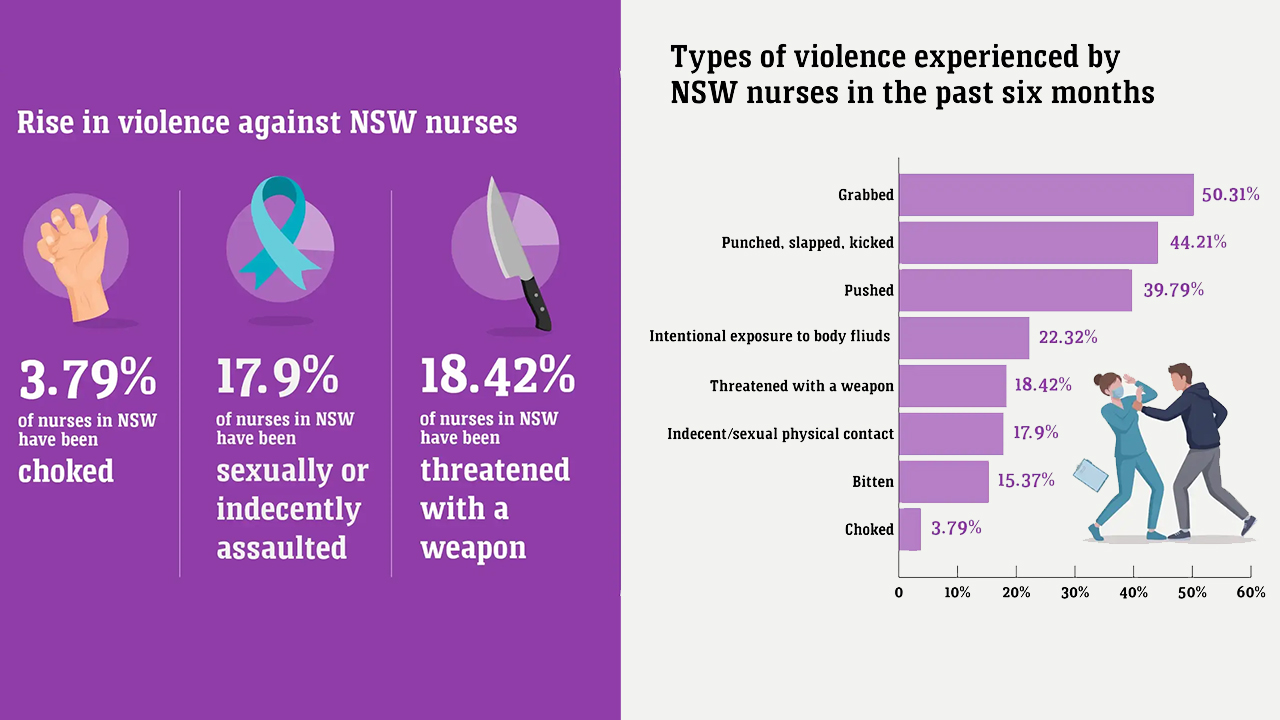
Going to work should not mean preparing to be punched, kicked, bitten, spat on or threatened with a weapon.
Yet for thousands of Australian nurses, midwives and carers, violence has become an alarming part of the working day – and those on the frontline are warning the situation cannot simply be accepted as part of the job.
A report from the NSW Nurses and Midwives’ Association (NSWNMA) has revealed that 88 per cent of nurses, midwives and carers surveyed had experienced or witnessed violence and aggression at work during a six-month period in 2025.
That figure has risen from 80 per cent in 2019, suggesting the problem is getting worse rather than better.
Almost half of nurses surveyed reported being punched, slapped or kicked, while almost one in five had been threatened with a weapon.
Perhaps just as concerning is how normalised such behaviour appears to have become.
According to the NSWNMA research, 68 per cent of nurses who experienced violence did not report it, with many believing doing so would result in little action or make no difference to preventing another incident.
For nurses including NSWNMA delegate Mr Howson, who works in the mental health unit at Cumberland Hospital, that violence has had very real consequences.
He told news.com.au he suffered a fractured rib after being punched by a drug-affected patient, yet returned to work just days later.
It was far from an isolated incident. Since beginning the job in 2018, he said he has been punched and bitten, and on one occasion was taken to hospital for spinal precautions after a patient threw him over a wall by his throat.
“We don’t invite violence and aggression by being healthcare workers,” he said. “We should be trying to minimise the opportunities and the reasons behind that aggression, not just hand-wave it away.”
Hornsby Hospital nurse and NSWNMA member Ellie Peach painted an equally disturbing picture of life on the frontline.
She said she is sworn at daily and has been spat on, while the violence she has witnessed has followed her home in the form of recurring nightmares about being choked while working in triage.
Her fear is that meaningful change may only come after the unthinkable happens.
“I think someone is going to die,” she told news.com.au. “We’ve already had the paramedic that sadly passed away, and I think someone else is going to die, and that’s what it will take for things to change.”
The NSWNMA says occupational violence should never be dismissed as an unavoidable consequence of working in healthcare.
Its report concludes that the human cost of violence against nurses, midwives and carers is unacceptable and that preventing it requires a systemic response. The consequences, it argues, extend beyond the workers themselves and can ultimately affect the delivery of safe, high-quality patient care.
NSWNMA Assistant General Secretary Michael Whaites said there was a “massive disconnect” in the way nurses and midwives were treated, with an expectation developing that abuse was simply something healthcare workers had to endure.
The problem also comes as Australia faces the challenge of retaining enough nurses to care for an ageing and growing population.
Australia is forecast to face a shortage of more than 70,000 nurses by 2035, while frontline workers warn that violence, burnout and difficult working conditions are already pushing experienced staff away from the profession.
Among the changes nurses are calling for are safer staffing levels, stronger security measures, better mental health support and a genuine zero-tolerance approach to violence against healthcare workers.
There have been attempts to tackle particularly dangerous situations. Special behavioural assessment areas known as PANDA units have been introduced at hospitals including St Vincent’s, Prince of Wales and Nepean, providing a safer environment for managing patients experiencing behavioural disturbances. A similar facility is planned for Westmead Hospital, with construction expected to be completed in early 2027.
NSW Health says it recognises the problem and has increased the state’s nursing workforce by more than 10 per cent between June 2023 and June 2026.
But for the nurses walking onto wards every day, the NSWNMA’s message is considerably simpler: caring for someone should never mean surrendering the right to be safe at work.
Images: NSWNMA